EV charger installation Sunshine Coast planning starts with your vehicle, daily kilometres, parking layout, electricity supply, solar system and switchboard capacity. A 7kW single-phase charger suits many homes, while 22kW charging needs three-phase power and compatible vehicles. Installation cost depends on cable distance, access, protection, load management and any switchboard or supply upgrade.
A dedicated EV charger beats a power point because it charges faster, runs on its own protected circuit, and is designed for long, high current sessions. Local electricians such as Sunshine Coast Projects & Electrical design the charger, cabling and safety gear to match Queensland rules, your EV and your switchboard. In this guide we will walk through what installation involves, explain 7 kW versus 22 kW, compare tethered and untethered options, unpack real cost factors in Queensland, and show how solar, batteries and local safety rules fit in. By the end you can decide what you need and know what to ask for when you book a quote.
Key Takeaways
-
Most Sunshine Coast homes are well served by a 7 kW Level 2 home charger. This size uses common single phase power and still adds around 30 to 40 kilometres of range per hour for many EVs. A 22 kW charger needs three phase and only helps if your property and your car can both use that higher rate.
-
Tethered chargers suit drivers who park in the same spot and want grab and go use. The fixed cable hangs on a hook or holster so there is no need to unpack a portable lead every night. Untethered chargers suit shared spaces or changing vehicles because any compatible cable can plug into the socket.
-
A typical ev charger installation sunshine coast bill has three parts that matter most. The first is the charger hardware, often from roughly $700 to $3,000 depending on brand and features. The second is standard installation, often around $600 to $1,200, and the third is any switchboard or three phase upgrade, which can range from about $800 to $2,500 or more.
-
Queensland law requires EV chargers to be wired by a licensed electrical contractor using standards such as AS NZS 3000. Safety items like RCD protection, correct cable size and weather rating make a big difference, especially in coastal and outdoor locations. Skipping these steps risks shocks, fires and invalid insurance.
-
A local, licensed team that also understands solar, batteries and three phase can design a neat system that suits your home today and later. That includes advice on charger size, cable type, solar matching and clear written quotes so you know what is included before anyone starts work.
What Does EV Charger Installation On The Sunshine Coast Actually Involve?
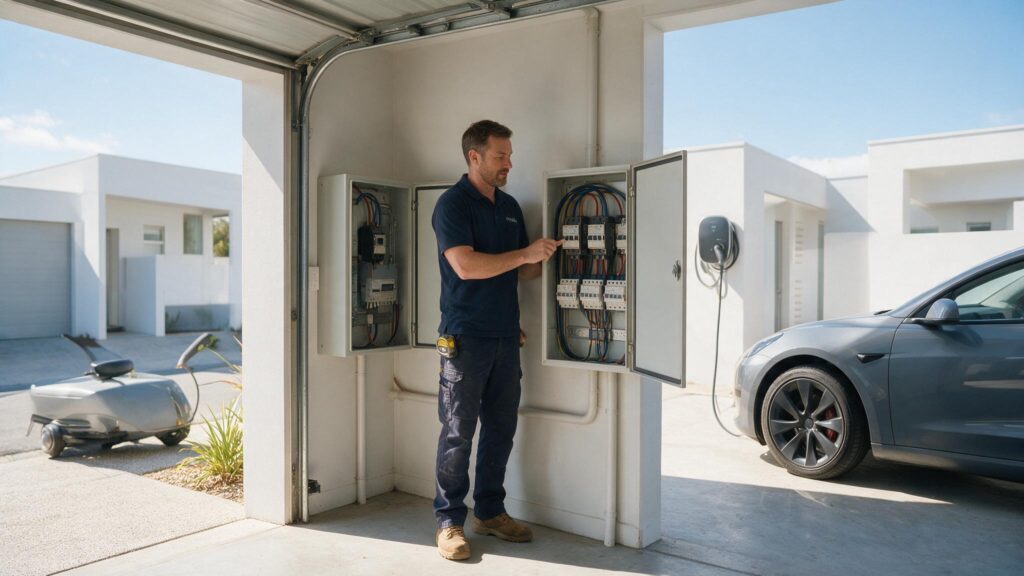
EV charger installation on the Sunshine Coast covers everything from the first phone call through to a working charger and paperwork. For a homeowner or small business, it means a licensed local electrician plans the charger position, checks your switchboard, runs new cabling and tests everything before you charge the car. This process protects both people and property and also keeps the network operator and your insurer happy.
The job usually starts with a short chat about your EV model, where you park and whether you have solar or plan to add it later, a planning step reflected in official charging infrastructure site-planning guidance used by engineers to streamline this exact early-stage assessment. From there the electrician visits or reviews clear photos of your switchboard and parking area to see how much spare capacity sits in the main supply and how far the cabling needs to run. They design a dedicated circuit for the charger, pick a suitable wall or post, then provide a written quote that lists the charger, labour, materials and any extra work such as a board upgrade.
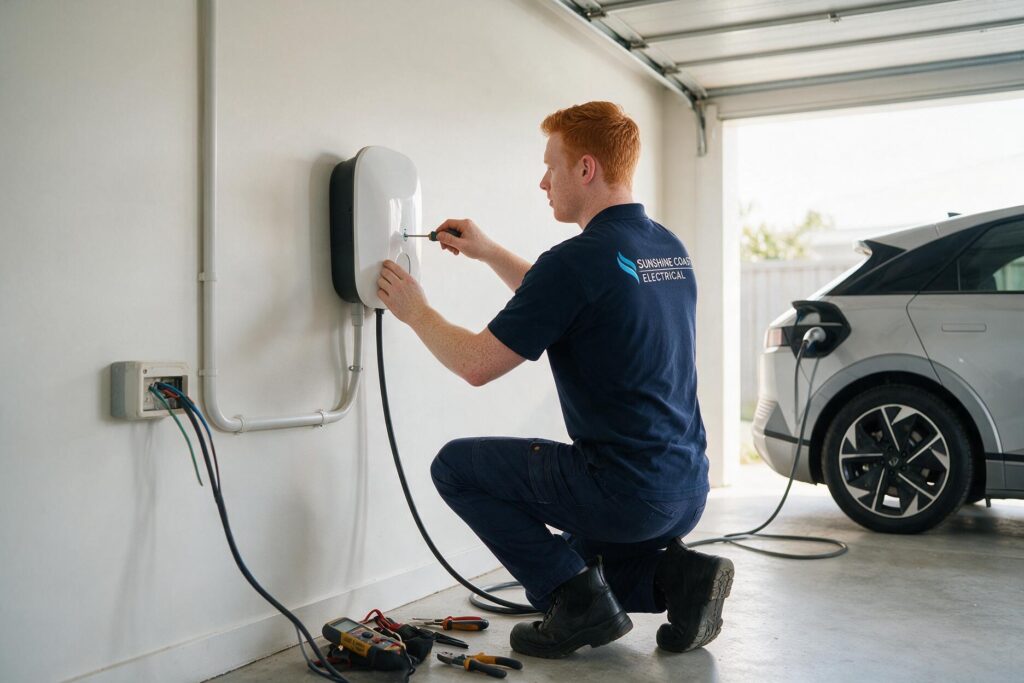
On installation day the electrician isolates power, installs new breakers and safety devices, then runs heavy duty cable from the switchboard to the charger location in conduit or suitable pathways. They mount the charger, connect it to the new circuit and carry out detailed checks such as insulation resistance, earth readings and RCD tests. Once testing passes, they plug in your EV or a test unit, confirm the correct charge rate and then walk you through basic use and any app features. Finally, they issue compliance paperwork so the installation record sits on file for Queensland authorities and for your own records.
Typical Home EV Charger Setup In Queensland
A typical home EV charger setup in Queensland means a Level 2 AC charger on its own circuit, not a portable lead in a power point. Level 1 charging uses a standard outlet at about 2 to 2.4 kW, while Level 2 chargers usually range from around 3 up to 22 kW. Level 2 is common for homes because it balances speed, safety and cost for overnight charging.
In many Sunshine Coast houses, the electrician installs a wall mounted charger rated around 7 kW on a single phase supply. This charger often connects back to the switchboard with suitably sized cable, supplied through an RCBO that combines overload and safety trip in one device. An isolator switch is often fitted near the charger so power can be turned off locally for maintenance or emergency work.
Common mounting spots are a garage wall near where the EV nose or tail sits, a post in a carport, or an outside wall close to the driveway. Outdoor chargers need an IP rating that suits heavy rain and high humidity, often IP54 or better, and fittings such as screws and brackets that handle salt in coastal air, an approach consistent with rooftop solar and EV charger design standards developed for hot, humid climates with strict electrical installation codes. A good installer also thinks about cable reach so the plug comfortably reaches the charge port without stretching across walkways.
Step-By-Step Installation Process With Sunshine Coast Projects & Electrical
The step by step installation process with Sunshine Coast Projects & Electrical follows a clear pattern so clients know what is happening. First, the team talks through your EV model, how far you drive most days, and whether you have solar or might add panels or a battery later. That early chat shapes the charger size, smart features and any extra wiring that may make sense for future upgrades.
Next, they check your switchboard and incoming supply, either on site or using good photos, to confirm whether the property has single phase or three phase and how much spare capacity is available. They suggest a charger location that suits parking habits, cable runs and safe clearances, then lay out any options such as tethered versus untethered or smart solar aware models. After that they prepare a written, itemised quote that separates hardware, standard installation and any extra work such as board upgrades.
On installation day they isolate power, complete the switchboard work, run and secure the new cable in conduit, then mount and wire the charger to match AS NZS 3000. They test the circuit, connect any Wi Fi or apps if it is a smart charger, and carry out a test charge with your vehicle. Finally, they explain how to use the charger, go through basic troubleshooting tips, and issue a Certificate of Electrical Safety for your records.
How Do 7 kW And 22 kW EV Chargers Compare For Sunshine Coast Homes?
Choosing between 7 kW and 22 kW EV chargers in Sunshine Coast homes comes down to power supply, EV limits and driving habits. In practice, a 7 kW charger suits most single phase houses, while 22 kW chargers need three phase supply and are mainly for heavy users or multi EV homes. Knowing what your EV can accept and how much range you need each day helps avoid over spending.
Charger power is measured in kilowatts and links directly to how many kilometres of range you add per hour. A single phase 7 kW charger on a typical Australian supply can often add about 30 to 40 kilometres each hour, which covers the daily driving of many families in only a few hours at night. Three phase chargers rated at 11 to 22 kW can add more range per hour, but only if your car has an onboard charger that supports that level and your electrical supply can feed it, and studies on grid efficiency and power quality in solar-connected charging setups highlight how proper system design keeps these higher-power installations stable.
Many popular EVs from brands such as Tesla, Hyundai and BYD have onboard AC chargers rated between about 7 and 11 kW. That means a 22 kW wall unit will not always run at full speed, even on three phase, because the limiting factor sits inside the car. In those cases, a 7 kW or 11 kW charger is usually the sweet spot, giving overnight full charges without pushing the home supply too hard. Higher power makes more sense when a property already has three phase for air conditioning or machinery and the household runs long daily trips.
Charging Speeds 7 kW Vs 22 kW In Everyday Driving
Charging speeds at 7 kW versus 22 kW look very different on paper, but real life use often narrows the gap. A 7 kW single phase charger commonly adds around 30 to 40 kilometres of range per hour for many current EVs. In contrast, an 11 to 22 kW three phase charger can add much more range in the same time where the vehicle and supply support it.
Think about an average Sunshine Coast driver who does 30 to 60 kilometres per day. With a 7 kW charger, they can put that energy back in roughly one to two hours in the evening, so plugging in overnight offers plenty of buffer. Even after a weekend trip of 200 kilometres, a 7 kW charger can replace that range during a single night, as long as the car is plugged in for several hours.
High kilometre drivers, trades, rideshare workers or families with back to back school and sport runs may like faster top ups. In those cases, if the property has three phase, a higher power charger lets them add a large amount of range in a shorter window between trips. However, many EVs cap AC charging at 7 or 11 kW, so buying a 22 kW unit often brings future proofing rather than instant speed gains. Checking the handbook of your car before choosing hardware is always a smart move.
When Is It Worth Upgrading To Three-Phase Power For 22 kW?
Upgrading to three phase power for a 22 kW charger on the Sunshine Coast only makes sense in certain situations. Three phase gives more capacity and faster potential charging, but it also needs extra work on the supply and switchboard. Most older houses with modest daily driving manage well on single phase with a 7 kW charger.
Three phase is worth a close look when a household has two or more EVs and wants them both ready early each morning. It can also help high kilometre commuters, regional workers or business fleets that return to base for short periods and need quick top ups. Properties that already rely on large loads such as ducted air conditioning, big pool pumps or workshop gear may gain better load sharing when EV charging joins the mix.
A three phase upgrade usually means network approval, a new meter, and switchboard changes, which is why it lifts total project cost. The electrician must calculate the total demand of the home, including future plans such as a second EV or induction cooktop, then size the main switch and cabling to match. For many Sunshine Coast homes the numbers show that single phase with smart load management is still the sensible option, and a good installer will explain the reasoning before you commit to any upgrade.
Should You Choose A Tethered Or Untethered EV Charger?
Choosing between a tethered and untethered EV charger is really about daily convenience versus flexibility for future or shared vehicles. A tethered charger has a fixed cable you lift straight into the car, while an untethered charger has only a socket and you plug in a separate lead each time. Both work well on the Sunshine Coast, but they suit different parking setups and habits.
In a private home where the same car parks in the same bay every night, a tethered unit often feels easiest. The cable hangs on a hook, stays ready to use, and never gets mixed up with other leads. In contrast, untethered chargers are common in apartment, workplace and visitor bays where many EV brands might come and go over time. There, a socket type unit allows each driver to bring their own cable that fits their car.
Weather and layout matter as well. If the charger sits in a windy carport or open driveway, a tethered cable needs tidy storage so it does not drag on the ground or sit in puddles. An untethered setup on the Coast means the loose lead should be stored out of sun when not in use to avoid early wear from UV light. Thinking about who will use the charger, and how neat you like the parking area to look, often points clearly to one option.
Pros And Cons Of Tethered Chargers On The Sunshine Coast
Tethered chargers on the Sunshine Coast have a fixed cable that always stays with the wall unit rather than in the boot. That simple fact is their main strength, because regular users never need to unpack a portable lead or hunt through the car each night. They just park, grab the plug from its holster and start charging with one quick motion.
Because the cable never travels in and out of the car, it usually stays cleaner and avoids being crimped by luggage or seat backs. A neat install adds hooks or reels so the lead loops off the ground, away from puddles and trip hazards, which is handy in wet summer storms. For many single EV homes or small offices with regular staff parking, this style becomes part of a simple routine that people stick with easily.
There are some trade offs. The cable length and plug type are fixed, so if you later buy a vehicle with a different inlet position or a rare connector, you might need a replacement charger or adaptor. In harsh coastal spots, the cable sheath and plug will spend years in sun and salt air, so picking gear with UV rated plastics and a covered location helps extend their life. Thinking through how long you plan to keep the current EV, and where the charger will sit, helps decide if tethered is the right call.
When An Untethered EV Charger Makes More Sense
An untethered EV charger has only a Type 2 socket on the front and relies on a separate removable cable. This setup makes more sense on the Sunshine Coast when different EVs may use the same bay over time, or when the owner likes a cleaner look on the wall. In these cases each driver keeps a cable in their boot and plugs in both ends when needed.
For multi vehicle households, an untethered unit lets you swap between cables of different lengths to suit various parking positions. In strata car parks or shared visitor bays, it avoids arguments over who paid for the fixed cable and how wear and tear should be managed. It also allows renters to take their cable when they move while leaving a standard charger socket ready for the next tenant.
There are some practical points to keep in mind:
-
Loose cables need safe storage off the ground to avoid water, grit and tyres, especially in open carports.
-
Owners should form a habit of packing the lead away after use so it does not become a trip hazard or collect UV damage in strong Sunshine Coast sun.
-
During site assessment, a good installer will ask how many cars use the space, whether it is shared, and how important a tidy wall is, then talk through whether an untethered setup fits best.
What Does EV Charger Installation Really Cost In Queensland?
EV charger installation really costs whatever the mix of charger, labour and electrical upgrades adds up to for your site. Across Queensland and the Sunshine Coast, that means some homes pay near the lower end of the range for a simple 7 kW install, while others sit higher once longer cable runs or switchboard work enter the picture. Understanding each cost piece makes quotes easier to compare.
Industry information for South East Queensland suggests many home charger units fall somewhere in the band from about $700 to more than $3,000 depending on brand, power and smart features. Standard single phase installation in a straightforward house is often around $600 to $1,200, covering reasonable cable length, protection devices and tidy mounting. When an older fuse box needs updating to modern safety standards or a three phase upgrade is involved, extra work often adds at least $800 and can reach $2,500 or more for large changes.
Because labour, copper prices and network requirements shift over time, any numbers you see online are only guides. Two homes in Maroochydore and Noosa might both ask for a 7 kW charger yet land in different cost bands because one has a modern board near the garage and the other needs long runs under a driveway. This is why a site check or detailed photo review is important before any electrician offers a firm price for ev charger installation sunshine coast.
Tip: Treat online price guides as a starting point only and rely on a written, site specific quote from a licensed Queensland contractor before you set a firm budget.
Cost Components Charger, Installation, And Electrical Upgrades
The cost components of a typical Queensland EV charger project start with the charger hardware itself. Simple non smart units at lower power levels sit towards the lower end of the $700 to $3,000 range, while feature rich brands such as Tesla Wall Connector, Zappi or Wallbox with Wi Fi and solar modes head higher. Three phase chargers that support 11 to 22 kW also push up the hardware price compared with basic 7 kW models.
Next comes standard installation, which for many Sunshine Coast houses means a single phase circuit from the main switchboard to a nearby garage or carport. Many jobs fall around $600 to $1,200 where the cable run is modest, walls are easy to access and the board already has space. That cost covers labour, heavy duty cabling, conduit, a new RCBO, labels and final testing.
The third piece is any upgrade or non standard work. Old ceramic fuses or crowded boards might need replacement with a modern enclosure and safety switches, which can add roughly $800 to $2,500 or more depending on size and complexity. Longer runs through roof cavities, drilling through concrete, trenching across a driveway or adding a free standing bollard or pedestal also lift labour time and materials. Reputable installers make these items clear in writing so clients see the base price versus extras before making a decision.
Example Cost Scenarios For Sunshine Coast Homes And Small Businesses
Example cost scenarios help show why one ev charger installation sunshine coast can be quite different from another. These are guides, not quotes, and real jobs still need proper site checks and written pricing from a licensed contractor.
-
A modern freestanding home with single phase supply and a garage right beside a new style switchboard might only need hardware and standard installation for a 7 kW charger. That kind of site usually falls near the lower cost band.
-
An older coastal weatherboard on single phase with an ageing fuse box and a detached carport might call for a smart 7 kW unit plus a switchboard upgrade and a longer cable run. Total spend there often lands in a middle band.
-
A small workshop or office with three phase supply and staff parking across a yard may choose one or two 11 to 22 kW chargers, extra cabling and a basic load plan to avoid clashing with machinery. That mix tends to sit in a higher band once labour, gear and planning are counted.
In every case the right way to budget is to treat online numbers as ballpark only and rely on a site specific written quote. Homeowners and business owners should also confirm any tariff changes or metering work with their retailer and the local distributor, as requirements can change.
What Electrical Checks And Safety Rules Apply In Queensland?
Electrical checks and safety rules for EV chargers in Queensland are firm and non negotiable for legal installs. Every charger must be wired and tested by a licensed electrical contractor, and the work must follow Australian standards such as AS NZS 3000, often called the Wiring Rules. These requirements exist because EV charging uses high current for long periods, so faults can have serious consequences.
Before installation, the electrician checks the main supply capacity, switchboard layout, earthing system and cable paths. They calculate the extra load the EV charger will add and look for any signs that the board is outdated or overloaded. During the job, they select cable sizes that handle continuous current, fit the right type of RCD or RCBO, and pick gear with a weather rating that suits the charger location.
After the wiring is complete, detailed testing confirms the circuit is safe and behaves as designed. This includes insulation resistance, earth continuity, polarity and trip tests on safety devices at the required currents. Only once those checks pass should an electrician plug in the EV for a live test session. At the end, the contractor issues compliance paperwork so there is a clear record that the work meets Queensland and Australian rules.
Queensland Rules, Standards, And Approvals You Need To Know
Queensland rules say that EV chargers must only be installed and connected by licensed electrical contractors, not by owners or handymen. The main technical reference is AS NZS 3000, which sets out how cables, protective devices, earthing and clearances must be designed. Other standards can apply when chargers link with solar inverters or complex energy systems.
Local network providers such as Energex and Ergon Energy may also have guidelines for new high loads, three phase upgrades or grouped chargers in car parks. These can include approval steps or limits on maximum demand to protect shared transformers and lines. Tariff options, such as time of use plans, come from electricity retailers and can change over time, so it pays to check current offers on official Queensland Government and provider websites:
-
Queensland Government: www.qld.gov.au (search “electric vehicles” and “energy tariffs”).
-
Energex: www.energex.com.au (for South East Queensland connection rules).
-
Ergon Energy: www.ergon.com.au (for regional Queensland network information).
-
Clean Energy Council: www.cleanenergycouncil.org.au (for accredited solar and storage guidance).
Sunshine Coast Projects & Electrical holds Queensland electrical contractor licence 79977 and designs charger installs to match these standards and network expectations. When needed, they handle electrical notifications and network forms as part of the project, so clients are not left guessing about paperwork. Homeowners and strata managers should still keep copies of all certificates so they can show compliance to insurers or future buyers.
Safety Considerations For Coastal Sunshine Coast Installations
Safety considerations for coastal Sunshine Coast installations go beyond basic wiring rules because of salt, humidity and storm activity. Chargers mounted outdoors need an IP rating suitable for wind driven rain and fine salt spray, often IP54 or higher, along with seals that keep moisture away from live parts. Fixings such as screws and brackets should be stainless or otherwise corrosion resistant so they do not rust and loosen over time.
Placing chargers under a roof, carport or eave helps shield them from direct sun and heavy showers, which extends their life. In areas close to the beach, installers may suggest extra care with conduit joints and entry points to keep out salt laden air. Surge protection at the switchboard, along with sound earthing, offers added defence against nearby lightning, which is a real risk in Queensland storm seasons.
Owners should avoid long term charging from old power points, power boards or extension leads, as these were never designed for continuous high current draw. Regular visual checks for cracks, discolouration, loose covers or damaged cables help catch minor issues early. Periodic electrical testing, especially for high use or exposed chargers, gives confidence that insulation and safety devices still operate as intended.
How Does Solar And Battery Integration Change Your EV Charging?
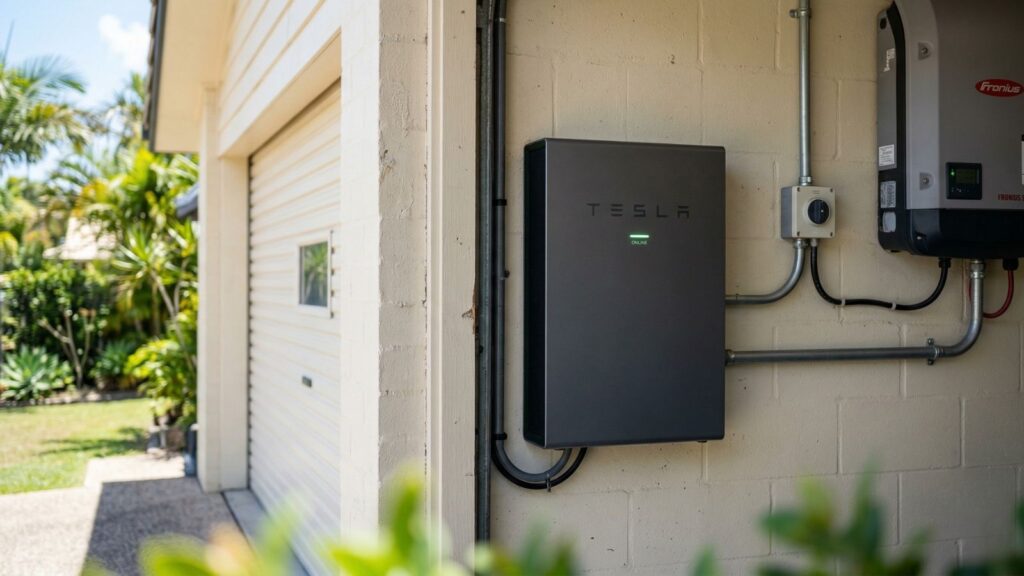
Recent research on consumer willingness to adopt smart charging shows growing driver interest in systems that automatically balance charging times with electricity grid demand, and solar and battery integration changes EV charging on the Sunshine Coast by turning your panels into part of your fuel supply. Instead of simply charging from the grid whenever the car is plugged in, a smart charger can follow solar output, battery status and tariff windows to pick cheaper, cleaner times. This setup suits a region with high rooftop solar use and many daytime parked cars.
In a simple grid only system, plugging in starts charging at the set power level and keeps drawing from the grid until the target state of charge is reached. When solar joins the picture, chargers from brands such as Zappi, SolarEdge or Evnex can watch the export flow at the meter and ramp charging up or down to soak up surplus. This helps households use more of their own generation and send less back to the grid at low feed in rates.
Adding a home battery gives another layer again. In some homes, the battery is set to cover evening house loads, while the EV takes surplus during the day. In others, owners prefer to fill the car first so they can drive on solar power, then let the battery mop up extra. Smart control through apps or energy management systems can juggle these choices without constant manual changes.
Using Solar To “Fuel” Your EV On The Sunshine Coast
A recent data-driven analysis of EV charging behaviour and residential solar integration found that real-world charging patterns often align closely with daytime solar generation, which is exactly the timing strategy behind using solar to fuel your EV on the Sunshine Coast. On many sunny days, households export a fair amount of energy to the grid during late morning and early afternoon. Solar aware chargers can watch that export and increase charging when there is spare, then slow down when the dishwasher or air conditioner kicks in.
Most smart chargers offer modes that follow simple patterns:
-
A fast mode charges at the maximum allowed rate even if that means drawing from both solar and the grid, which is handy when you need the car ready quickly.
-
An eco or solar match mode tracks export and adjusts power so the EV mainly uses surplus solar.
-
A solar only mode holds back until enough export is present to run the charger almost entirely from the roof.
This approach can reduce running costs because each kilowatt hour used on site avoids both grid energy charges and, in effect, the loss from low feed in tariffs. It also improves the payback of the solar system by lifting self consumption and reduces the carbon footprint of your driving. For example, someone working from home in Buderim could roll the car onto the driveway at 11 am, start an eco mode charge, and return to a near full battery before school pickup while hardly touching grid power.
Planning Around Batteries, Tariffs, And Load Management
Planning EV charging around batteries, tariffs and load management turns a simple charger into part of a whole house energy plan. When a home battery is present, owners may choose to prioritise keeping a certain reserve for night time lights and fridges or allow deeper discharge so the EV can sip some stored solar after sunset. These choices depend on lifestyle, risk tolerance and the size of both battery and car pack.
Time of use tariffs add another layer. Many Queensland retailers offer cheaper off peak rates during late night hours, with higher prices in the late afternoon and early evening. By using the car’s inbuilt timer or the charger app, owners can schedule charging to start after the off peak window opens so that most of the energy comes at a lower cost. This blends nicely with daytime solar charging when the car is at home.
Dynamic load management helps keep all of this safe on the electrical side. Current transformers or smart meters watch the total current draw of the house and ask the charger to reduce power when other big loads like ovens or air conditioners run. This helps avoid nuisance trips at the main switch and makes better use of limited supply capacity. A Clean Energy Council accredited contractor can design EV chargers, solar and batteries to share data and run smoothly together.
How Do You Choose The Right EV Charger And Cable Setup?
Choosing the right EV charger and cable setup for a Sunshine Coast property means matching hardware to how the site is used. Owners need to weigh charger power, tethered versus untethered style, smart features, parking layout and future plans such as extra EVs or solar. A bit of thinking up front makes later use simple and avoids paying for features that never get used.
Start by looking at the EV or EVs that will plug in, including their onboard AC charger rating and connector type, a planning approach echoed in a systematic review of EV-ready building design, which stresses matching electrical infrastructure to real vehicle charging needs from the outset. A car that only accepts 7 kW on AC gains nothing from a 22 kW wall box in day to day use, unless you want to allow for a future vehicle. Consider daily driving patterns as well, since short commutes rarely need high power, while long distance workers or fleets may depend on fast turnaround.
Then consider the property itself:
-
Check if the home has single phase or three phase supply.
-
Look at spare capacity in the switchboard and whether there is room for new protection devices.
-
Think about the distance between the switchboard and the preferred parking spot, as this affects cabling effort and cost.
-
Decide whether the charger will be indoors, under cover or fully exposed to weather.
A single phase home with a compact switchboard and limited spare capacity may be better served by 7 kW and good load management than a full three phase overhaul for charging alone. Garage layout, distance to the switchboard, and whether the charger will be indoors, under cover or fully exposed all influence the best choice between tethered and untethered designs.
Key Questions To Answer Before You Buy An EV Charger
Key questions before buying a charger help narrow down the right setup and make quotes more accurate. Useful points to think through include:
-
How many kilometres you usually drive per day and per week, since this sets how fast the charger really needs to be.
-
Whether your property has single phase or three phase supply, which can often be seen on the electricity bill or confirmed by an electrician.
-
Whether you already have solar or plan to fit a system or battery in the next few years.
-
How many EVs might share the charger over time, and whether any will be work vehicles that need charging at odd hours.
-
Where the car will normally park and how far that is from the switchboard.
-
Whether you prefer a simple plug and charge unit with few settings or an app controlled model with graphs and schedules.
-
How you feel about a visible coiled cable on the wall versus a cleaner faceplate and a loose cable kept in the boot.
Answering these questions before you call a contractor helps them suggest the right charger types and gives you more accurate pricing from the outset.
Comparing Charger Features, Brands, And Installation Options
Comparing charger features, brands and installation options does not have to be complex if you focus on a few key points.
Look first at:
-
Power rating and phase support, so the charger can supply what your car can use and matches your single phase or three phase supply.
-
Tethered versus untethered versions, based on how fixed or flexible your parking and vehicle mix will be.
-
Smart features such as Wi Fi or Bluetooth, phone apps, charging schedules, solar aware modes and simple load management links.
Many modern chargers from makers such as Tesla, Zappi, Wallbox, ChargeAmps and generic Type 2 units offer some mix of these features. Warranty length and local support networks matter too, because EV gear is long term infrastructure and faults may need parts some years down the track.
Practical installation details can be just as important as brand names. Cable length, mounting height and the side of the car with the inlet all affect how easy it is to plug in every day. Outdoor units should have an IP and UV rating that suits Sunshine Coast weather, and wall structures need to be strong enough to hold the weight of the charger and cable. Preparing a short wish list based on these points before speaking with an electrician helps speed up the design and quoting process.
How Can Sunshine Coast Projects & Electrical Help With Your EV Charger?
Sunshine Coast Projects & Electrical helps with EV chargers by combining general electrical skills with solar and EV experience across local homes and businesses. The team handles everything from first questions about 7 kW versus 22 kW through to final testing and paperwork. Having one contractor manage switchboard upgrades, charger selection and solar links keeps the project tidy and avoids finger pointing between trades.
As a local business, it understands the range of building types on the Coast, from older fibro shacks to new high density townhouses and industrial sheds. That helps when choosing cable routes, deciding where to mount chargers and planning load sharing between existing appliances and new EV loads. The team also knows the common brands in the market and can explain in plain language what features matter and what you can skip.
Importantly, they work with both residential and commercial clients, so they can design single driveway home chargers and multi bay workplace systems. For landlords and strata committees, they can outline shared infrastructure approaches and individual billing options without pushing a single brand of hardware. The goal is always to supply a safe, reliable charger that fits the site and budget, backed by clear communication.
If you are unsure where to start, a short phone call to 0400 677 514 with your EV model and a couple of photos of your switchboard and parking spot is often enough to get clear next steps.
Local Expertise, Licensing, And End-To-End Service
Local expertise, proper licensing and end to end service matter for any high current electrical work. Managing Director Charlie Doblo has more than 20 years in the electrical trade and leads a team that handles everything from everyday repairs to EV charging and solar integration. That long exposure to Sunshine Coast building styles, weather and network quirks feeds into better on site decisions.
The business operates as a Queensland licensed electrical contractor under licence number 79977 and is an Accredited Master Electrician member as well as Clean Energy Council accredited. Those accreditations reflect ongoing training on current standards and good practice, not just a one off ticket. They also support work across residential streets, commercial precincts and light industrial estates all along the Coast.
Because EV charging often links with other projects, their service spans switchboard assessments, safety upgrades, single phase and three phase changes, solar array design, battery storage and charger installation. They handle design, hardware supply, wiring, testing and certification so clients are not left coordinating multiple contractors. That single point of contact makes faults easier to diagnose later, because one team knows how all the pieces are wired together.
Getting A Quote For EV Charger Installation On The Sunshine Coast
Getting a quote for ev charger installation sunshine coast starts with a quick call or message with some basic details. When you reach out, having your EV make and model handy helps, along with a note on whether you already have solar or a battery. It also helps to know where the car usually parks and where the switchboard is located in the home or building.
Clear photos can speed things up:
-
Pictures of the switchboard with the door open.
-
Photos of the parking area from a few angles.
-
Any obvious cable paths between the two.
From there, the electrician can often provide a rough range or decide that a site visit is needed to check cable routes, board space and meter position.
After that assessment, the next step is a written quote that explains the chosen charger type, the size of the circuit, and any optional extras such as smart solar integration or load management. The quote should separate hardware from labour and list any potential extra charges such as long runs or civil work. Once accepted, the job is booked for a time that suits, and after installation you receive compliance paperwork and a walkthrough of how the charger works.
In Summary
Most Sunshine Coast homes get strong value from a 7 kW Level 2 charger on single phase power, especially for regular overnight charging. Faster 22 kW three phase units come into their own when properties already have three phase supply, host multiple EVs or need quick turnarounds between long trips. Checking your car’s onboard AC limit and your typical daily kilometres is the best way to decide.
Tethered chargers fit set and forget use where one or two regular cars park in the same place and drivers want the simplest grab and plug routine. Untethered units with sockets and separate leads work better in shared, rental or mixed brand parking where flexibility and a clean wall face matter more. Both can be installed safely outdoors with suitable IP ratings and careful cable management.
Final cost for ev charger installation sunshine coast depends mainly on the charger chosen, cable distance, switchboard condition and whether any three phase or upgrade work is needed. Queensland law requires chargers to be installed by licensed electricians using standards such as AS NZS 3000 and network rules, so DIY is not an option. With the right advice from a local expert such as Sunshine Coast Projects & Electrical, EV charging can slot neatly into your broader home or business energy plan. Ready to discuss the right electrical solution? Call Sunshine Coast Projects & Electrical on 0400 677 514 to request an obligation-free quote. Learn more at https://sunshine-coast-electrician.com.au/services/ or contact the team at https://sunshine-coast-electrician.com.au/contact/. For authoritative information, see https://www.energex.com.au/. Australian Government EV information is available at https://www.energy.gov.au/households/transport/electric-vehicles.
Frequently Asked Questions.
A 7 kW home EV charger is enough for most Sunshine Coast drivers. It usually adds around 30 to 40 kilometres of range per hour, which easily replaces typical daily driving during an overnight session. It may feel limiting only in homes with several EVs or very long daily trips. In those cases, an electrician can design higher power or multi charger setups to match real usage.
You can use a standard power point for occasional slow charging, but it is not ideal for regular use. This Level 1 method is very slow and can stress older outlets because they were not designed for long high current sessions. Queensland rules say any fixed EV charger must be installed by a licensed electrician. A dedicated Level 2 charger is safer, faster and better suited to daily charging.
Freestanding homes usually only need compliant electrical work and do not require separate council approval for a standard wall charger. Units and townhouses in strata complexes often need body corporate consent, especially when common areas or shared wiring are involved. It is wise to check building by laws and any local planning rules before work starts. An electrician can supply technical details to support approval requests.
Most straightforward residential EV charger installations on the Sunshine Coast take around half a day on site. Jobs can run longer when cable paths are complex, the switchboard needs significant upgrades, or multiple chargers are fitted at once. Commercial and fleet projects with several bays or networked systems may take one or more days. Installers usually confirm expected timing as part of the quoting and booking process.
Standard EV chargers stop working during a power outage because they rely on active grid supply. Some homes with batteries can keep limited circuits running, and in certain designs that may include the charger. Whether that happens depends on how the backup system is wired and sized. Vehicle to home setups, where the car feeds the house, are still not common in Australia at this stage and owners should seek current advice before planning around them.
Queensland rebates have mainly focused on helping people buy EVs rather than on home charger hardware. Programs and offers change over time, so it is best to check current information on the official Queensland Government website before planning based on any incentive. Electrical contractors can point clients towards known schemes, but they do not usually process rebate applications on behalf of owners.
EV chargers benefit from simple regular checks and occasional professional testing. Owners should look every so often for cracks, loose covers, damaged cables or corrosion, especially in coastal areas. For high use or outdoor chargers, an electrician can carry out periodic testing of RCDs, connections and insulation as part of broader safety inspections. This keeps the system reliable and reduces the risk of hidden faults building up.