Single-phase power is standard in most Australian homes and can support basic EV charging, typically delivering up to about 7kW—enough for steady overnight charging. Three-phase power, however, provides significantly more capacity and can charge an EV much faster, often up to 22kW depending on the charger. Choosing between them depends on your home’s electrical setup, charging speed requirements, and whether you want to future-proof your property for growing energy demands.
Which Power Setup Charges Your EV Faster at Home?
As electric vehicles (EVs) become a more common sight on Sunshine Coast roads, homeowners are facing a new and important question: how can I charge my car efficiently and safely at home? The answer often comes down to a fundamental aspect of your property’s electrical system, sparking the debate of single phase vs 3 phase power. This choice isn’t just a technical detail; it directly impacts how quickly your EV charges, how well your home handles its total energy demand, and your readiness for a more electric future.
For many, the world of active wires, voltage, and amperage can seem daunting. You might wonder if your current setup is sufficient or if you need an upgrade to support a powerful new home EV charger. Making the wrong decision could lead to slow charging, overloaded circuits, or the need for expensive rework down the line. It’s a significant consideration that requires clear information and expert guidance.
This guide will clarify the difference between single phase and three phase electricity, helping you understand what they are, how they work, and which is the best fit for your home and your EV. We will discuss charging speeds, upgrade requirements, and the long-term benefits of each option. As the Sunshine Coast’s trusted specialists in electrical services and EV charger installation, Sunshine Coast Projects & Electrical is here to provide the expertise you need to make a confident and informed choice, making sure your home is perfectly prepared for the electric vehicle revolution.
Key Takeaways
-
Single-phase power is the standard for most homes and is suitable for basic needs, while three-phase power provides higher capacity, enabling significantly faster EV charging.
-
Many older homes on the Sunshine Coast may require switchboard upgrades to safely accommodate the electrical load of any modern EV charger.
-
For safety, compliance, and warranty purposes, professional EV charger installation by a licensed electrician is absolutely essential.
-
Sunshine Coast Projects & Electrical specializes in 3-phase power upgrades and can design a custom-made EV charging approach for your specific vehicle and household needs.
Understanding Your Power: Single Phase Electricity Explained
Single-phase power is the standard electrical supply for the vast majority of residential properties across the Sunshine Coast and Australia. It’s the system most of us have grown up with, reliably powering our homes day in and day out. Think of it as the main road for electricity into your house, perfectly designed for typical household traffic.
Its core components are straightforward. Power is delivered from the street to your switchboard via two main wires: one active wire that carries the electrical current into your home, and one neutral wire that completes the circuit by providing a return path. This system supplies an Alternating Current (AC) at a standard voltage of 230V in Australia, with the current changing direction 50 times per second, known as a 50Hz frequency. This is the bedrock of residential power, efficiently running everything from your lights and refrigerator to your television and small kitchen appliances — and understanding the distinctions in a Single Phase vs Three phase system is essential before making any upgrade decisions.
When considering a basic home electric vehicle charger, a single-phase supply is often sufficient, especially for overnight charging. The amperage, or the amount of current an appliance draws, is a key factor here. Your home circuits are designed for standard loads, typically using 10A or 15A plugs. A single-phase EV charger operates within these parameters, but it’s at the higher end of what a single circuit can handle. While a single phase power upgrade isn’t always necessary for a basic charger, it’s important to understand the system’s limitations. If you have multiple high-draw appliances running simultaneously—like a ducted air conditioner and an oven—adding an EV charger can strain the system and potentially lead to circuit overloads. This directly affects the single phase EV charging speed, which is generally capped at around 7kW, providing a steady but slower charge.
Utilizing the Strength: Three Phase Power for High-Demand Homes
If single-phase power is a main road, think of three-phase power as a three-lane highway. It’s a more sturdy, reliable and powerful electrical supply designed for properties with higher energy demands. While traditionally found in commercial and industrial settings, residential three-phase power is becoming increasingly popular on the Sunshine Coast, especially for modern homes with advanced technology and energy needs.
A three-phase system is defined by its use of four wires: three separate active wires and a single shared neutral wire. The magic of three-phase power lies in how these three active wires deliver their current. Their AC waves are staggered, meaning they peak at different times. This creates a much more consistent and continuous flow of power, eliminating the slight dips that occur in a single-phase supply. This results in a higher voltage, typically 400V between any two active wires, which allows for significantly more power delivery.
The advantages are clear. First, you get a massive increase in capacity—essentially triple the potential of a single-phase connection. This is invaluable for homes running large ducted air conditioning, electric pool pumps, or extensive heating systems. Second, the power delivery is more stable and efficient, which is particularly beneficial for equipment with electric motors. This smoother power can extend the life of your appliances and help them run more effectively. For homeowners looking to future-proof their property against growing energy demands, installing a three phase EV charger home setup is a smart move. The difference in wiring is more involved than a standard setup, but the performance gains for high-load applications are undeniable.
Single Phase vs. Three Phase for EV Charging on the Sunshine Coast
When it comes to charging your electric vehicle at home, the choice between a single-phase and a three-phase connection directly translates to convenience and speed. Both can get the job done, but they offer very different experiences, particularly for busy Sunshine Coast households.
Most home installations involve a Level 2 (AC) charger, which is significantly faster than plugging into a standard wall socket. The power draw of these chargers is what makes the difference between single phase and three phase so important.
A single-phase EV charging setup is a practical approach for many drivers. It’s perfectly suited for overnight charging and is often adequate if you have a moderate daily commute. A typical single-phase charger can deliver up to 7.4kW of power. This means it can add around 40-50 kilometres of range per hour of charging. For someone who drives less than 100km a day and can plug in for 8-10 hours overnight, this is generally sufficient.
“The convenience of home charging is a game-changer for EV owners. Choosing the right power setup means the difference between simply topping up and truly integrating your EV into your daily life without compromise.” – Energy Matters Blog
However, a three-phase EV charging system is where you get true high-speed home charging. By drawing power from all three active wires, a three-phase charger can deliver up to 22kW of power. This can add over 120 kilometres of range per hour—a massive difference. This speed becomes important for households with multiple EVs that need to be charged, for drivers with long daily commutes, or simply for those who want the flexibility to get a significant top-up in just a couple of hours. A 3 phase home charging station is the premium choice for performance and future-readiness.
At Sunshine Coast Projects & Electrical, we provide expert EV charger installation Sunshine Coast services for both systems. We install a range of high-quality smart chargers from leading brands like Tesla, Zappi, and Wallbox. Our licensed electricians don’t just install a box on the wall; we conduct a thorough electrical system assessment to recommend the most suitable approach for your home, vehicle, and lifestyle. We make sure every installation is safe, compliant, and backed by an electrical safety certificate, giving you complete peace of mind.
Making the Right Choice: Assessing Your Home’s Needs and Upgrades
Choosing between single phase vs 3 phase power for your EV charger starts with understanding your current setup and future needs. For many Sunshine Coast homeowners, this decision may also involve considering a power upgrade to make sure your electrical system can handle the load safely and efficiently.
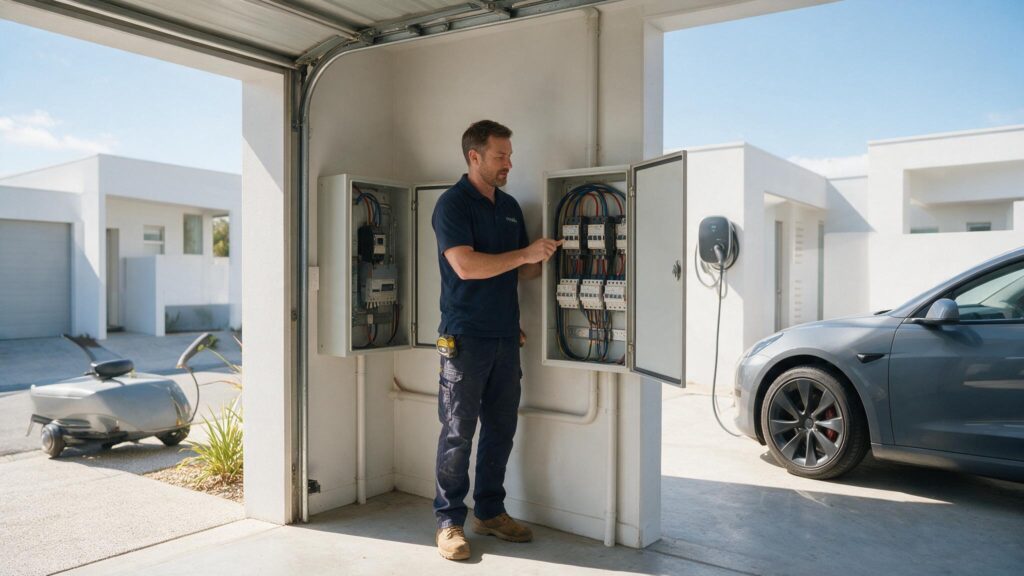
First, you need to identify your current power type. The simplest way is to look at your main switchboard. A single-phase home will typically have one large main switch, while a three-phase property will have a wider switchboard with three main switches (or one large switch with three poles). If you’re unsure, a licensed electrician from Sunshine Coast Projects & Electrical can provide a quick, safe, and definitive assessment.
A three phase power upgrade home is highly recommended in several scenarios. If you plan on installing a 3 phase home charging station for rapid charging, it’s a necessity. It’s also a wise choice if you run other large electrical loads like ducted air conditioning, a pool pump, and workshop machinery, as it prevents circuit overloads. Furthermore, upgrading future-proofs your home, adding value and making sure you’re ready for even greater electrical demands down the road. While some ask, “is 3 phase cheaper than single phase?”, the upfront investment in an upgrade provides long-term benefits in capacity, efficiency, and operational reliability that can be more cost-effective over time.
The upgrade process with Sunshine Coast Projects & Electrical is managed seamlessly. It begins with an initial consultation and assessment. From there, we handle everything, including managing the necessary applications with your network provider (Energex for Sunshine Coast properties), performing switchboard upgrades, and completing the full 3-phase power installation. Our comprehensive project management and 12-month labour guarantee make sure a smooth transition. Remember, EV charger installation and power upgrades are not DIY projects. The safety risks of incorrect installation are significant, which is why a licensed electrician is essential for a compliant, safe, and high-performing system.
Conclusion
The decision between single phase and three phase power for your EV charger in the end depends on your charging speed requirements, your household’s overall energy consumption, and your plans for the future. While single-phase is adequate for steady overnight charging, a three-phase system offers the superior speed and capacity needed for high-demand lifestyles and future-proofing your home.
At Sunshine Coast Projects & Electrical, we provide custom-made approaches that align with your specific needs. Our team offers professional installation and comprehensive project management, whether you’re setting up a simple charger or undertaking a full power upgrade. We make sure every ev charger installation Sunshine Coast residents receive is safe, efficient, and ready for the road ahead.
Contact Sunshine Coast Projects & Electrical today for a free quote, and let our experts prepare your home’s electrical system for your electric vehicle.
FAQs
What’s the main difference between single phase and three phase electricity for my home?
Single phase (230V) uses two wires and is ideal for general household needs. Three phase (400V) uses four wires, delivering more power and stability, making it perfect for high-demand applications like fast EV charging and large appliances.
Do I need a three phase power upgrade home for my EV charger?
Not always. A single-phase connection is often sufficient for slower, overnight charging. However, for faster charging speeds, households with multiple EVs, or to future-proof your home, a three phase power upgrade home for a 3 phase home charging station is highly recommended.
What does 3 phase vs single phase cost for installation?
A three-phase upgrade has a higher upfront investment due to more involved wiring and necessary switchboard upgrades. However, it provides long-term value through increased capacity and faster charging capabilities. We provide clear, transparent quotes for all work.
How can Sunshine Coast Projects & Electrical help me choose the right EV charging approach?
Our licensed electricians provide a complete electrical system assessment and expert consultation. We design custom-made approaches for individual homes, making sure a safe, compliant, and efficient ev charger installation Sunshine Coast homeowners can rely on, for either single or three-phase systems.
Ready to Install an EV Charger at Home?
Make sure your Sunshine Coast home has the right power setup for safe, efficient EV charging.
⚡ Book a Home EV Charging Assessment
Have a licensed electrician assess your switchboard and power supply to determine whether single-phase or three-phase charging is best for your home.
⚡ Request a Free EV Charger Installation Quote
Get a clear, no-obligation quote for EV charger installation, switchboard upgrades, or a three-phase power upgrade.
⚡ Upgrade to Three-Phase Power for Faster Charging
Future-proof your home and enjoy faster EV charging with a professional three-phase power upgrade.
⚡ Speak With a Sunshine Coast EV Charging Expert
Not sure which system is right for your vehicle and home? Our experienced electricians can guide you through the best EV charging solution.
C