Who can do electrical work Queensland is strictly controlled by licensing law. Licensed electricians working through licensed electrical contractors perform almost all fixed-wiring work. Handymen, builders, solar installers, homeowners and tenants may handle only limited non-electrical tasks. Illegal DIY can cause shock, fire, insurance problems and serious penalties, so check a contractor’s licence before work begins.
Solar installers who connect panels, inverters, batteries or EV chargers also have to be licensed electricians, and most grid‑connected systems require Clean Energy Council accredited design and installation. This guide explains what different people can and cannot do under Queensland rules, using clear Sunshine Coast examples. You will see where the legal line sits, how to check licences, and when to call a local contractor rather than risk fines, shocks or void insurance. Sunshine Coast Projects & Electrical fits into this framework as a fully licensed Master Electrician based on the Sunshine Coast.
Key Takeaways
Queenslanders often feel unsure about who can legally touch electrical wiring. These points summarise the main rules about who can do electrical work in Queensland.
-
Only people with a current Queensland electrical work licence, usually working for a licensed electrical contractor, can lawfully perform almost all electrical work. Everyone else, including handymen and unlicensed trades, must stay away from fixed wiring, electrical connections and internal live parts, even for apparently simple tasks.
-
Homeowners and tenants can do user jobs such as plugging in appliances, changing light globes, cleaning fans and filters, and carefully resetting tripped safety switches. As soon as you expose wiring, remove covers, alter circuits or hard wire equipment, you move into electrical work that must be done by a licensed electrician.
-
A licensed electrical contractor must be used whenever you pay someone to install, repair or alter electrical wiring, including for switchboard upgrades, renovations, shop fit outs, EV chargers, solar panels or battery storage systems. Businesses and landlords have extra duties under the Electrical Safety Act 2002 (Qld) and Work Health and Safety laws to use competent, licensed people.
-
Solar, battery and EV charger systems are classed as electrical work and involve extra technical standards and Clean Energy Council requirements for most grid‑connected systems. DIY solar kits, unaccredited installers and “cashie” EV charger wiring can undermine safety, insurance cover, product warranties and government incentives, even if the system appears to operate normally.
-
The Queensland Electrical Safety Office and WorkSafe Queensland publish guidance, provide an Electrical Licence Search and require “Don’t DIY” warning signs for some products. Checking licences, reading these notices and calling a licensed contractor keeps you compliant and protects your family, tenants and staff.
What Counts As “Electrical Work” Under Queensland Law?
Queensland law defines electrical work much more broadly than most people expect, so many small jobs are actually regulated tasks. In simple terms, if the job affects fixed wiring, internal electrical parts or the way your electrical installation connects to supply, it is almost certainly electrical work.
Under section 18 of the Electrical Safety Act 2002 (Qld), electrical work covers manufacturing, constructing, installing, testing, maintaining, repairing, altering, removing or replacing electrical equipment. Electrical equipment here includes not only appliances like fridges or TVs but also fixed wiring in walls and ceilings, switchboards, sockets, light fittings, solar arrays and EV chargers. This wide definition means tasks that seem minor, like swapping a light fitting or adding a power point, still count as electrical work and cannot be DIY.
Legal Definition And Everyday Examples
The Electrical Safety Act 2002 states that electrical work includes manufacturing, constructing, installing, testing, maintaining, repairing, altering, removing or replacing electrical equipment. In everyday language, any job that connects to, changes or interferes with a circuit in your property is treated as electrical work. The same rules apply whether you live in a detached home in Buddina, a unit in Maroochydore or manage a warehouse in Caloundra.
For homes and rentals, electrical work includes:
-
Installing new power points or upgrading single outlets to doubles
-
Moving or replacing light switches and light fittings
-
Replacing a light with a ceiling fan or exhaust fan
-
Wiring ovens, cooktops and some air conditioners
-
Changing or adding circuits to switchboards and mains
-
Installing hard wired smoke alarms
-
Running cables to sheds, granny flats or pool equipment
-
Installing EV chargers and surge protection
-
Connecting solar panels, inverters and batteries to your main board
Even building or repairing extension leads, by wiring a new plug or socket onto a flexible cord, is defined as electrical work in Queensland.
For shops, offices and industrial sites, electrical work includes:
-
Adding outlets for desks and workstations
-
Installing warehouse or car park lighting
-
Wiring three‑phase machinery and commercial kitchen equipment
-
Modifying or expanding distribution boards
-
Testing and fault finding on live circuits
-
RCD testing and work on hard wired plant
-
Supplying power to data cabinets and rack equipment where it connects to mains
Because the law is written so broadly, the safe assumption is that any job that opens an electrical cover, touches conductors or changes how power flows must be done by a licensed electrician.
Tasks That Are Not Classed As Electrical Work (But Can Still Be Risky)
Queensland law also lists certain tasks that are not treated as electrical work, as long as you do not disturb internal electrical parts. These activities are lawful for unlicensed people, but they can still be risky if you are not careful about where wiring is located. The Queensland Electrical Safety Office advises that you must still manage electrical hazards during non‑electrical work.
Typical non‑electrical tasks include:
-
Cutting holes in plaster to fit a fan body, duct or downlight can
-
Mounting a wall oven into cabinetry without connecting it
-
Hanging a television on a bracket above an existing power point
-
Assembling flat‑pack furniture that includes cable channels without running any cables
-
Routine cleaning of ovens, rangehoods, bathroom fans and air conditioner filters, following manufacturer instructions and without removing covers that expose wiring
In these cases, the work changes surfaces, fittings or cabinetry, not the wiring itself, so it sits outside the legal definition of electrical work.
This caution is backed by research on electrical worker safety: a systems-thinking review of electrical incidents found that licensing alone does not guarantee competency, and hazards often arise from gaps between regulation and real-world practice, underscoring why non-electricians should never risk disturbing hidden wiring. If there is any chance you might hit wiring, move a cable or expose live parts, you should stop and call a licensed electrician to make the area safe. This respects the legal line about who can do electrical work in Queensland and helps avoid shocks, fires and building damage.
Who Can Legally Do Electrical Work In Queensland?
In Queensland, only people with a current electrical work licence can physically carry out electrical work, and they usually do so through a licensed electrical contractor. Everyone else, including homeowners, tenants, handymen and unlicensed trades, must stay within narrow user tasks such as changing lamps and plugging in devices. The question of who can do electrical work in Queensland is answered in the Electrical Safety Act and enforced by the Queensland Electrical Safety Office.
There are two main licence types:
-
An electrical work licence, held by an individual electrician or electrical worker, which authorises that person to do particular classes of work.
-
An electrical contractor licence, held by a business or sole trader, which authorises that entity to offer electrical services to the public for payment.
In most day‑to‑day jobs, you engage the contractor, and the contractor sends a licensed electrician to perform the work.
Licensed Electricians And Electrical Contractors
A Queensland electrical work licence is the personal licence issued to the person on the tools, such as an electrical mechanic who performs general domestic and commercial wiring. Other classes cover work like fitting and repairing motors or doing restricted work for other trades, such as refrigeration mechanics. Everyone who physically touches wiring or live parts must hold a current licence in the correct class and must follow the Electrical Safety Act, associated regulations and technical standards such as AS/NZS 3000 (the Wiring Rules).
An electrical contractor licence is the business‑level licence that allows a company or individual to offer electrical services for payment. The contractor must:
-
Appoint at least one Qualified Technical Person, responsible for the technical standard of work
-
Appoint a Qualified Business Person, responsible for business management
-
Hold at least $5 million in public liability insurance, including a $50,000 consumer protection component, as required by the Electrical Safety Office
Sunshine Coast Projects & Electrical holds Queensland electrical contractor licence 79977, uses licensed electricians for all site work and carries insurance cover that meets contractor requirements.
For customers across the Sunshine Coast, this split means you should always see:
-
A contractor licence number on quotes, invoices, websites and vehicles
-
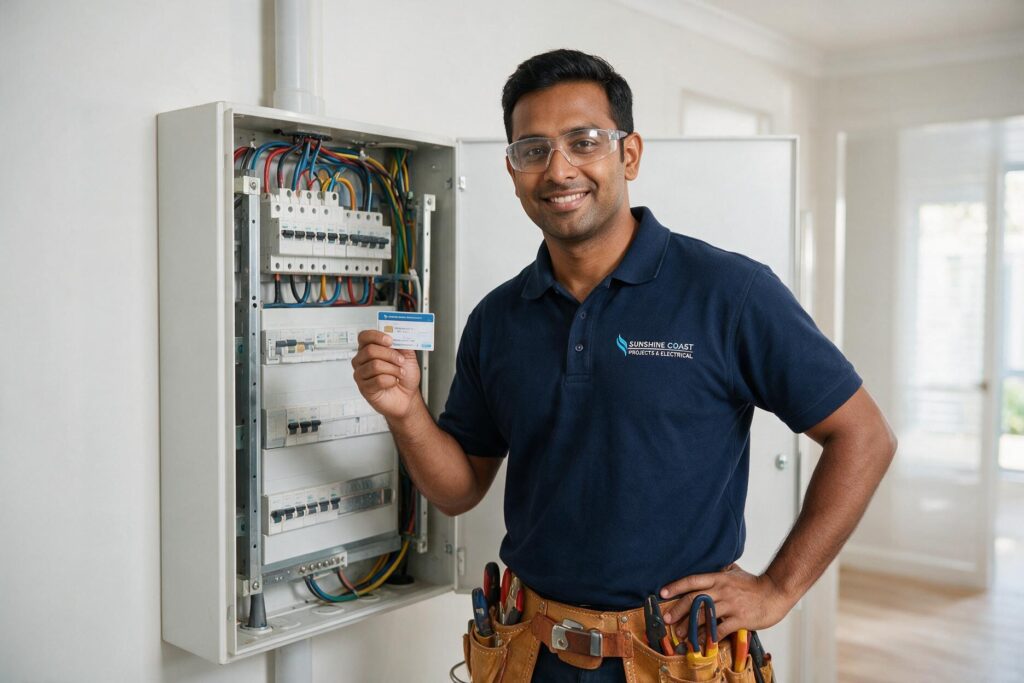
An individual electrical work licence card in the pocket of the person doing the job
If either piece is missing, that person or business cannot legally perform electrical work in Queensland, regardless of experience.
Why DIY And “Cashie” Electrical Work Is Illegal In Queensland
Queensland’s “DDIY – Don’t Do It Yourself” messaging makes it clear that unlicensed electrical work is illegal. The safety risk is straightforward: 240‑volt mains power can cause fatal shocks, and faults in hidden wiring can lead to fires months or years later. Shocks, burns and house fires from poor terminations, wrong cable sizes or missing earthing can occur without much warning.
Unlicensed work also carries heavy penalties. Under the Electrical Safety Act 2002:
-
Individuals who perform unlicensed electrical work can face substantial fines.
-
Far higher penalties apply if the breach exposes someone to the risk of death or serious injury.
-
Corporations that use unlicensed workers can face large penalties under both electrical and work health and safety laws.
-
In the most serious cases, where gross negligence leads to a fatality, imprisonment is possible.
Insurance is another major issue. Many home and business insurance policies require that electrical work is done by a licensed electrician and allow the insurer to refuse claims if illegal work caused a fire or shock. A seemingly cheap “cashie” switchboard upgrade can become very costly if it later causes a fault. The safest and most cost‑effective approach is to always hire a properly licensed electrical contractor and never attempt electrical work yourself.
What Can A Licensed Electrician Do That A Handyman Cannot?
A licensed electrician in Queensland can legally perform almost every type of fixed wiring, installation, testing and repair that your home or business will ever need. A handyman, by contrast, cannot legally perform any electrical work, even if the task appears simple or they “have done it before.” When you ask who can do electrical work in Queensland for a particular job, the correct answer is almost always a licensed electrician working through a contractor, not a handyman.
To make the difference clearer, consider common Sunshine Coast scenarios.
For example:
-
Changing a light globe in an existing fitting is allowed for homeowners, tenants and handymen because it does not expose wiring.
-
Replacing a light fitting or ceiling fan involves fixed wiring, so it is only lawful for a licensed electrician.
-
Adding or moving a power point or GPO changes circuits and wiring, which again must be done by a licensed electrician.
-
Building or repairing an extension lead, such as fitting a new plug or socket, is defined as electrical work and must be done by a licensed electrician.
-
Wiring EV chargers, spas, pools or pumps onto dedicated circuits is electrical work for licensed electricians only.
-
Installing or wiring solar panels, inverters or batteries is electrical work that must be performed by licensed electricians, and most grid systems also require Clean Energy Council accredited design and installation.
Typical Jobs For Licensed Electricians In Queensland Homes And Businesses
In Sunshine Coast homes, licensed electricians regularly handle:
-
New or relocated power points
-
Extra circuits for air conditioning, induction cooktops and EV chargers
-
Replacement light fittings and ceiling fans
-
Hard wired smoke alarm upgrades to meet Queensland rental and sale requirements
-
Outdoor and garden lighting, including pool and spa supplies
-
Switchboard upgrades to modern safety switches and circuit breakers
-
Investigation of nuisance tripping, flickering lights or power surges
-
Replacement of old wiring that no longer meets current standards
For EV owners, electricians design and wire dedicated charger circuits, assess supply capacity and, if needed, upgrade mains or switchboards.
In commercial spaces such as shops, offices and warehouses, licensed electricians:
-
Design and install lighting layouts
-
Install emergency and exit lighting
-
Provide three‑phase outlets for machinery and commercial kitchen equipment
-
Supply power to data cabinets and office technology
-
Carry out programmed maintenance, including test and tag of portable equipment
-
Undertake RCD testing and repairs to hard wired plant
On rural and hinterland properties, electricians run submains to sheds, pumps and workshops, including three‑phase supplies where needed for heavier loads.
Many larger jobs, such as new circuits in renovations or commercial fit outs, require formal testing and documentation such as an Electrical Certificate of Compliance or similar records. A licensed contractor can provide this paperwork, which gives proof for certifiers, property managers and insurers that work was carried out to the correct standard.
What A Handyman May And May Not Do Around Electrical Equipment
The term handyman is only a general description and not any type of electrical licence category in Queensland. A handyman can lawfully carry out non‑electrical work such as:
-
Patching plaster around fittings
-
Painting and basic carpentry
-
Replacing cabinetry or benchtops
-
Hanging shelves or brackets
They can also help with some preparatory elements of a job, such as cutting a hole in a ceiling for a fan body or lifting a light fitting into place, as long as no wiring is connected or altered during their part of the work.
However, a handyman must not:
-
Remove electrical covers that reveal wiring or live parts
-
Disconnect or connect electrical conductors
-
Add or move power points
-
Change hard wired light fittings or fans
-
Run cables to sheds or external structures
-
Build or repair extension leads or replace damaged plugs
-
Modify appliance wiring in any way
If a handyman offers to do these tasks, even as a favour or cheap cash job, they are asking you to participate in unlicensed work.
A practical rule is to ask for an electrical contractor licence number before agreeing to any electrical job, no matter how small. If the person cannot provide a valid Queensland contractor licence, or they say they “do not need one for this work,” they cannot legally perform electrical work in Queensland and should not touch your wiring.
What Can Queensland Homeowners And Tenants Legally Do Themselves?
Queensland homeowners and tenants can legally perform only a small set of basic tasks around their electrical installation. These jobs are classed as normal use or user maintenance, not electrical work, because they do not disturb wiring or internal live parts. Everything beyond this narrow list becomes controlled electrical work, and then the answer to who can do electrical work in Queensland is very clear: only a licensed electrician.
The Queensland Electrical Safety Office explains that you may:
-
Plug appliances into existing outlets
-
Change light globes in suitable fittings
-
Reset safety switches or circuit breakers
-
Clean accessible parts of certain equipment
You can also use extension leads and power boards correctly, as long as they are already built and undamaged. What you cannot do is open fittings, change the way cables are connected or install permanent wiring, even if the job looks easy in an online video.
Safe, Legal DIY Tasks For Everyday Households
A small number of everyday jobs sit on the legal side for DIY, as long as you treat them sensibly:
-
Plugging in and unplugging appliances and equipment to existing power points, provided cords and outlets are in good condition and rated for the load.
-
Changing light globes in properly installed fittings, after turning the switch off and letting hot lamps cool down.
-
Resetting a tripped safety switch or circuit breaker once or twice after checking for an obvious cause such as a faulty appliance or wet outdoor socket. If the device keeps tripping, you must stop resetting it and call a licensed electrician.
-
Using power boards and extension leads correctly by keeping them flat, dry and fully unwound, and avoiding overloading them with high‑power devices.
Cleaning jobs are usually fine when they follow the product manual. Examples include:
-
Wiping the accessible parts of ovens, rangehoods or ceiling fans
-
Vacuuming or washing air conditioner filters according to instructions
-
Dusting around fixed fittings without removing covers that require tools
The key is simple: do not remove panels that need tools, do not open appliance cases and never expose wiring or metal parts that are normally hidden.
Common Illegal DIY Jobs To Avoid
Many Queenslanders still attempt DIY jobs that feel minor but are clearly banned under the Electrical Safety Act. Common illegal jobs include:
-
Installing or replacing ceiling fans, because this always involves fixed wiring and often changes the mechanical support in the ceiling.
-
Swapping an old oyster light for a modern downlight, which requires altering connections and often cutting new openings.
-
Adding a double power point where there was a single outlet.
-
Running twin and earth cable to a new shed or granny flat.
-
Replacing damaged plugs or sockets on leads.
-
Buying an EV charger or DIY solar panel kit online and trying to wire it into your switchboard.
WorkSafe Queensland and the Electrical Safety Office stress that if you have any doubt whether a task is electrical work, you should assume that it is and use a licensed contractor.
Relying on a friend with overseas trade experience, a retired electrician whose licence has lapsed or a cheap unlicensed “cashie” is still treated as unlicensed work. If something goes wrong, you as the property owner may face enforcement action, civil claims and refusal of insurance. For anything beyond the short list of basic user jobs, contact a licensed electrician and stay out of the roof space and switchboard.
How Are Solar Installers Regulated Compared With General Electricians?
Solar and battery installations in Queensland follow the same core electrical licensing rules as other wiring work, plus extra industry standards and Clean Energy Council requirements. The people who install and connect solar panels, inverters and batteries must be licensed electricians, not just roofing workers or general contractors. When asking who can do electrical work in Queensland for solar or batteries, the law again points to licensed electricians working through licensed contractors.
Because solar and battery systems can involve high DC voltages, complex protection devices and grid connection approvals, the regulatory framework includes several layers of control. Installers must hold the right Queensland electrical work licence and must work for or as an electrical contractor with a valid contractor licence. For most grid‑connected systems that claim Small‑scale Technology Certificates, the designer and installer must also hold Clean Energy Council accreditation.
Licensing And Accreditation For Solar And Battery Work
From a legal point of view, wiring solar panels, inverters and batteries is electrical work under the Electrical Safety Act 2002. Installers have to:
-
Meet all usual obligations, such as complying with the Wiring Rules and relevant codes of practice
-
Test their work in line with standards and manufacturer instructions
-
Manage risks of electric shock and fire
Solar and battery installations also bring additional standards into play, including those dealing with DC isolators, array earthing, disconnection points and battery enclosure requirements.
For most grid‑connected rooftop systems, Clean Energy Council accreditation is required for both:
-
The system designer, and
-
The installer on site
This accreditation sits alongside the electrical work licence and electrical contractor licence and reflects additional training in solar‑specific risks. Recent guidance from regulators has focused heavily on battery safety, after incidents where poorly installed systems caused fires.
DIY or “cash job” solar work creates several problems at once:
-
It breaches Queensland electrical licensing laws.
-
It can expose people to hazardous DC voltages and dangerous fault currents.
-
It may void panel, inverter and battery warranties.
-
It can lead to loss of STCs or rejection of grid connection applications by Energex or Ergon Energy.
A properly licensed and accredited contractor can design and install systems that comply with regulations and protect your investment.
How Sunshine Coast Projects & Electrical Manages Solar, Battery And EV Safety
On the Sunshine Coast, many households want solar, batteries and EV chargers to work together, which adds complexity to electrical design. The company combines a Queensland electrical contractor licence with Clean Energy Council accreditation to manage this work from start to finish. Managing Director Charlie Doblo has more than 20 years of electrical trade experience and leads a team that focuses on safe, compliant installations across residential and commercial sites.
Their work covers:
-
Solar panel and battery installation and upgrades
-
Switchboard upgrades to suit new loads and safety requirements
-
Dedicated EV charger wiring and supply assessments
-
Safety inspections and fault finding on existing solar and battery systems
-
Grid connection paperwork with Energex or Ergon Energy where required
All wiring is carried out by licensed electricians under contractor licence 79977, in line with guidance from the Queensland Electrical Safety Office, WorkSafe Queensland and the Clean Energy Council. The team also provides documentation that insurers and certifiers often request.
For customers, this joined‑up approach means you do not have to guess who can do electrical work in Queensland when your project involves solar, batteries and EV charging. One licensed contractor takes responsibility for design, installation, testing and compliance records.
When Must You Use A Licensed Electrical Contractor? (Real‑World Scenarios)
In practice, you must use a licensed electrical contractor any time you pay someone to perform electrical work on your property. That applies whether you are a homeowner, landlord, business owner, body corporate or builder, and whether the job is small or large. Looking at real‑world scenarios makes it easier to understand who can do electrical work in Queensland in each situation.
Businesses and landlords have extra duties as persons conducting a business or undertaking (PCBUs) under the Work Health and Safety Act 2011 (Qld), which includes managing electrical safety. Using unlicensed labour for electrical work can expose them to prosecution, large fines and civil claims if someone is injured. For private homeowners, the risk of shock, fire and voided insurance claims makes licensed contractors the sensible option.
Common Residential And Renovation Situations
Home renovations are one of the most common times when electrical work is needed and also a common time for people to cut corners. During a renovation, you must use a licensed electrical contractor when:
-
Adding or moving power points during kitchen or bathroom upgrades
-
Changing halogen downlights to LED downlights that require rewiring or new drivers
-
Wiring a new deck, patio or outdoor entertaining area
-
Rewiring or upgrading an older switchboard
-
Installing hard wired smoke alarms to current Queensland rental/sale standards
-
Providing power to a new shed, studio or pool equipment area
Builders and owner‑builders still need to engage licensed electricians for all wiring, regardless of their own skills.
Older Sunshine Coast homes, particularly in areas such as Nambour, Palmwoods and Buderim, often still have outdated wiring, rewirable fuses or limited safety switch coverage. When these homes are extended or refurbished, the electrical installation often needs substantial upgrades to meet current standards. A licensed contractor can:
-
Assess the existing installation and capacity
-
Design new circuits and safety switch protection
-
Upgrade mains if required
-
Integrate new and existing wiring into a modern switchboard
Even smaller jobs, such as wiring a new air conditioner, adding outdoor power points for a pool or spa, or running a submain to a detached shed or studio, are firmly electrical work. Planning these tasks with a licensed contractor early in the design stage helps avoid rework and ensures all wiring is tested and documented.
Commercial, Body Corporate, EV And Emergency Scenarios
In commercial and industrial settings, the need to use licensed electrical contractors is even clearer. Common examples include:
-
Shop fit outs in centres such as Kawana
-
Office refurbishments in Maroochydore
-
Warehouse and factory lighting upgrades
-
Power and lighting in body corporate common areas
-
Test and tag programs for portable equipment
-
New circuits, changes to distribution boards and three‑phase outlet installations
-
Emergency and exit lighting installations and testing
All these activities are electrical work and must be completed by licensed electricians.
EV charging is another area where only licensed contractors should be involved. Home wallboxes, workplace chargers and three‑phase chargers in car parks all draw high currents and must be wired on dedicated circuits with appropriate protection and load assessment. Incorrectly installed EV chargers can:
-
Overload wiring and switchboards
-
Trip supply or cause nuisance outages
-
Damage vehicles or charging equipment
-
Create dangerous touch voltages
Queensland regulators require licensed electricians to design and install these systems, and larger commercial charger banks may need careful load management and network approvals.
During storms, floods and other emergencies, it can be tempting to open the switchboard, dry things out or “get the power back on” yourself. The Queensland Electrical Safety Office and WorkSafe Queensland warn strongly against this, because flood‑damaged wiring, switchboards, solar systems and appliances can remain dangerous long after the water has gone. In these situations you should:
-
Isolate power at the main switch if it is safe to do so
-
Keep people and pets away from affected areas
-
Call a licensed electrical contractor that can handle emergency work
Attempting repairs yourself in these circumstances can be life‑threatening.
How Do You Check If Someone Is Properly Licensed In Queensland?
Checking licences before work starts is the simplest way to confirm who can do electrical work in Queensland at your property. The Queensland Electrical Safety Office provides an online Electrical Licence Search so you can verify both electrical contractors and individual workers. Spending a few minutes on these checks can help you avoid unlicensed operators, unsafe work and disputes.
You do not need specialist knowledge to use the search, only a licence number or business name. If the person or company you are speaking with cannot give you a contractor licence number, that is a strong warning sign. You should not allow them to start electrical work, regardless of how urgent your job is.
Using The Queensland Electrical Licence Search
The Electrical Licence Search is a public tool provided by the Queensland Electrical Safety Office. To use it:
-
Ask your electrician or business for their Queensland electrical contractor licence number. It should also appear on their website, vehicles and paperwork.
-
Go to the Electrical Safety Office website and open the Electrical Licence Search page.
-
Enter the licence number or business name.
-
Confirm that the record matches the details you have been given. Check that:
-
The licence is listed as current, not expired, cancelled or suspended.
-
The trading name, ABN or address align with the information on quotes and invoices.
-
If something does not look right or you cannot find the listing, you can call the Electrical Safety Office helpline on 1300 362 128 for guidance.
You can also ask the individual electrician on site to show their personal electrical work licence card, which confirms their name, licence number and expiry date. A properly licensed contractor such as Sunshine Coast Projects & Electrical will appear under contractor licence 79977 in the search. Carrying out these checks before work starts helps you keep your electrical work compliant and avoid problems later.
Red Flags And “Don’t DIY” Warning Signs
Certain warning signs suggest a person or business may not be properly licensed to perform electrical work in Queensland. Be cautious if you see:
-
Advertisements, flyers or social media posts offering electrical services without a Queensland electrical contractor licence number.
-
Very cheap offers for complex jobs like switchboard upgrades, solar systems or whole‑house rewires, especially when combined with cash‑only payment and no paperwork.
-
Reluctance to provide licence details or a current insurance certificate on request.
Retailers in Queensland that sell certain hard wired electrical products must display “Don’t DIY” warning notices near those items, both in store and online. These signs remind you that while you can buy items such as:
-
Power points and light switches
-
Ceiling fans and hard wired exhausts
-
Cooktops and some ovens
-
Wired EV chargers
only a licensed electrician may install them.
When you buy electrical equipment for a renovation or upgrade, ask the salesperson whether it requires installation by a licensed electrician. If the answer is yes, plan ahead and coordinate with your contractor. Combining careful product choice with licence checks and attention to “Don’t DIY” signs is one of the best ways to keep your project compliant.
To Sum Up
Queensland has some of the clearest rules in Australia about who can do electrical work, and those rules are strict for good reason. Almost every job that touches fixed wiring, internal electrical parts, switchboards, solar systems or EV chargers is classed as electrical work and must be done by a licensed electrician working through a licensed electrical contractor. Homeowners, tenants and handymen are limited to simple user tasks such as plugging in appliances, changing globes, cleaning accessible parts and carefully resetting safety switches.
Handymen and other unlicensed trades cannot legally install or alter power points, light fittings, fans, circuits, switchboards, extension leads, solar systems, batteries or EV chargers, even if they feel confident. Solar and battery installations add another layer, as they must also follow Clean Energy Council accreditation requirements and additional safety standards for DC circuits and energy storage. DIY efforts or cheap “cashie” jobs can lead not only to shocks and fires but also to loss of rebates, rejected insurance claims and enforcement action.
If you own or manage property on the Sunshine Coast and need electrical work, the safest path is to confirm contractor and worker licences, pay attention to “Don’t DIY” signs and avoid any offer that skirts Queensland electrical safety laws. For compliant residential, commercial, solar, battery or EV work, you can call Sunshine Coast Projects & Electrical on 0400 677 514 and speak directly with a licensed Master Electrician. For edge cases or to check current rules and standards, always refer to current guidance from the Queensland Electrical Safety Office, WorkSafe Queensland and relevant national standards rather than guessing. Unsure who is legally qualified for your job? Call Sunshine Coast Projects & Electrical on 0400 677 514 to discuss the work and book a licensed contractor. Learn more at https://sunshine-coast-electrician.com.au/services/.
Frequently Asked Questions
No. A Queensland handyman cannot legally replace a light fitting or ceiling fan, because that work involves fixed wiring and disconnection and reconnection of conductors. Only a licensed electrician, working under a licensed electrical contractor, may perform those tasks. A handyman may help with non‑electrical parts, such as mounting a fan bracket or patching plaster, but the wiring and testing must be left to a licensed electrician engaged through a contractor.
You do not need a licensed electrician just to plug a standard appliance into an existing power point. Plugging in dishwashers, TVs, microwaves or similar devices is considered normal user activity. However, many ovens, cooktops, some air conditioners and EV chargers are hard wired and require a new circuit or direct connection. Any hard wired installation or circuit alteration must be carried out by a licensed electrician, so always read the manual carefully and ask your electrician if you are unsure.
No. It is not legal to build or repair your own extension leads in Queensland, because that work is defined as electrical work. Adding a new plug or socket, shortening a cord or replacing damaged connectors all involve wiring that must be done by a licensed electrician. Poorly terminated leads can cause shocks, burns or fires, even under normal use. The safer approach is to buy approved, factory‑made leads and have damaged ones replaced or repaired by a licensed electrician.
A builder or carpenter cannot do electrical work as part of a renovation unless they also hold the required Queensland electrical work licence and work through an electrical contractor licence. Even if they “know how” from other jobs or overseas experience, they are not permitted to touch wiring or switchboards without those licences. They should instead engage a licensed electrical contractor to design, install and test all circuits as part of the renovation.
Yes. Solar installers in Queensland must be licensed electricians, because wiring panels, inverters and batteries is electrical work under the Electrical Safety Act 2002. For most grid‑connected systems, the designer and installer also need Clean Energy Council accreditation so customers can access incentives such as Small‑scale Technology Certificates. Non‑electrician roofing crews may help with panel mounting under supervision, but they cannot legally make electrical connections or perform testing.