Power outage or fault my house QLD is a common urgent search when the lights suddenly go out. First check whether nearby homes and streetlights are also dark. A widespread outage is usually an Energex issue; power loss limited to your property may indicate a fault after the meter. Keep clear of hazards, check the outage map and never attempt electrical repairs yourself.
Within 5 minutes you can check neighbours, look at your switchboard from a safe distance, unplug a few appliances and confirm the Energex outage map. This article walks you through that short safety‑first check, then explains when to call 000, Energex, Ergon or a licensed Sunshine Coast electrician. Sunshine Coast Projects & Electrical, led by Managing Director Charlie Doblo, shares local experience so you can stay calm, stay safe and avoid risky DIY.
Key Takeaways
-
Work out if it is Energex or your house by checking neighbours, streetlights and the Energex Outage Finder, then looking for property‑only signs like partial power or repeated tripping. These steps give you a quick first answer before you touch any switches and help you explain the situation clearly when you ring for help.
-
Use a simple 5‑step, 5‑minute check that covers safety, neighbours, the outage map, basic switchboard observations and unplugging obvious appliances. You do not need tools or electrical knowledge to follow it; you only need a torch, your phone and a clear head.
-
Call 000 first whenever there is fire, smoke, electric shock, or fallen powerlines touching cars, roofs, fences or the ground. Once everyone is safe, contact Energex on 13 19 62 for network hazards and updates. Always keep a safe distance from any damaged lines or poles.
-
Call Sunshine Coast Projects & Electrical on 0400 677 514 when your Sunshine Coast home or business seems to have its own fault, such as no power while neighbours are normal, repeated tripping, burning smells, or issues after storms. A licensed electrician can test wiring and equipment and restore power safely.
-
Plan ahead for the next outage by keeping torches, power banks and key phone numbers handy, and by talking with an electrician about your switchboard condition, solar, batteries or EV chargers. That way the next power cut is an inconvenience rather than a crisis.
What Is The Difference Between A Power Outage And A Fault At My House In QLD?
The difference between a general power outage and a fault at your house in QLD comes down to which side of the meter has the problem. A network outage affects multiple properties and is handled by the electricity distributor, while a house fault affects only your installation and needs a licensed electrician. Understanding that split makes your decisions faster and safer.
Network conditions in this region are shifting too, with a planning perspective on reactive power trends in South East Queensland showing that reactive power flows have been trending in a new direction in recent years, which is part of why distributors continually adjust and monitor their network equipment across most of the Sunshine Coast, where Energex is the distributor, while many regional parts of Queensland use Ergon Energy. These companies own and maintain the poles, wires and transformers that deliver electricity to homes, shops, farms and workshops. When a storm hits a line or a car takes out a pole, that is their job to fix and they update tools such as the Energex Outage Finder.
From the point where the service line reaches your meter onward, the wiring and equipment belong to you as the property owner. That includes the main switch, safety switches, circuit breakers, socket outlets, lights, EV chargers, solar inverters and anything else wired in. Under Queensland law, any work on that fixed wiring must be done by a licensed electrician, not by the homeowner. The Queensland Electrical Safety Office explains this duty on its page about electrical safety and licensing.
Knowing whether you are looking at a network outage or a house fault stops a lot of wasted effort. If the whole street is dark, calling an electrician will not bring the network back quicker, so you call Energex or Ergon instead. If only your property has no power, Energex will usually tell you to speak with a licensed electrician, because the issue is on your side of the meter.
How Power Gets To Your Sunshine Coast Home
How power gets to your Sunshine Coast home explains where Energex stops and your responsibility begins. Electricity starts at power stations, moves along high‑voltage transmission lines owned by companies such as Powerlink Queensland, then reaches local substations. From there, Energex or Ergon step the voltage down and send it through street lines or underground cables.
Your property connects to this local network through a service line to the point of attachment on your roof or boundary. The supply passes through the meter so your retailer, such as AGL or Origin Energy, can bill you for what you use. Retailers manage accounts and tariffs, while distributors manage physical wires and repairs to them. The Australian Energy Regulator explains this split on its page about finding your energy distributor.
Understanding how electrical infrastructure is inspected and maintained, including research on weakly supervised defect detection in electrical infrastructure, shows why distributors invest heavily in monitoring the poles, wires and transformers before problems ever reach your main switch and switchboard. Inside that board sit safety switches, circuit breakers and sometimes surge protectors that look after circuits for lights, power points, ovens, air conditioning, EV chargers, solar battery installation and more. All of that gear is part of your electrical installation. If it fails, trips or overheats, you call a licensed electrician to inspect and repair it.
What Counts As A Network Outage Vs A House Fault?
What counts as a network outage versus a house fault is easiest to see from the symptoms. If several houses, units or shops near you are dark and streetlights or traffic lights are also out, that usually points to a distributor problem. When you open the Energex Outage Finder and see an unplanned outage listed for your suburb and street, that confirms a network issue.
A house fault looks different. Your lights might be off while next‑door looks normal, or only some rooms might be dead while others still work. You might hear a safety switch click off again and again, or smell hot plastic at a power point after rain. Those signs point to problems with your switchboard upgrade, your wiring or an appliance.
This distinction still matters after Energex or Ergon fix a known network fault. Power may come back for the street, but your own switchboard or appliances might have suffered storm or surge damage. In that case, the distributor has done its job and a licensed electrician needs to check your installation. Queensland law, guided by the Electrical Safety Act and explained by the Electrical Safety Office, makes it clear that only licensed electricians can legally repair or alter fixed wiring.
What Are The First Safety Checks When The Power Goes Out?
The first safety checks when the power goes out focus on danger to people before anything else. Only after you are sure there is no fire, smoke, shocks or fallen lines should you think about whether this is Energex or your own house. That order of steps keeps you and your family out of harm’s way.
Power loss can hide hazards. A failed light can conceal smoke, and a dark yard can hide a fallen line after a storm. That is why you start by stopping, using a torch and listening. You are not trying to fix anything during this phase, only to spot trouble and move away from it. If at any point you feel unsafe, you stop and ring 000.
Some quick actions help protect your gear during this first sweep. Turning appliances off at the wall reduces the chance of damage when power returns with a surge. Unplugging computers, TVs and game consoles where it is easy and safe can save them from harm, especially during electrical storms. These steps take less than a minute and make the rest of the check calmer.
How To Check For Immediate Danger
How to check for immediate danger starts with your senses. Use a torch, not a candle, and look for smoke, flames, glowing plastic or scorch marks at the switchboard, meter box, power points and appliances. Listen for loud buzzing, cracking or popping sounds, which can mean arcing electricity. Smell for strong burning or melted plastic, especially around outlets or light fittings.
If you can safely see outside, scan for low or fallen powerlines, trees on lines or poles that look damaged. Stay at least 8–10 metres away from any suspected powerline hazard and keep others back. Do not try to move branches or touch a car, fence or roof that might be in contact with a line. Energex and Ergon both warn on their safety pages that all fallen lines must be treated as live.
If someone has received an electric shock, call 000 immediately. Do not touch them if they are still in contact with live equipment. If and only if it is safe, you can turn off the main switch, but your focus is getting emergency help. After calling 000, and only once life safety is under control, you can call Energex on 13 19 62 to report fallen lines or ongoing network hazards.
Life Support, Medical Needs And Sensitive Equipment
Life support, medical needs and sensitive equipment need special care during any power cut. If someone in the house relies on powered medical equipment such as an oxygen concentrator, home dialysis machine or ventilator, switch to your backup supply straight away. That may mean backup cylinders, manual devices or a battery pack. If there is any doubt about their health, call 000 without delay.
Queensland distributors and retailers have specific processes for customers on life support. You should already have a written plan from your doctor and energy retailer that explains what to do in an outage. The Queensland Government’s energy pages explain how to register life support equipment so Energex, Ergon and your retailer know your situation and can contact you when planned interruptions are expected. Check that registration details stay current.
For sensitive electronics such as TVs, computers, routers and game consoles, turn them off and unplug them at the wall if it is easy and safe. This helps protect them from voltage spikes when the power returns, which often happen after storms or network faults. Leave fridges and freezers closed so they stay cold longer, but turn off other large appliances like air conditioning until you are sure supply is stable again.
How Do I Tell If It’s An Energex Outage Or Just My Place? (Five‑Minute Check)
Telling whether you are in an Energex outage or dealing with a fault in your own place is usually possible in about 5 minutes. A short, calm sequence of checks can answer the “power outage or fault my house qld” question without tools or technical knowledge. The idea is to gather simple clues, not to repair anything.
The five‑minute check runs in a clear order. You check safety first, then see what your neighbours and streetlights are doing. After that, you confirm the Energex Outage Finder or Ergon information on your phone if mobile coverage is available. Finally, you take a careful look at your switchboard position and unplug a few appliances to see whether the problem seems local.
At every step there are clear “stop” points. If you see fire, smoke, or fallen lines, you stop and call 000. If you feel unsure at any stage, you stop and call a licensed electrician instead of guessing. The local team offers free initial phone advice, so you can talk through what you see before booking an after‑hours call‑out.
Step 1: Check Neighbours, Streetlights And Recent Weather
Step 1 is to check neighbours, streetlights and recent weather so you know whether the issue feels local or wide. With a torch, look out a window or step outside if it is safe and dry. See whether nearby houses, units or shops still have interior lights, porch lights or glowing appliances. Look at streetlights and any visible traffic lights.
If several nearby homes and streetlights are dark, you are probably dealing with a wider outage. In that case, note the time and anything you have seen, such as trees down or flashes from a transformer. Recent heavy rain, lightning, high winds or extreme heat also point toward network faults. Distributors like Energex publish storm safety advice on their pages about power outages and storms.
If neighbours look normal and only your home seems dark or “odd”, the odds swing toward a property‑only fault. Odd behaviour includes partial power, flickering only in your house or the sound of a safety switch tripping in your switchboard. In that case, you will still check the outage map, but it is less likely to answer the problem.
Step 2: Check The Energex Outage Map And Your Distributor Details
Step 2 is to check the Energex outage map and your distributor details to confirm whether the network has a known fault. For most Sunshine Coast suburbs, Energex is the distributor, while many regional and rural districts use Ergon Energy Network. If you are unsure, check the “Faults and emergencies” section on your electricity bill, or use the Australian Energy Regulator’s online guide to find your distributor.
On a phone with mobile data, open the Energex Outage Finder at the address listed on your bill or by searching for “Energex outage finder”. The page offers an interactive map and text lists showing both planned and unplanned outages. Enter your suburb or postcode and look for coloured shapes over your area, then read the notes about causes and estimated restoration times on that section of the map.
If the map shows an outage that includes your street around the time your power dropped, that is almost certainly a network issue. In that case, a licensed electrician cannot restore power until Energex repair crews fix the fault and re‑energise the lines. You can still call Energex on 13 19 62 if you see extra hazards such as fallen lines or if the map does not list the problem yet. If your neighbours’ power returns and yours does not, that is when you move to the “my house only” checks and call an electrician.
What Simple Checks Can I Safely Do At Home Without Touching Wiring?
The simple checks you can safely do at home without touching wiring focus on eyesight and unplugging appliances. You do not open the switchboard, undo screws or work on bare wires. Instead, you look for patterns that suggest whether the fault is a whole‑house issue, a single circuit, or just one bad appliance.
Many “power outage or fault my house qld” problems turn out to be a single tripping safety switch keeps tripping or a faulty kettle, heater or outdoor fitting. By using only the switchboard door, wall switches and appliance plugs, you can often narrow the problem enough to know what to tell a licensed electrician. That can save time and help avoid unnecessary emergency call‑outs.
The key rule is simple. If something looks damaged, smells hot or makes you uneasy, stop right there. Leave the relevant switch off and call a licensed electrician instead of trying one more reset.
Looking At, Not Into, Your Switchboard
Looking at, not into, your switchboard gives you useful clues without risky work. Your board is usually near the front door, on an external wall, in the garage or in a meter box outside. It might have a metal or plastic door with labels for lights, power points, hot water, air conditioning and so on.
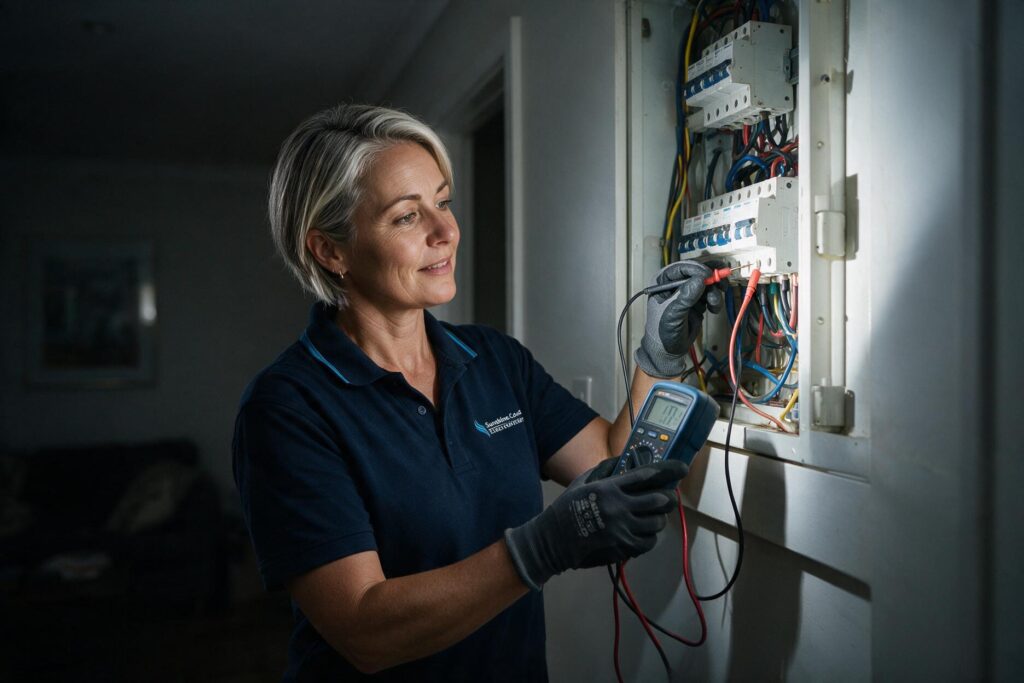
Use a torch and gently open the door if it does not feel stuck or damaged. Stand back and look along the rows of switches. See whether any are clearly down or sitting in a middle “tripped” position while others are up. Look for obvious issues such as scorch marks, melted plastic, rust, water droplets or signs that insects have been inside. Do not remove any covers or touch bare parts.
If you see damage, water, heavy rust, or a main switch that will not stay on, stop and close the door. Do not keep flicking switches to “see what happens”, and do not tape anything on. Call a licensed electrician such as Sunshine Coast Projects & Electrical on 0400 677 514 and describe exactly what you saw. A short phone chat will help decide whether you need urgent attendance.
How To Check Appliances Safely At The Wall
How to check appliances safely at the wall helps you spot a single faulty item without tools. Start in the room where you first noticed the power drop, such as the kitchen or lounge. Turn each appliance off at the wall switch, then gently unplug it if the plug is easy to reach and the area is dry. That includes kettles, toasters, heaters, lamps and phone chargers.
If some circuits still work, such as lights, while a group of power points is dead, focus on that “dead” group. Unplug everything from those outlets and leave them unplugged for a few minutes. After a short pause, try turning the wall switches on again without plugging anything back in. Sometimes a safety device inside an outlet resets after the load is removed.
Common troublemakers include old fridges and freezers, portable heaters, cheap power boards and outdoor gear that has been wet. If turning a particular appliance on at the wall causes a visible spark, crackle or burning smell, switch it off again straight away and leave it unplugged. Do not test it a second time. Instead, arrange repair or replacement, and ask a licensed electrician to check the outlet if you have any doubt.
When Should I Call 000, Energex, Or A Licensed Electrician?
Knowing when to call 000, Energex or a licensed electrician makes your response to a power problem much clearer. Emergencies that threaten life or property always go to 000 first. Hazards or faults in the street or on the distributor’s gear go to Energex or Ergon. Anything within your own wiring and equipment needs a licensed Sunshine Coast electrician.
This clear split stops you being passed from one number to another while anxious and in the dark. It also lines up with Queensland’s legal framework, which puts strict limits on unlicensed electrical work. The Electrical Safety Office explains on its guidance pages that only licensed electricians may perform electrical work, except for simple tasks such as changing a globe or plugging in appliances.
Sunshine Coast Projects & Electrical provides 24/7 emergency call‑outs and free initial phone advice. That means you can ring, describe what you have seen and heard, and get clear advice on whether it sounds like a network issue, a simple appliance problem or a fault that needs rapid attendance.
Clear Rules For Emergencies And Network Problems
Clear rules for emergencies and network problems help you act fast under pressure. Call 000 straight away if you see fire, smoke or flames at the switchboard, meter box, roof, walls or appliances. Do the same if someone receives an electric shock, even if they seem fine, or if you see powerlines on cars, roofs, fences or the ground. Emergency operators can also connect you with fire and ambulance as needed.
Call Energex on 13 19 62 when you have a widespread outage, visible damage to poles or wires, or when the Outage Finder shows your area but you notice extra danger. That includes lines sparking in trees, poles leaning after storms or loud arcing sounds in the street. Energex crews are trained and have the right equipment to make those sites safe. Distributors manage supply up to the meter and will not work on wiring inside your building.
The Queensland Electrical Safety Office asks that serious electrical incidents and dangerous events be reported through its official channels. Their website explains the process for reporting electrical incidents for householders and businesses. While this is usually handled by electricians and employers, it is useful to know that such a process exists.
When To Call Sunshine Coast Projects & Electrical (And When To Stop Trying DIY)
When to call Sunshine Coast Projects & Electrical is any time your own checks suggest the fault sits on your side of the meter. That includes situations where neighbours and streetlights are fine but your home is dark, when only some rooms have power, or when safety switches keep tripping even after you unplug likely appliances. Burning smells, hot outlets, crackling switches or strange behaviour after a storm are also clear signs.
You should stop trying DIY the moment you feel unsure or nervous. If a switch refuses to stay on, if you cannot tell which device is tripping, or if you see any sign of heat or damage, do not keep experimenting. Leave the affected switch off, keep everyone clear and call 0400 677 514. Describe exactly what you have seen, heard and smelled so the electrician can judge the urgency.
The business is a local Sunshine Coast electrical contractor led by Managing Director Charlie Doblo, an Accredited Master Electrician and Clean Energy Council accredited electrician with more than 20 years of trade experience and QLD contractor licence 79977. The team handles residential and commercial faults, storm damage, older wiring, EV chargers, solar and batteries, and can give free initial phone guidance before you commit to a call‑out.
What Do Common Power‑Loss Scenarios Look Like In Real Life?
Common power‑loss scenarios on the Sunshine Coast follow patterns you can learn to recognise. When you understand these patterns, it is easier to decide whether you are facing a network outage or a fault in your own home. That takes some worry out of the classic “power outage or fault my house qld” moment.
These scenarios tie together the five‑minute check, the safety rules and the escalation options. Each one starts with what you see and feel, then links that to likely causes and the best next call. The goal is not for you to diagnose complex faults, but to feel calmer and make sensible choices while waiting for help.
Stormy coastal weather, older beachside wiring, modern loads such as EV chargers and solar batteries all shape how outages appear. The team has seen the same patterns in Buddina, Mountain Creek, Nambour, Palmwoods and other suburbs, and the following examples reflect that day‑to‑day experience.
Four Quick Sunshine Coast Scenarios And What To Do
Four quick Sunshine Coast scenarios and what to do can help you match your own situation.
In Buddina, a summer storm rolls through with strong wind and lightning, and the entire street suddenly goes black, including streetlights. You check the Energex Outage Finder on your phone and see an unplanned outage over your suburb with a restoration estimate. Your job is to keep fridge and freezer doors shut, use torches instead of candles and stay well away from any fallen branches on lines. You call Energex if you see damaged poles or sparking lines, and only call an electrician later if your house stays dark after neighbours’ power returns.
In Mountain Creek, you notice your house is dark but you can see the glow of TVs and lights through nearby windows, and the streetlights are on. After confirming that the Outage Finder shows no problem in your area, you do the five‑minute check. You unplug kitchen appliances, safely look at the switchboard for any clearly tripped switches and still cannot get supply back. At that point calling a licensed electrician is the right move, because the issue is clearly on your side of the meter.
In Nambour, you find that only some rooms are without power and lights flicker whenever the oven starts. You might hear a soft click from the switchboard each time a large appliance kicks in. That pattern points toward a partial supply problem, perhaps an overloaded or loose circuit. You leave any suspect circuit off if you know which one it is, do not hold any switch in place, and book an electrician to test the wiring and switchboard.
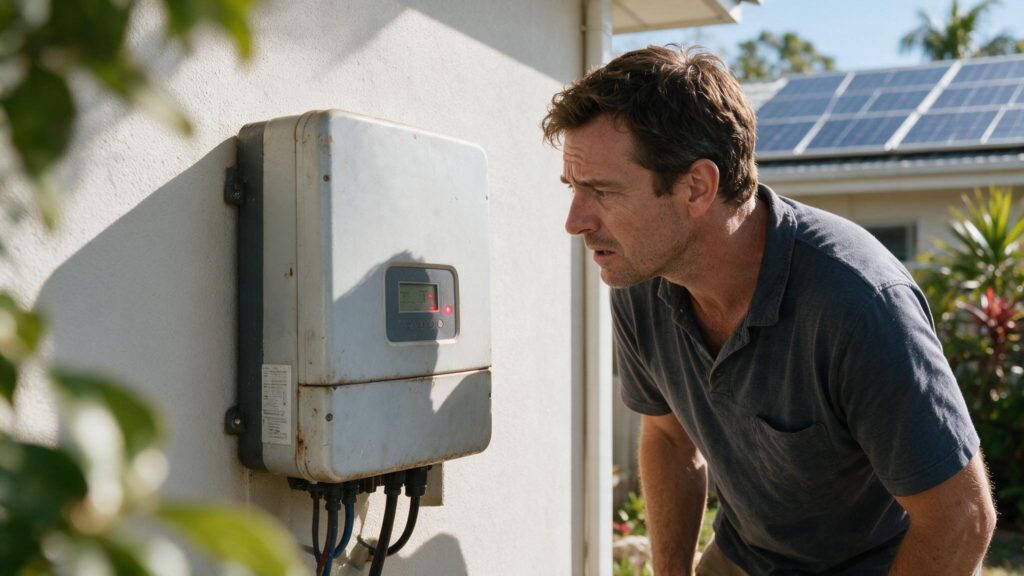
After a storm elsewhere on the Sunshine Coast, grid power returns and neighbours seem fine, but your solar inverter shows error codes and your EV charger trips the house safety switch when you plug the car in. In that case, the Energex network may be stable but your equipment has likely suffered surge or water damage. You stop using the inverter and charger, switch them off at clearly labelled isolators if you know how, and arrange for a Clean Energy Council accredited electrician to assess your solar, battery and EV circuits.
How Can I Prepare My Sunshine Coast Home Or Business For Future Outages?
Preparing your Sunshine Coast home or business for future outages makes the next event less stressful. A small amount of planning and some basic gear turn a power cut into more of a nuisance than an emergency. Thoughtful electrical upgrades can also cut the odds of faults that only affect your property.
Simple preparation starts with information. Having key numbers and a short written plan on the fridge means guests, teenagers or older relatives are not left guessing in the dark. Businesses gain even more by knowing which equipment is critical, such as fridges, EFTPOS terminals and computers, and building that into their plans.
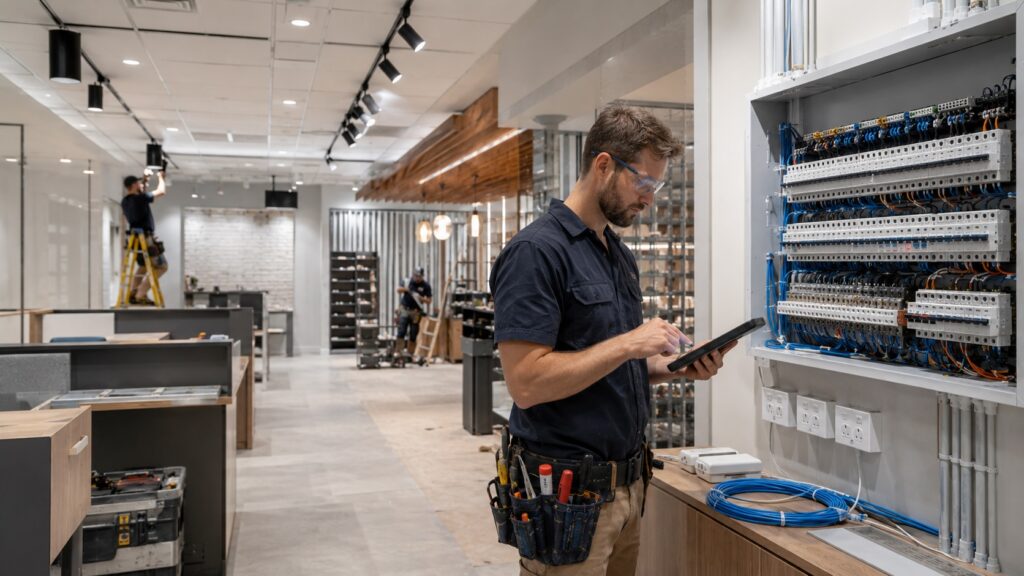
For the electrical side, regular inspection of old wiring dangers helps catch loose connections, corrosion and water entry before they cause faults. This is especially true for coastal properties affected by salt air and summer storms. The local electrician can advise on switchboard upgrades, dedicated EV charger circuits and integrating solar or batteries in a way that supports resilience as well as energy savings.
Simple Outage Kit And Contact List
A simple outage kit and contact list give you quick control when the lights cut out. Store a couple of torches with spare batteries, a small battery lantern and a charged power bank for phones in one easy‑to‑reach spot. Add a manual can opener and some long‑life food in the pantry so you can prepare meals without power. For households with young children, a small box of quiet activities that do not need power can also help.
Write a short list of important numbers and keep it on the fridge and near the switchboard. Include 000 for emergencies, Energex on 13 19 62 for outages and 13 12 53 for general enquiries, your electricity retailer’s contact number, and Sunshine Coast Projects & Electrical on 0400 677 514. Save all of these in your mobile as well, in case you need to call from outside or from a neighbour’s house.
Research on household electricity use patterns, such as an analysis of daily 60-minute interval electricity use in Queensland households, shows how varied and unpredictable residential power demand can be, which is part of why businesses may want to add basic hardware such as uninterruptible power supplies for key IT gear or payment systems. A licensed electrician can size and install these properly so that they carry critical loads long enough for safe shutdown or short outages. That planning keeps trading losses and data risks to a minimum when the grid drops out.
When Is It Worth Talking To An Electrician Before There Is A Problem?
It is worth talking to an electrician before there is a problem whenever you see repeat minor issues or plan to add new loads. Signs include safety switches tripping from time to time, lights dimming when large appliances start, or a very old switchboard still using ceramic fuses. Buying an EV, adding more air conditioning or planning a renovation are also good prompts.
A safety inspection or switchboard upgrade can make a big difference for older Sunshine Coast homes. Local factors such as storms, salt air and vermin in roof spaces can all weaken wiring and connections over time. A licensed electrician can check earthing, circuit sizes and RCD coverage, and recommend practical upgrades that improve both safety and reliability. The Clean Energy Council also advises using accredited installers for solar and battery work, as explained on its page about choosing a quality solar installer.
Sunshine Coast Projects & Electrical offers services that reduce the risk of future faults, including modern switchboards, rewiring of older homes, EV charger circuits and safe integration of solar and batteries to Australian Standards. Remember that laws, standards and tariffs change over time. Always confirm current rules with the Queensland Electrical Safety Office and seek site‑specific advice and quotes instead of relying only on general online guidance.
In Summary
When the power cuts out, a short, calm checklist helps you work out whether you are facing a network outage or a fault at your place. By thinking through the “power outage or fault my house qld” question in that order, you avoid guesswork and limit risk. The aim is never to repair things yourself, only to decide who to call.
Start by checking for danger, then look at neighbours and streetlights to see whether the problem is wider than your home. Use the Energex Outage Finder or Ergon information to confirm any network outages. Inside your property, unplug obvious appliances, observe the switchboard without touching wiring and watch for signs such as partial power, repeated tripping or burning smells.
From there, act on clear rules. Call 000 whenever life or property seems at risk, Energex for problems on the street or network, and a licensed electrician such as Sunshine Coast Projects & Electrical when the signs point to a fault in your installation. Finally, take some time now to put torches, power banks and key contact numbers in one place, and consider a chat with an electrician about your switchboard, EV charger or solar plans. Saving 0400 677 514 in your phone means you have a trusted local to ring the next time something does not look or feel right. Need help with a property-only outage or recurring trip? Call Sunshine Coast Projects & Electrical on 0400 677 514 to book a licensed electrician. Learn more about our electrical services at https://sunshine-coast-electrician.com.au/services/.
Frequently Asked Questions
A power cut from a tripped safety switch often leaves some parts of the house still working. You might notice power dropping only when a certain appliance runs or when one group of outlets stops. At the switchboard, one switch may sit down or halfway. Do not keep resetting it. If it trips again or you are unsure, leave it off and call a licensed electrician.
You should not reset a tripped switch more than once after a power outage. The Queensland Electrical Safety Office warns that repeated resetting of devices that trip means there is a fault that needs professional attention. If there are no signs of burning or damage, one gentle reset is reasonable. If it trips again, leave it off, do not force it on, and call a licensed electrician.
If neighbours’ power is back but your Sunshine Coast home is still dark, first check the Energex Outage Finder to confirm the wider outage has ended. If your area shows as restored, the remaining problem is very likely on your side of the meter. In that case, phone Sunshine Coast Projects & Electrical for help, and contact Energex as well if you can see visible damage at your service line or meter box.
Most grid‑connected solar panels will not keep your lights on during an Energex outage. Standard inverters shut down automatically when the grid fails to protect line workers from back‑feed. Only systems that include properly designed battery backup and dedicated backup circuits can run selected loads during an outage. Check your system manual and speak with a Clean Energy Council accredited electrician, such as Sunshine Coast Projects & Electrical, about your exact setup.
It is not legal to do your own electrical repairs in Queensland on fixed wiring or fittings. The law requires a licensed electrician for work on switchboards, cables, power points, lights and similar equipment. You can still change light globes and plug appliances into sockets. For anything more, use a licensed contractor and check current legal guidance on the Queensland Electrical Safety Office website.