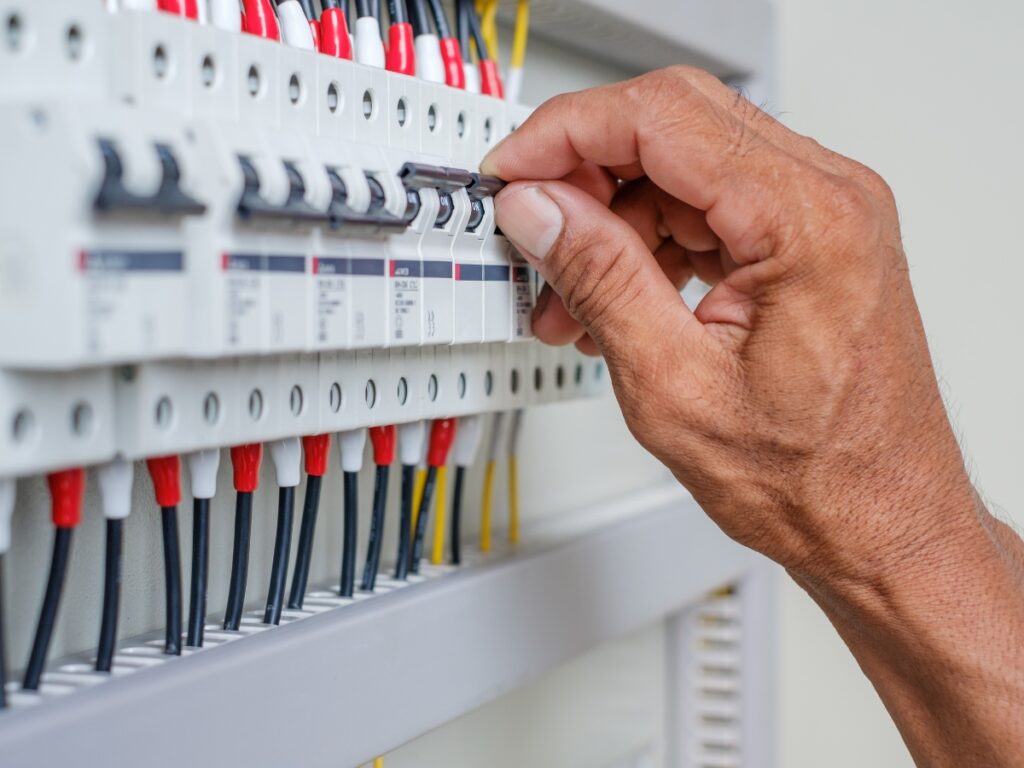
It’s a classic Sunshine Coast scene. You’re running the air conditioner on a humid afternoon, you pop the kettle on, and the kids are on the Xbox. Suddenly, click. The power in half the house cuts out.
With a sigh, you head to the switchboard, flick the little switch back up, and carry on… until it happens again 10 minutes later.
A tripping circuit breaker is one of the most common electrical problems we see in Sunshine Coast homes, from the older Queenslanders in Nambour to the modern builds in Mountain Creek. While it’s tempting to just sigh and reset it, a tripping breaker is a warning sign.
It’s your home’s electrical safety system screaming, “There is a problem!”
Ignoring it, or just “living with it,” is a dangerous gamble. That click is the sound of your switchboard protecting you from a potential electrical fire.
As your local Sunshine Coast electricians, we believe in giving you honest, straight-talking advice. So, let’s break down exactly what’s happening, what it means, and when you need to stop resetting and start calling a professional.
First: Is It a Circuit Breaker or a Safety Switch?
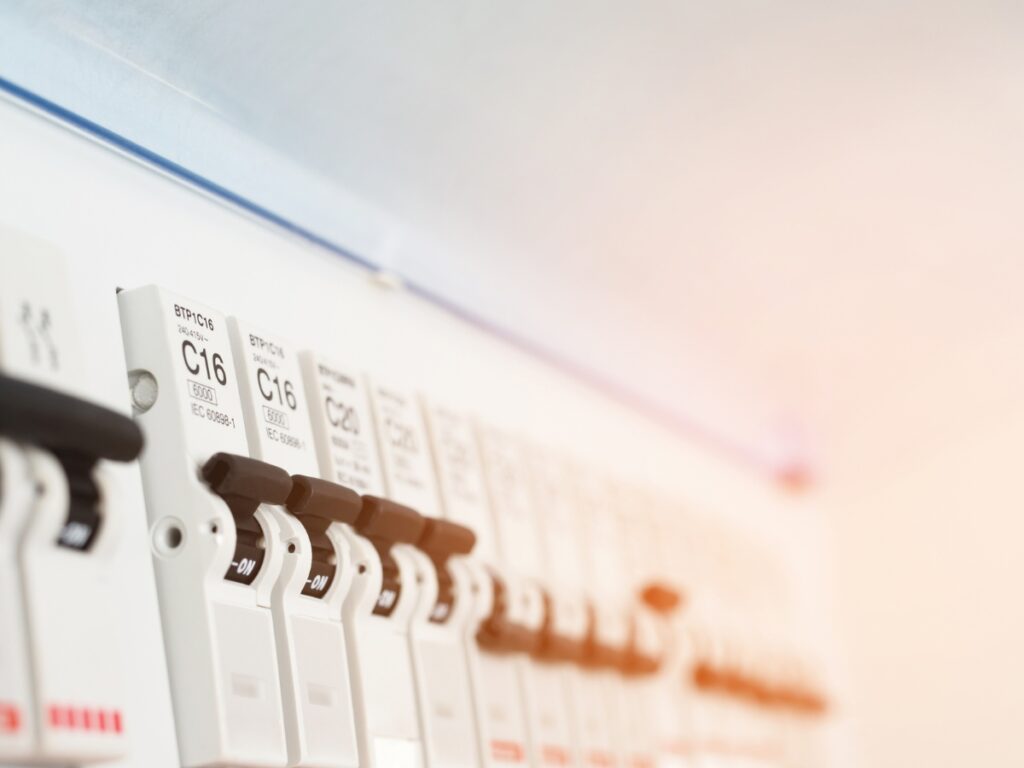
Before we go any further, let’s clear up a major point of confusion. Head to your switchboard. You’ll see rows of switches.
- A Circuit Breaker (or “CB”) is a safety device designed to protect your wiring and appliances from fire. It trips (cuts the power) when it detects a dangerously high flow of electricity. It’s protecting your property.
- A Safety Switch (or “RCD”) is a safety device designed to protect you from electric shock. It has a small “T” or “Test” button on it. It trips when it detects a tiny, dangerous leak of electricity (like the amount that would flow through a person). It’s protecting people.
In Queensland, it’s mandatory to have safety switches protecting your power points, lights, and other circuits.
If the switch that’s tripping has a “Test” button, you have a “safety switch” trip. This is often caused by a single faulty appliance or moisture.
If it’s one of the plain switches without a test button, that’s a circuit breaker tripping. This almost always points to one of the three major problems below.
(For the record: If you can’t reset either of them, you should call an emergency electrician immediately).
The “Big 3” Reasons Your Circuit Breaker is Tripping
When a circuit breaker trips, it’s doing its job. It has detected a fault and has cut the power to prevent the wiring in your walls from overheating and catching fire.
There are three main culprits for a circuit breaker tripping in your Sunshine Coast home.
Cause 1: Circuit Overload (The “Too Much Stuff” Problem)
This is the most common and least “dangerous” reason, but it’s still a serious warning.
- What it is: A circuit overload happens when you try to draw more power from a single circuit than it’s designed to handle. Every circuit (e.g., “Kitchen Power,” “Lights Circuit 1”) is rated for a specific amount of power (amperage).
- The Analogy: Think of it like a single-lane road (the circuit) rated for 10 cars (amps). If 15 cars try to use it at once, you get a traffic jam (overload). The circuit breaker sees this “jam” and shuts the road to prevent a crash (fire).
- The Common Scenario: It’s 5:30 PM. You’re using the electric stovetop, the oven is on, you boil the kettle, and the kids start the microwave. All these high-draw items are on the same “Kitchen” circuit. The total load is too high, and click, the breaker trips.
- The Sunshine Coast Factor: We see this constantly in summer. You’ve got the main split system A/C running, the pool pump kicks in, and you turn on the vacuum cleaner. The combined load is too much for your switchboard, especially in older homes that were never designed for this much power.
What to do: If a breaker trips, unplug all appliances from that circuit. Reset the breaker. Then, plug them back in one by one. When you plug in the “problem” appliance, the breaker will likely trip again. The solution? Try to run your high-power items on different circuits or, better yet, get us to install a new, dedicated circuit for that appliance (like your A/C or dryer).
Cause 2: Short Circuit (The “Dangerous” Problem)
This one is much more serious. A short circuit is a major fault and a significant fire hazard.
- What it is: A short circuit happens when a “hot” (active) wire inside your home’s wiring or in an appliance touches a “neutral” wire.
- The Analogy: Instead of power flowing through the appliance (the “car” driving down the “road”), it takes a “short cut” directly back. This shortcut has almost zero resistance, causing a massive, uncontrolled, and instantaneous surge of electricity—thousands of times higher than normal.
- The Result: The circuit breaker detects this violent surge and snaps off in a fraction of a second to prevent the wiring from melting or bursting into flames. You may hear a “pop,” see a spark, or notice black scorch marks around the power point or appliance plug.
- Common Causes:
- Old, degraded wiring insulation (a big risk in older Sunshine Coast homes).
- A rodent chewing through a cable in the roof.
- A loose wire in a power point or light fitting.
- A serious internal fault in an appliance (like a toaster with a loose element).
What to do: DO NOT just reset the breaker. A short circuit is a physical fault. If you reset the breaker and it immediately trips again, switch it off and leave it off. This is not a DIY fix. You need a licensed electrician for electrical fault finding to locate and repair the short safely.
Cause 3: Ground Fault (The “Shock Hazard” Problem)
A ground fault is similar to a short circuit, but it’s often confused with a safety switch trip—because it should trip your safety switch first.
- What it is: A ground fault happens when a “hot” (active) wire touches a “grounded” part of the appliance (like the metal casing) or the ground wire in your home’s wiring.
- The Analogy: The electricity “leaks” out of its proper path and tries to find a shortcut to the earth.
- The Danger: This is a major shock hazard. If the electricity leaks to the metal casing of your toaster, the next person to touch it will become the path to the ground, resulting in a severe or fatal electric shock.
- What Should Happen: Your safety switch (RCD) is designed to detect this exact scenario. It will see the “leak” and trip instantly, long before the circuit breaker even notices.
What it means if your Circuit Breaker trips from a ground fault: If you don’t have a safety switch on that circuit (common for lights or A/C in older homes), the fault is so severe that it’s drawing enough power to trip the main circuit breaker. This is an extremely dangerous situation.
What to do: This is an urgent safety issue. Contact your local electrician right away. It’s a sign your wiring is faulty and your home is missing critical, life-saving protection.
What to Do: A Simple Troubleshooting Test
If your power cuts out, follow these steps in order.
- Stop & Look: Go to your switchboard. Which switch tripped? Is it a Circuit Breaker (no test button) or a Safety Switch (with a test button)?
- The “Safety Switch” (RCD) Fix:
- Unplug Everything: Go through the house and unplug every single appliance on the circuit that’s off (e.g., all kitchen appliances, all lounge room electronics).
- Reset: Go back and reset the safety switch. If it stays on, the problem is one of your appliances.
- Isolate: Go back and plug in your appliances one by one. Plug in the kettle… wait 30 seconds. Plug in the toaster… wait 30 seconds. When you plug in the “faulty” appliance, the switch will trip.
- Solution: That last appliance is faulty. Do not use it again.
- The “Circuit Breaker” (Overload) Fix:
- Unplug High-Power Items: Did the trip happen when you turned on the A/C or the kettle? Unplug that high-power item.
- Reset: Reset the circuit breaker.
- Solution: If it stays on, you’re overloading the circuit. Try to use that appliance on a different power point in another room. If this happens constantly, you need a switchboard upgrade or a new circuit.
- The “Circuit Breaker” (Short Circuit) Fix:
- Reset: Try to reset the breaker.
- If it trips instantly (with a “pop” or “snap”): You have a short circuit. Stop. Do not try again. Leave the breaker OFF and call an electrician. This is a fire hazard.
Don’t Risk It: When to Call the Pros
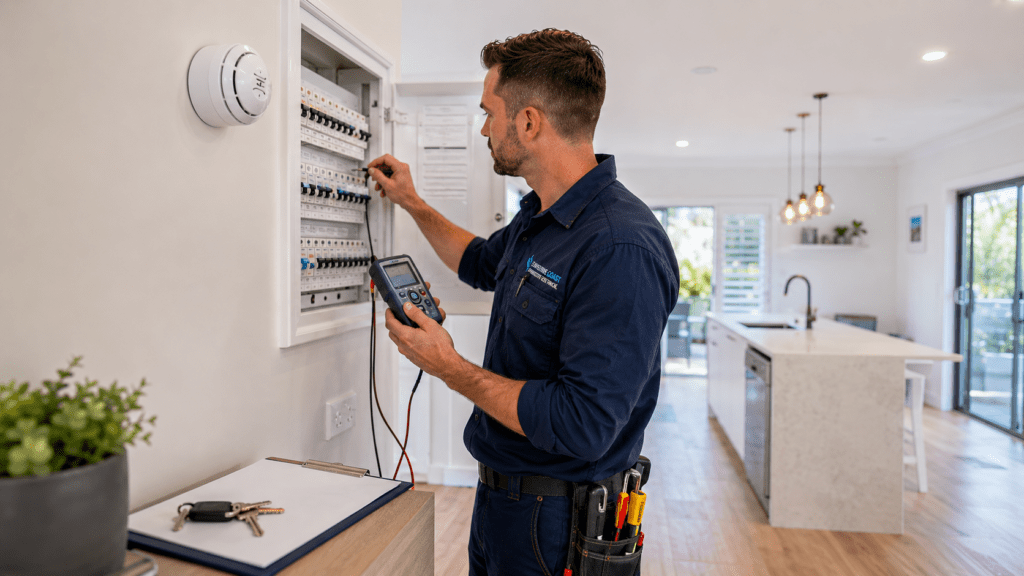
You can reset a breaker, but you can’t fix a fault. As a team of licensed, professional electricians, we have the diagnostic tools and experience to find the real problem.
Call Sunshine Coast Projects & Electrical immediately if:
- The breaker trips instantly, every time you reset it.
- You smell burning plastic or a “fishy” smell from the switchboard.
- You see scorch marks or melted plastic on a power point or the switchboard.
- Your lights are flickering wildly, even after a reset.
- You just don’t feel safe or aren’t sure what to do.
Our team provides transparent, upfront pricing and is known for our tidy, reliable work. We’re not here to just flip a switch; we’re here to find the fault, fix it for good, and ensure your Sunshine Coast home is safe for your family.
Don’t ignore the warning signs. Contact us today for an electrical safety inspection or a same-day call-out for urgent faults.
Circuit Breaker FAQ (Frequently Asked Questions)
Q: Why does my circuit breaker trip when it rains? A: This is almost always caused by moisture getting into an outdoor power point, light, or a leak in your roof that’s hitting your wiring. This creates a ground fault. Your safety switch should trip first. If it doesn’t, or if the breaker itself trips, call an electrician immediately as this is a serious shock and fire risk.
Q: How often should I test my safety switches? A: The Queensland Electrical Safety Office recommends you test your safety switches (the ones with the ‘T’ button) every three months. Just press the “Test” button—it should trip the power to that circuit. If it doesn’t, it’s faulty and needs to be replaced.
Q: Is a constantly tripping breaker a sign I need a switchboard upgrade? A: Yes, it’s one of the biggest signs. If your breakers are tripping from simple overloads (like running a kettle and a toaster), it’s a clear signal your switchboard is old, overloaded, and wasn’t designed for modern life. A switchboard upgrade will give you the capacity you need and protect your home with safety switches on all circuits.
Q: Can a faulty appliance damage my wiring? A: Yes. A faulty appliance that causes a short circuit can send a massive surge of power through your wiring, melting the insulation and creating a fire risk inside your walls. This is exactly what the circuit breaker is designed to prevent, but relying on it to catch faults is a bad strategy. If you suspect an appliance is faulty, stop using it.