Sunshine Coast ceiling fan installation must be completed by a licensed electrician in Queensland to stay safe, compliant and insured. A professionally installed ceiling fan helps manage the region’s warm, humid climate, improve airflow and reduce cooling costs without risking faulty wiring, unsafe mounting, voided warranties or insurance issues.
This guide will walk you through everything you need to know about ceiling fan installation on the Sunshine Coast. We cover everything from understanding local requirements to choosing the right fan and setting up a safe, efficient system. Partner with a local expert like Sunshine Coast Projects & Electrical for reliable service and peace of mind.
Let’s get started on finding the best cooling solution for your home.
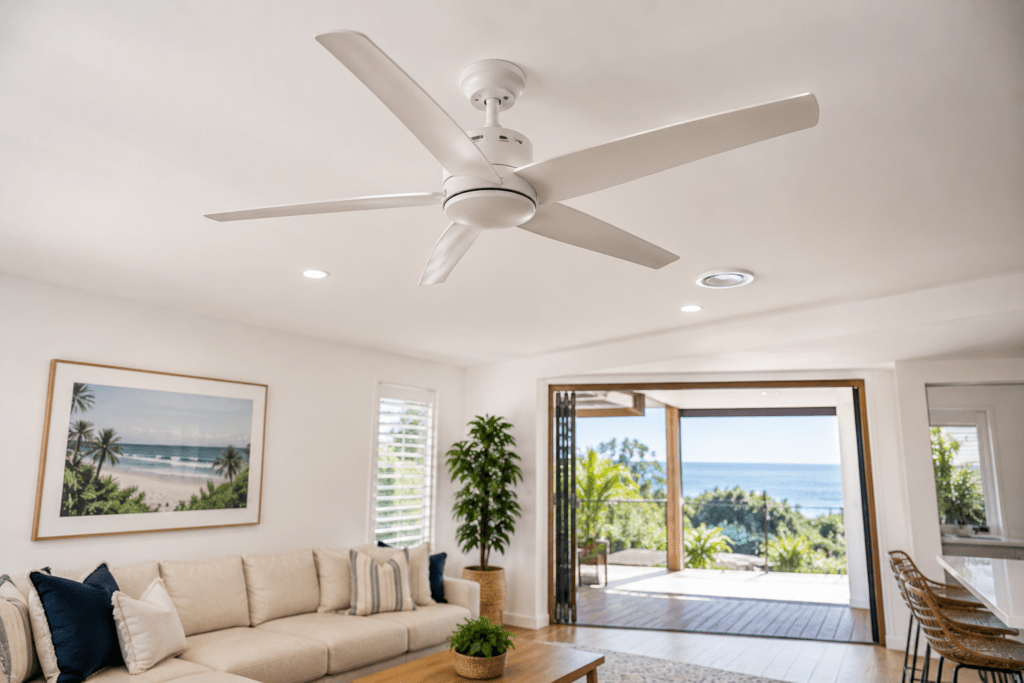
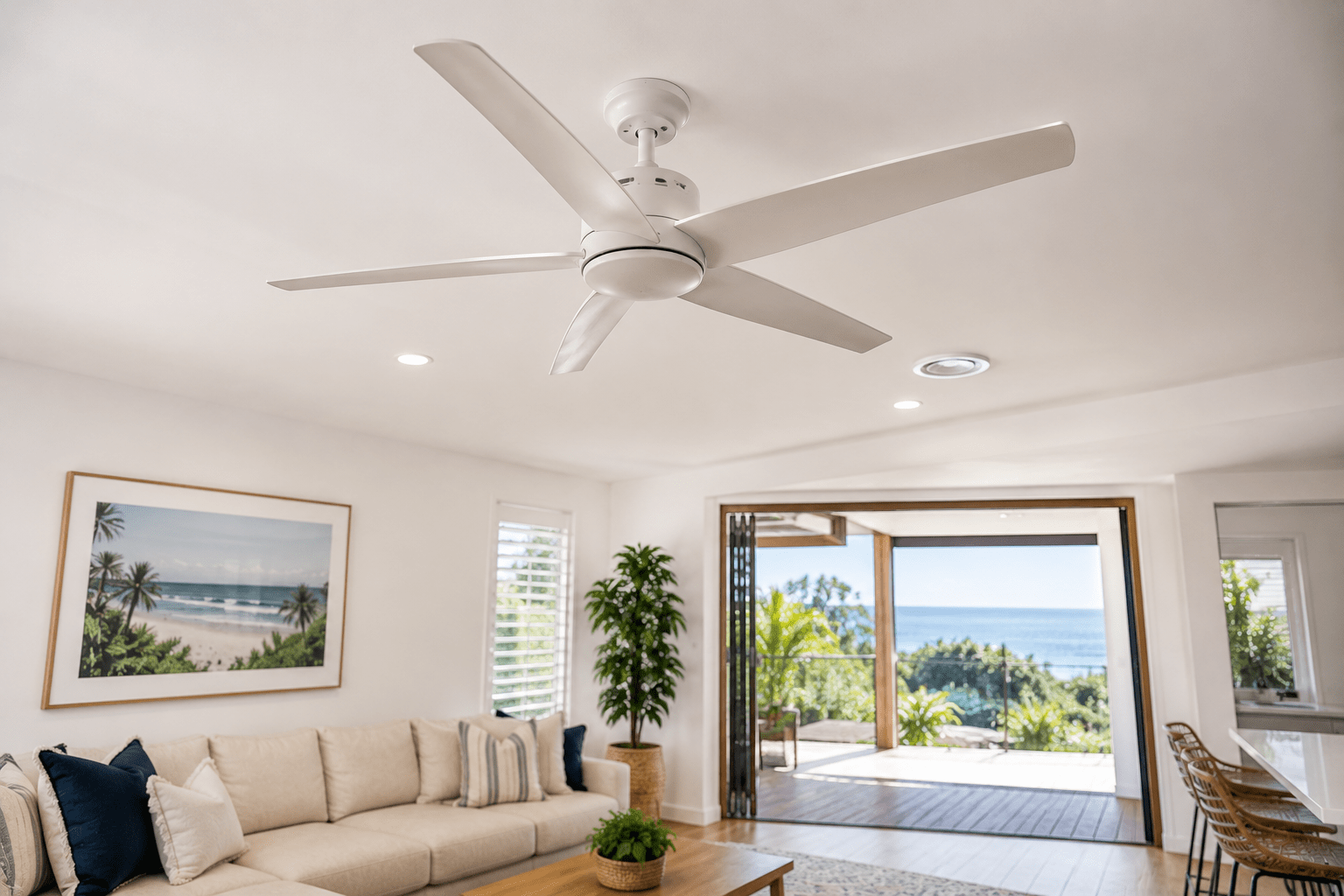
A realistic, professional image of a modern ceiling fan installation in a bright Sunshine Coast home. Show a stylish ceiling fan securely installed in a clean coastal-style living room or bedroom with natural light, white walls, timber flooring and relaxed Australian interior styling. Include subtle details such as neat electrical finishing, balanced fan blades and an airy, comfortable atmosphere. The scene should feel cool, safe, energy-efficient and professionally installed. High-quality realistic photography style.
Key Takeaways
-
Licensed electricians are legally required for ceiling fan installation in Queensland to maintain safety and compliance with Australian Standards.
-
Proper fan selection is essential for coastal conditions, considering factors like size for the room, blade material to resist salt air, and motor type for energy efficiency.
-
Professional installation means that the fan is structurally secure, wired correctly, and operates at peak performance, preventing hazards like wobbling or electrical faults.
-
Ceiling fans offer substantial energy savings over air conditioning, with modern DC models costing as little as 0.5 cents per hour to run.
-
Understanding how to use seasonal modes and performing regular maintenance can maximise your fan’s efficiency and extend its operational lifespan.
Jump to section
- Why Is Professional Ceiling Fan Installation Critical on the Sunshine Coast?
- Choosing the Right Ceiling Fan for Your Sunshine Coast Home
- The Professional Ceiling Fan Installation Process: What to Expect
- Understanding Ceiling Fan Costs and Energy Efficiency on the Sunshine Coast
- Maximising Comfort: Operation, Maintenance, and Troubleshooting
- Powering a Safer, Cooler Home
- Frequently Asked Questions
Why Is Professional Ceiling Fan Installation Critical on the Sunshine Coast?
A professional ceiling fan installation is essential for Sunshine Coast homes, providing both safety and legal compliance. Queensland’s laws are very clear that all fixed electrical wiring must be handled by a licensed professional to avoid serious risks like electrical fires or personal injury. Beyond the legal requirements, an expert installation accounts for the specific challenges of our coastal environment.
The process of installing a ceiling fan involves more than just connecting a few wires. A qualified electrician from a company like Sunshine Coast Projects & Electrical will assess the structural integrity of your ceiling to make sure it can support the fan’s weight and motion. They also confirm that your home’s electrical circuits can handle the additional load, preventing overloaded systems. This professional oversight means your fan operates safely, efficiently, and provides optimal comfort for years to come.
Do I Need a Licensed Electrician to Install a Ceiling Fan in Queensland?
Yes, you are legally required to use a licensed electrician for ceiling fan installation in Queensland. Any work involving fixed electrical wiring falls under the strict regulations of the AS/NZS 3000 Wiring Rules. Attempting this job yourself is illegal and carries significant risks that far outweigh any potential cost savings. The dangers of DIY electrical work include electrocution, house fires, and causing damage to your home’s electrical system.
Furthermore, a DIY installation will immediately void the manufacturer’s warranty on your new ceiling fan. It will also invalidate your home and contents insurance policy, meaning you would not be covered for any damage or injury resulting from the faulty installation. At Sunshine Coast Projects & Electrical, our licensed electricians provide an Electrical Certificate of Compliance (ECOC) after every job. This document is your proof of a safe, compliant installation, protecting you from legal issues and maintaining your family’s safety with over 20 years of local expertise.
What Are the Safety Considerations for Ceiling Fan Installation?
Safety is the most important factor in any ceiling fan installation. A professional electrician addresses several key safety points that a DIY approach cannot offer. First is the structural support; ceiling fans are heavy and generate constant force while spinning. They must be mounted directly to a solid timber beam or a purpose-installed structural noggin, never just to plasterboard, which can easily give way. Our team at Sunshine Coast Projects & Electrical conducts rigorous checks to confirm a rock-solid mounting.
Next is the electrical load and wiring. In many older Sunshine Coast homes, existing wiring or switchboards may not be prepared to handle new appliances safely. We assess your home’s circuitry to prevent overloads and can perform switchboard upgrades if needed. Finally, there are legal clearance requirements. A ceiling fan’s blades must be at least 2.1 metres from the finished floor level. For rooms with lower ceilings, we can recommend and install specific low-profile models to meet this standard without compromising safety.
Choosing the Right Ceiling Fan for Your Sunshine Coast Home
Selecting the perfect ceiling fan for your Sunshine Coast property is about balancing performance, durability, and style. The right choice involves considering the motor technology, whether you need integrated lighting, and its ability to withstand our humid, salty coastal air. For instance, an outdoor fan for a patio requires different specifications than one for a bedroom.
The physical attributes of the fan, such as its diameter and the materials used for the blades, are also very important for its performance and longevity, as highlighted in Affordable Near- and Medium-Term research on integrating efficient cooling solutions in residential buildings. An appropriately sized fan will circulate air effectively without being overpowering, while the right materials will resist rust and warping. A knowledgeable local electrician can provide advice to help you make the best choice for each room in your house.
Which Type of Ceiling Fan Suits Coastal Conditions Best?
For our coastal environment, choosing the right type of ceiling fan is key to both performance and longevity. DC (Direct Current) motor fans are a fantastic choice, as they use up to 70% less energy than traditional AC (Alternating Current) models, operate almost silently, and offer more speed settings. Their efficiency makes them perfect for keeping power bills down during long, warm summers. For outdoor areas like patios and verandahs, you must choose a fan with a high IP (Ingress Protection) rating, which certifies it is built to resist moisture and salt spray.
When it comes to lighting, modern fans with integrated LED panels offer a sleek, dual-purpose approach, serving as both a light source and a cooling appliance. If you prefer a fan without a light to pair with downlights, placement is important to avoid a flickering “strobe” effect. Remote-controlled fans are another great option, especially for homes with solid ceilings or apartments where running new switch wires is difficult or impossible. They simplify the ceiling fan wiring process by using the existing light wiring for power.
How Do I Select the Correct Size and Material for My Ceiling Fan?
Choosing the correct size and material means your ceiling fan performs efficiently and lasts for years in the Sunshine Coast climate. For standard bedrooms, we now recommend a 1320mm (52-inch) diameter fan for superior airflow. For larger living rooms, open-plan spaces, or outdoor areas, a fan with at least a 1400mm (56-inch) diameter is best to make sure air circulates throughout the entire space. An undersized fan will only cool a small area directly beneath it.
Material selection is perhaps the most important decision for longevity. We strongly recommend polycarbonate (ABS plastic) blades. They are completely resistant to the coastal air and will not rust, warp, or discolour. Timber blades can absorb moisture and swell, while even stainless steel fans often show rust within a few years on the coast. Finally, look at the fan’s airflow rating, measured in cubic metres per hour (m³/hr). A rating above 14,000 m³/hr indicates excellent performance. Remember, airflow and blade pitch are more important than the number of blades. The team at Sunshine Coast Projects & Electrical can help you choose the best fan for your home’s needs.
The Professional Ceiling Fan Installation Process: What to Expect
Understanding the professional ceiling fan installation process helps set clear expectations and builds confidence in the work being done. The process always begins with a detailed assessment of your home’s structure and electrical system to maintain a safe and compliant installation. This initial step is vital for identifying any potential issues before the work begins.
From there, the focus shifts to meticulous mounting and precise wiring to confirm the fan operates flawlessly. A professional electrician will handle every step with care, from securing the mounting bracket to testing the fan’s balance and functionality. This means your new appliance is not only safe but also provides optimal cooling performance and has a long operational life.
What Happens During a Ceiling Fan Installation?
During a professional ceiling fan installation, our licensed electrician follows a careful, step-by-step process. The first step is a pre-installation assessment where we inspect the existing wiring, the structural support in your ceiling, and the current light switches. We then securely mount the fan’s heavy-duty bracket directly into solid timber, as attaching it to plasterboard is unsafe and will lead to failure. We use heavy-duty 12-gauge screws to make sure it can handle the fan’s weight and movement.
Next, we run any necessary new wiring or configure the receiver for a remote-controlled unit, making sure all connections adhere strictly to the AS/NZS 3000 standards. Once the wiring is complete, the fan is assembled and securely hung from the bracket. The final stage involves thorough functional testing. We check all speeds, test the light if it has one, and balance the blades with a precision kit to eliminate any wobble or vibration, providing smooth, quiet operation.
When Is It Time to Replace or Relocate an Existing Ceiling Fan?
Knowing when to replace a ceiling fan can save you from potential hazards and improve your home’s energy efficiency. Clear signs that it’s time for an upgrade include persistent wobbling that cannot be fixed, loud humming or clicking noises from the motor, or blades that have started to rust or buckle. If the fan runs at its highest speed but barely moves any air, it’s a sure sign the motor is failing and it’s time for a modern, efficient replacement.
Relocating a fan is a smart choice when the unit is still in good working order but is poorly positioned in the room. This often happens after a room layout changes. Relocation can drastically improve airflow and comfort while saving you the expense of buying a new fan. Sunshine Coast Projects & Electrical also offers complete removal services, which are useful during major renovations or if you are switching to a ducted air conditioning system. This service includes safely disconnecting the unit and can include plaster patching to leave your ceiling looking perfect.
Understanding Ceiling Fan Costs and Energy Efficiency on the Sunshine Coast
When considering a ceiling fan installation, it is helpful to understand both the initial cost and the long-term energy savings. The cost for a standard installation is transparent, though it can vary based on the fan you choose and the specifics of your home’s wiring. This investment quickly pays for itself through lower energy bills.
Ceiling fans are a remarkably budget-friendly and eco-friendly way to cool your home, especially when compared to air conditioning. Their low energy consumption means you can stay comfortable during the warm Sunshine Coast months without worrying about high electricity costs. This makes them a smart addition to any home looking for sustainable and affordable cooling.
How Much Does Ceiling Fan Installation Cost on the Sunshine Coast?
The cost for a professional ceiling fan installation on the Sunshine Coast typically ranges between $120 and $350 per fan. The final price depends on a few factors. These variables include the type and complexity of the fan itself, the accessibility of your ceiling cavity and wiring, and whether new wiring runs are needed to power the fan and a separate light switch. Ceiling height and any need for extra structural support can also influence the cost.
At Sunshine Coast Projects & Electrical, we believe in complete transparency. That is why we provide fast, free, and obligation-free quotes before any work begins. Our upfront pricing means you know exactly what to expect, with no hidden surprises or fees. This approach allows you to budget effectively for your home cooling project.
What Are the Energy Savings of Using Ceiling Fans vs. Air Conditioning?
The energy savings from using ceiling fans instead of air conditioning are substantial. According to Canstar Blue, a split system air conditioner can cost between 25 and 97 cents per hour to run. In contrast, a traditional AC ceiling fan costs about 1.8 cents per hour, while an ultra-efficient DC fan costs a mere 0.5 cents per hour. Over a summer, this difference can add up to hundreds of dollars in savings.
We often recommend a “hybrid cooling strategy” to our clients. This approach uses ceiling fans as the daily workhorses for consistent, affordable cooling, reserving the air conditioner for the most intense heatwaves. This combination maximises comfort while drastically reducing your power bills. Choosing ceiling fans is a simple way to adopt a more eco-friendly and sustainable cooling solution for your home.
Maximising Comfort: Operation, Maintenance, and Troubleshooting
To get the most out of your ceiling fans, it is important to know how to operate them correctly and perform basic maintenance. Properly using features like seasonal modes can improve your comfort year-round and even improve your home’s heating efficiency during cooler months. A little bit of proactive care goes a long way.
Additionally, being able to identify common issues can help you know when to call a professional for a quick fix. Understanding the causes of problems like wobbling or unusual noises can extend the life of your fan and mean it continues to perform as it should. This knowledge empowers you to maintain a comfortable and efficient home environment.
How Do Summer and Winter Modes Optimise Ceiling Fan Use?
Most modern ceiling fans come with a reverse function that makes them useful throughout the entire year. This feature allows you to change the direction the blades spin to optimise airflow for both cooling and heating, saving energy in every season. This simple switch changes your fan from a summer staple to a year-round efficiency tool.
In summer, the blades should rotate anti-clockwise. This motion pushes cool air directly downwards, creating a pleasant wind-chill effect that makes you feel cooler. During winter, you can switch the fan to rotate clockwise. This gently pulls the cooler air from the floor upwards and pushes the warm air that has risen and become trapped at the ceiling down the walls, helping to circulate heat more effectively without creating a cold draught. The team at Sunshine Coast Projects & Electrical can show you how to operate this feature on your new fan.
What Are Common Ceiling Fan Issues and How Are They Addressed?
Even high-quality ceiling fans can develop issues over time. Wobbling is the most common complaint, but it is rarely a defect in the fan itself. It is almost always caused by an installation issue, such as a loose mounting bracket, incorrect screws, or a slight imbalance in the weight of the blades. A professional can quickly diagnose and fix the root cause.
Excessive noise like humming or clicking can point to mechanical wear in the motor’s bearings or loose wiring inside the canopy that is tapping against moving parts. If you have very high or vaulted ceilings and are getting poor airflow, the problem is likely the fan’s height. In these cases, installing an extended downrod (often 900mm long) lowers the fan to an effective height. Sunshine Coast Projects & Electrical has the expertise to troubleshoot and resolve these common issues safely and effectively.
Powering a Safer, Cooler Home
A professional, compliant, and efficient ceiling fan installation is one of the smartest investments you can make for your Sunshine Coast home. It improves comfort, reduces energy bills, and makes sure your family’s safety. At Sunshine Coast Projects & Electrical, we are committed to providing the highest quality service backed by decades of local experience.
For expert advice, installations, or upgrades, our team is here to help. Contact Sunshine Coast Projects & Electrical today for your obligation-free quote and let us help you power a safer, cooler home.
Frequently Asked Questions
Question: Is it legal to install a ceiling fan myself in Queensland?
No, it is strictly illegal for an unlicensed person to perform any fixed electrical work in Queensland, including installing a ceiling fan. This work must be done by a licensed electrician to comply with Australian law (AS/NZS 3000), maintain safety, and keep your home insurance and product warranties valid.
Question: How long does a typical ceiling fan installation take?
A standard ceiling fan installation, where wiring and structural support are already in place, usually takes between one and two hours per fan. More complex jobs that require new wiring runs, a new switch, or structural reinforcement in the ceiling may take longer. We provide a time estimate with our quotes.
Question: Can I install a ceiling fan with a light where there’s only a light fitting now?
Yes, this is usually possible. However, it requires a professional assessment to make sure there is adequate structural timber above the ceiling to support the fan’s weight. Additionally, you may need new wiring to control the fan and light independently from the wall, unless you choose a remote-controlled model which simplifies this process.
Question: Are outdoor ceiling fans safe to use in the salty Sunshine Coast air?
Yes, but only if you choose a model specifically rated for outdoor or coastal use. These fans have high IP ratings and are made from marine-grade materials like polycarbonate (ABS plastic) that resist rust, corrosion, and humidity. Using a standard indoor fan in an outdoor setting is unsafe and will lead to rapid deterioration.
Question: What’s the best way to control my new ceiling fan?
The best control method depends on your preference. Traditional wall controls offer simple, reliable operation. However, modern remote controls, which come standard with most DC fans, provide greater convenience, allowing you to change speeds and settings from anywhere in the room. Some advanced models even offer smart-home integration for control via an app.
Question: My old fan is wobbling and making noise. Should I fix it or replace it?
It’s best to have a professional assess the fan. Wobbling and noise often point to installation or mechanical issues with mounting or bearings. In many cases, the cost to repair an old, inefficient AC motor can be close to the cost of installing a brand new, quieter, and more energy-efficient DC fan, making replacement the better long-term option.
Question: Why do Sunshine Coast Projects & Electrical recommend a “hybrid cooling strategy”?
Our “hybrid cooling strategy” combines ceiling fans and air conditioning to create the most efficient and comfortable home environment. We suggest using ceiling fans as your primary, low-cost cooling solution for daily use, and reserving your power-hungry air conditioner for extreme heatwaves. This approach provides maximum comfort while keeping your electricity bills as low as possible.