Rental property electrical compliance QLD duties require landlords and property managers to provide safe electrical installations, arrange prompt repairs and use licensed contractors. Safety switches, smoke alarms, switchboards, appliances supplied with the tenancy and maintenance records all need appropriate attention. Requirements vary by property and circumstance, so documented inspections and current Queensland guidance are essential.
For a concise answer: Queensland landlords, property managers, strata bodies and holiday rental owners must provide rental homes that are electrically safe, with compliant smoke alarms and safety switches, safe fixed wiring and appliances, and a reliable process for maintenance and fault response, using only licensed electricians and keeping good records.
This guide breaks down those checks into a simple checklist for houses, units, holiday rentals and strata properties across the Sunshine Coast. You will see what the law actually requires, what smart landlords do on top, and how records, inspections and clear fault procedures protect both tenants and your investment. Sunshine Coast Projects & Electrical provides many of the audits and upgrades discussed here, but the focus is squarely on helping you understand your responsibilities. Read on for a clear, practical roadmap you can adapt to each property.
Key Takeaways
-
Landlords and property managers in Queensland must keep rental homes electrically safe under the Electrical Safety Act and tenancy laws. This covers fixed wiring, switchboards, safety switches, smoke alarms and any hard wired appliances supplied with the lease. Compliance is not a one off job, since wear, storms and added loads change risk over time.
-
Smoke alarms and safety switches are the most important devices for rental property electrical compliance QLD. You need interconnected photoelectric alarms in all required locations and safety switches on power circuits at a minimum. Insurers and the Electrical Safety Office strongly encourage extra coverage for lighting and high risk circuits such as pools and air conditioning.
-
A simple inspection and maintenance routine goes a long way to keeping properties safe. Regular electrical checks, smoke alarm tests, safety switch tests and appliance servicing help catch small issues before they become dangerous. Written plans and logs turn this into a repeatable process instead of guesswork.
-
Emergency electrical faults and tenant reports need clear, fast handling. Shocks, tingles, burning smells and repeated tripping sit in the emergency repair category under Queensland rental law. Owners and property managers should provide clear contact details, record each report and arrange a licensed electrician promptly.
-
When you need extra help, a local licensed contractor can audit properties, upgrade older switchboards and bring alarms and safety switches up to current standards. On the Sunshine Coast, Sunshine Coast Projects & Electrical offers rental compliance checks, upgrades and emergency fault response that slot neatly into the checklist in this guide.
What Does Rental Property Electrical Compliance In QLD Actually Involve?
Rental property electrical compliance in Queensland means keeping every rental property electrically safe, legal and properly maintained. It covers how smoke alarms, safety switches, wiring, switchboards, fixed appliances and electrical records line up with state law and tenancy rules. For landlords, bodies corporate and property managers across the Sunshine Coast, that means treating electrical safety as an ongoing duty, not just a box to tick at lease start.
Two laws sit at the heart of this duty. The Electrical Safety Act 2002 and its Regulation cover how electrical work is carried out, licensing, safety switches and what counts as unsafe electrical risk. The Residential Tenancies and Rooming Accommodation Act 2008 (RTRA Act) requires rental homes to be safe, in good repair and not in breach of any health or safety law, which includes electrical safety and minimum housing standards. Taken together, they expect you to know about likely hazards, organise licensed repairs and avoid cutting corners that could hurt someone.
On top of the legal baseline, there is best practice and insurer expectation. Best practice might mean safety switches on all circuits, more frequent checks in older Queenslanders or holiday rentals, and combining smoke alarm and electrical inspections between tenancies. Insurers often look at this when deciding how to treat claims after a fire or shock incident. Since legal minimums can be different from what insurers and risk managers see as sensible, it pays to understand both.
Legal Framework And Who Is Responsible
The legal framework for rental property electrical compliance QLD rests on a mix of electrical and tenancy laws. The Electrical Safety Act 2002 and Electrical Safety Regulation cover licensing, safe work, safety switches and penalties for behaviour that puts people at risk from electricity. The RTRA Act 2008 and minimum housing standards require rental properties to be safe, in good repair and not in breach of any safety law, including electrical rules.
In most cases, the landlord is treated as the person conducting a business or undertaking, often called a PCBU, for the purpose of the Electrical Safety Act. That means the owner holds overall responsibility for managing electrical risk, even if a property manager looks after day to day matters. Property managers act as the owner’s agent by arranging inspections, repairs and access, but they do not remove the owner’s legal accountability.
Tenants have duties as well. They must take reasonable care for their own safety, use electrical fittings properly, report faults promptly and allow access for inspections and repairs when given correct notice. The Residential Tenancies Authority (RTA) and Queensland Civil and Administrative Tribunal (QCAT) can deal with disputes where tenants claim the property is unsafe or repairs are delayed. For current legal wording, owners should check official sources such as the RTA and Queensland Government websites and treat this article as general information, not formal legal advice.
Types Of Rental Properties And Risk Profiles
Different types of Queensland rentals face different electrical risks, even though the laws are the same. A standard three bedroom house in a suburb like Buderim or Nambour might have modern wiring and safety switches, while an older Queenslander in inner Maroochydore may still have ceramic fuses and limited RCD coverage, a mismatch highlighted in comparative research on energy efficiency and mould risk across different external wall systems in low-rise Australian homes. Both must be electrically safe, but the older property often needs closer attention.
Holiday rentals and short stay properties around Noosa, Mooloolaba or Caloundra usually have higher guest turnover and more intensive use of appliances. Guests are less familiar with the home, so there is less room for confusing switchboards or half working smoke alarms. Owners of these properties still fall under the Electrical Safety Act and are treated as running a business, so frequent checks and strong documentation make sense.
Strata and body corporate settings add shared areas to the mix. Common property such as pool equipment rooms, carpark lighting and lift motor rooms usually sit under the body corporate, while lots have their own switchboards and smoke alarms. That means strata managers and committees must think about compliance both inside lots and in shared plant. The checklist in this guide applies across these property types, but the frequency and depth of checks should scale with age, usage and risk.
How Do You Check Smoke Alarm Compliance In A Queensland Rental?
Checking smoke alarm compliance in a Queensland rental means confirming that alarm type, placement, power supply and interconnection all match current rules. It also means checking that testing, cleaning and record keeping routines match what Queensland Government and Queensland Fire and Emergency Services (QFES) recommend. Smoke alarms sit alongside safety switches as the most important safety devices in rental property electrical compliance QLD.
Since 2022, Queensland has some of the strictest smoke alarm laws in Australia. According to the Queensland Government smoke alarm guidance, rental homes must have photoelectric, interconnected alarms in all bedrooms, in connecting hallways and on every level of the dwelling, with alarms either hardwired or fitted with a sealed 10 year battery. Older ionisation alarms and simple 9 volt battery alarms no longer meet rental standards. Owners must bring properties up to this standard before entering into a new lease or renewing an existing one.
Legal Requirements For Smoke Alarms In QLD Rentals
Queensland smoke alarm rules for rentals focus on photoelectric technology, interconnection and correct placement. Photoelectric alarms detect visible smoke and respond well to smouldering fires, which is why the Queensland Government and QFES moved away from older ionisation models. In a compliant rental, when one alarm activates, all alarms throughout the dwelling sound together, so tenants in every bedroom hear the warning.
Placement rules are also clear. Alarms must sit in every bedroom, in the hallways that link bedrooms to the rest of the home and on each storey, even where there are no bedrooms on that level. Power can come from hardwired mains supply with a backup battery or from a sealed 10 year lithium battery pack. Standard replaceable 9 volt battery models no longer meet the requirements for rental homes.
New and renewed leases must meet the current standard, which aligns with Australian Standard AS 3786:2014, as noted on the Queensland Government smoke alarm page at:
-
Queensland Government smoke alarm laws: https://www.qld.gov.au/emergency/safety/smoke-alarms
Owners should check that page for current detail, because standards and dates can change. Anything that goes beyond this, such as extra alarms in living rooms, falls under best practice rather than strict law, but many owners choose to add them.
Smoke Alarm Testing, Records And Common Compliance Gaps
Legal requirements only work if alarms stay in working order, so testing and record keeping matter. Owners must provide a property with working, compliant alarms before a lease starts and arrange replacement when devices reach the end of their service life, usually 10 years from manufacture. Tenants are expected to press the test button regularly, keep alarms free of dust and report beeping, faults or missing units promptly.
During routine inspections, property managers can run a simple check by pressing the test button on each alarm and listening for all units to sound. They should also look at the manufacture dates and note when alarms will need replacement. A smoke alarm compliance certificate from a suitably qualified person gives a clear record of what is installed, where it sits and when it was last checked, and it should be stored in agency software and owner files.
Common gaps found across Queensland include one bedroom with no smoke alarm, alarms that are not actually interconnected, old 9 volt battery alarms still present in corners and alarms disabled because of nuisance beeping near kitchens or bathrooms. A licensed electrician can design and install a fully compliant system, and on the Sunshine Coast, Sunshine Coast Projects & Electrical often combines this work with broader electrical checks so landlords have aligned smoke alarm and electrical records.
What Safety Switches (RCDs) Are Required For Queensland Rental Properties?
Safety switches, often called residual current devices or RCDs, are devices that trip quickly when they detect current leaking to earth, which helps prevent electric shock. For a Queensland rental, having the right safety switches in place is a core part of rental property electrical compliance QLD. The law sets a minimum coverage level, and regulators strongly encourage owners to go further for better protection.
Under Queensland law, all power point circuits in rental homes must have safety switches installed. For older homes, including many built before 1992, that may not have been the case at construction, so owners had obligations to add safety switches at sale or when preparing new tenancy agreements. The Electrical Safety Office explains that installing and testing these devices is licensed electrical work and that owners who ignore safety switch rules can face fines.
Legal And Best-Practice Safety Switch Coverage
At a base level, a compliant Queensland rental has safety switches on every power point circuit. This means general power outlets in bedrooms, living areas, kitchens and outdoor areas sit behind RCD protection at the switchboard. Owners who discover that a rental has no safety switch on power circuits must arrange installation by a licensed contractor as soon as they reasonably can, rather than waiting for a convenient time.
Regulators and many insurers now expect safety switches on more than just general power. The Electrical Safety Office and many industry groups suggest fitting RCDs on lighting circuits and on high risk circuits such as pool pumps, outdoor power and air conditioning systems. Newer homes already have that level of coverage built into their switchboards as standard practice, because modern wiring rules take a broad view of where RCDs should go.
Here, it helps to distinguish legal requirements from strong recommendations:
-
Power circuits fall into the must category under current law.
-
Lighting circuits and other dedicated circuits fall into the should category for many existing homes, but they may become musts when circuits are modified or when new equipment such as an electric vehicle charger is added.
Owners who go beyond the bare minimum usually give themselves a safer home and a stronger position with insurers.
Testing Safety Switches And When To Upgrade The Switchboard
Even the best safety switch is not set and forget. The Electrical Safety Office advises that push button testing should occur roughly every three months, with the person responsible pressing the test button on each RCD to check that it trips and then resetting it once power is off. This simple test can be done by tenants or owners, but the tenancy agreement should clearly state who will do it so there is no confusion.
In settings such as commercial tenancies, multi unit complexes or high risk homes, many electricians recommend more formal RCD testing every one to two years. This involves test equipment that checks how fast and at what current each device trips, which can reveal wiring issues that a simple button press might miss. Visual checks at routine inspections also help, such as looking for missing labels, scorch marks or obvious damage around the switchboard.
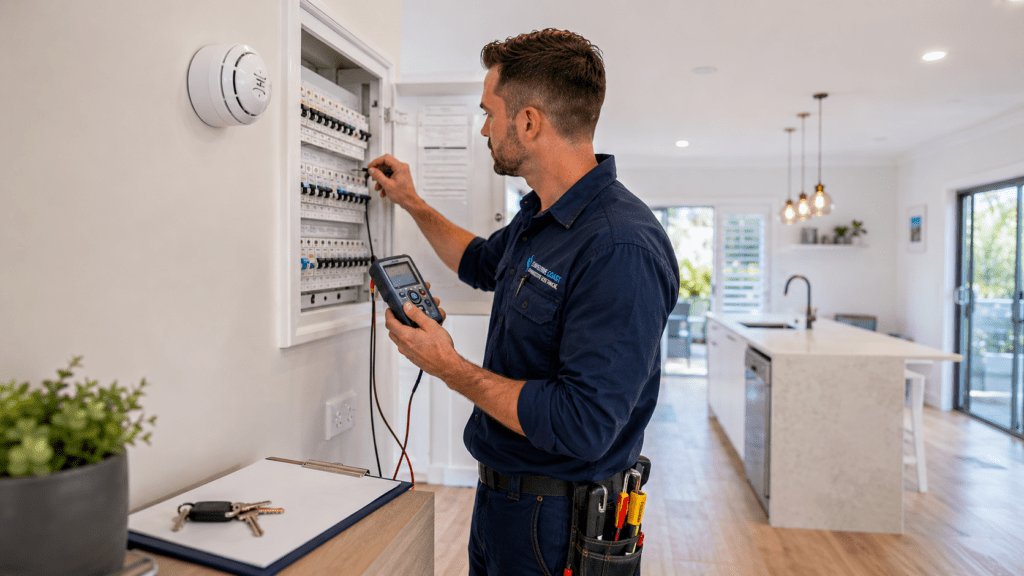
Some signs point clearly to the need for professional attention. A switchboard that still has ceramic fuses, no visible safety switches, frequent tripping without a clear cause or a safety switch that will not reset all suggest that an upgrade is due. On the Sunshine Coast, this local contractor regularly replaces older boards with modern units that include RCDs on key circuits and issues test reports and Electrical Certificates of Compliance that owners can file for insurance and tenancy records.
How Should Switchboards, Wiring And Fixed Appliances Be Maintained In Rentals?
Maintaining switchboards, wiring and fixed appliances in rentals means keeping the electrical installation safe, stable and suited to the loads tenants place on it. For rental property electrical compliance QLD, this sits alongside smoke alarms and safety switches as a core part of a landlord’s duty of care. A neat, modern switchboard with well maintained wiring and reliable appliances reduces both incident risk and the chance of costly unplanned repairs.
Queensland’s minimum housing standards state that fixtures and fittings, including electrical items, must be in good repair and not likely to cause injury. That covers power points, light switches, ceiling fans, ovens, air conditioning, pool equipment and any other fixed items supplied with the property. Older Sunshine Coast homes, especially character Queenslanders and houses near the coast, can suffer from worn insulation, corroded terminals and overloaded boards, so they can need more regular attention than newer builds, a pattern echoed in research on climate resilient housing features that links tenant satisfaction with retrofit investment decisions.
Switchboards, Wiring And Outdoor Areas: Inspection Checklist
A quick visual check of the switchboard and wiring during inspections can reveal issues that justify a licensed electrician visit. A modern board uses circuit breakers instead of rewireable ceramic fuses and has safety switches on key circuits such as power, lighting and high risk loads. Labels should make it clear which breaker controls which part of the home, and covers and doors should sit neatly in place without cracks or rust.
Any sign of scorching, discolouration, melted plastic or a buzzing noise near the board deserves immediate follow up. Frequent tripping when normal appliances are running can point to overloading, poor connections or defects in appliances or wiring, all of which can affect safety. Where boards show these signs, or still run with ceramic fuses, an upgrade is generally the safest course.
Inside the dwelling, routine checks can spot damaged flexes, cracked or loose power points, broken light switches and flickering lights that may show a failing fitting or loose joint. Outside, outlets and lights should be weatherproof and sit at safe heights, with covers that close properly. Pool areas need particular care, with dedicated RCD protected pump circuits, suitable weather rated outlets and compliant distances between outlets and the water edge.
Holiday rentals see heavier use of power points, fans and kitchen appliances, so switches and outlets may suffer more wear. Property managers should look closely at these fittings between bookings and consider shorter inspection intervals than for a quiet long term tenancy. While only a licensed electrician may remove covers or work on wiring, these visual checks help owners know when to call for professional help.
Fixed Appliances, Air Conditioning And Other Hard-Wired Equipment
Fixed appliances that come with the rental are part of the electrical safety picture. Common examples include ovens, cooktops, rangehoods, dishwashers, ceiling fans, bathroom heat and fan units, split system or ducted air conditioning and pool equipment. The landlord is responsible for providing these in a safe, working state at the start of a tenancy and for repairing or replacing them within a reasonable time if they fail during the lease.
Air conditioning needs special attention. Installation and major repairs must be carried out by a technician who holds both a Queensland electrical licence and an ARCtick refrigerant handling licence, because handling refrigerant gas without a licence is illegal. Regular servicing, often every one or two years, helps maintain efficiency and spot issues such as water leaks, loose terminals or overloaded circuits before they cause bigger problems. Tenancy agreements often ask tenants to clean filters, but technical servicing remains the owner’s job.
Warning signs that fixed appliances may present an electrical risk include burning smells, tripping breakers when the appliance runs, unusual noises, visible damage or shocks and tingles from metal parts. Tenants should be encouraged to report these signs promptly and to stop using the appliance until it is checked. They must not attempt their own hard wired repairs, as DIY electrical work is illegal in Queensland. Sunshine Coast Projects & Electrical installs and services many of these fixed systems and can also advise whether a switchboard can safely support new loads such as extra air conditioning or an electric vehicle charger, an assessment area also covered in a technical brief on electric readiness in residential energy code planning.
How Often Should Landlords Inspect And Service Electrical Systems?
The frequency of inspections and servicing for electrical systems in rentals depends on property age, usage and risk, but some clear patterns have emerged. For rental property electrical compliance QLD, most electricians recommend a planned routine that covers general electrical safety inspections, smoke alarm checks, safety switch tests and servicing of key appliances like air conditioning. This planned approach often costs less over time than waiting for faults to appear.
Queensland does not currently set a fixed inspection interval for all private rentals, but government agencies encourage proactive maintenance. For example, the RTA outlines minimum housing standards on its website at:
-
Minimum housing standards for rentals: https://www.rta.qld.gov.au/renting/during-a-tenancy/rental-law-reforms/minimum-housing-standards
The RTA notes that fixtures and fittings must be in good repair. Owners who can show a regular inspection and repair pattern usually have a stronger position if a dispute reaches QCAT or an insurer reviews a claim, which aligns with findings on the role of energy assessments in shaping retrofitting and maintenance decisions for residential properties.
Suggested Inspection And Maintenance Schedule
A common suggestion for standard houses and units is a full electrical safety inspection by a licensed electrician every three to five years. This visit can include checking switchboard condition, wiring, earthing, safety switch coverage and the state of fixed appliances. Older homes, homes with high electrical demand or properties that have had ad hoc renovations may benefit from more frequent checks.
Smoke alarms deserve shorter cycles. Tenants can press the test button each month and report any issues, while owners or managers may arrange a professional smoke alarm check yearly or at each change of tenancy. Safety switches should have push button tests about every three months, whether by tenants or owners, provided the person knows what they are doing and understands that power will go off during the test.
Air conditioning systems in rentals usually run hard during Sunshine Coast summers, so they respond well to yearly or every second year servicing. Pool and outdoor areas can be checked visually at general inspections, with formal electrical checks lined up alongside broader electrical inspections. Some insurers set their own conditions or expectations around inspection frequency, so owners should read policy wording and ask their insurer if unsure.
Documentation, Records And Using A Maintenance Plan
Records turn a maintenance routine into clear evidence of reasonable care. Useful documents include smoke alarm compliance certificates, Electrical Certificates of Compliance and safety certificates for work such as switchboard upgrades, rewiring, EV charger installs and appliance replacements. Test reports for RCDs, written air conditioning service reports and pool equipment checks also help build a solid history for each property.
It is wise to keep copies of tenant reports, repair requests, emails, work orders and invoices that relate to electrical issues. A practical rule is to keep major compliance documents for the life of the installation and repair or testing records for at least the length of the tenancy plus several years, although owners may wish to confirm periods with their legal or insurance advisers. Digital storage in cloud systems or agency software reduces the chance that key papers go missing.
The Electrical Safety Office publishes guidance that includes maintenance planning tools for rental properties. Such a plan sets out what will be checked, how often and where results will be recorded. Sunshine Coast Projects & Electrical supports this approach by providing detailed job sheets, test reports and digital copies of compliance documents straight to owners and property managers, which makes keeping those records far simpler.
How Should You Handle Tenant Electrical Fault Reports And Emergencies?
Handling tenant electrical fault reports and emergencies well is a big part of rental property electrical compliance QLD. Dangerous faults fall under the emergency repair category in the RTRA Act, while less urgent issues still need attention within a reasonable time. Clear procedures help tenants act safely and help landlords and property managers meet their duties without confusion.
Every tenancy agreement should name an emergency repair contact and set out how tenants should raise both urgent and routine electrical issues. Contact details might be for the property manager, for a nominated electrician or for an after hours answering service that can reach both. Owners should check that whoever is named understands their role and can respond swiftly when a serious report comes in.
Emergency Electrical Issues: What Counts And What To Do
Emergency electrical issues are faults that pose an immediate risk of shock, fire or serious property damage. Common examples include:
-
Electric shocks or tingles from taps, pipes, showers or hard wired appliances
-
Burning smells from power points, light fittings or switchboards
-
Visible arcing or sparking
-
Safety switches that trip at once and refuse to reset
-
Water in electrical equipment after storms or flooding
-
Fallen powerlines or a damaged service line to the property
If a tenant feels a tingle or shock from a tap, pipe or other metal fitting, the recommended first step is to contact their electricity distributor’s emergency line, which is printed on power bills and listed on the Electrical Safety Office website. The distributor can send staff to make the installation safe and investigate. The tenant should then call the emergency repair contact listed in the lease, stay clear of the affected area and warn others not to touch taps, pipes, the meter box or the switchboard until the property is declared safe.
For shocks from a specific appliance, burning smells, waterlogged fittings or sudden tripping, tenants should stop using the affected device, switch it off at the wall or isolator if it is safe to do so and contact the emergency repair contact. Owners and managers must treat these reports as urgent. They should arrange a licensed electrician quickly, follow any advice from the distributor about isolation and document the report, the time response started and the electrician’s findings. Sunshine Coast Projects & Electrical offers around the clock emergency electrical repairs in many Sunshine Coast suburbs, helping owners meet these urgent repair duties while keeping clear records.
Non-Urgent Faults, Entry Notices And Communication
Not every electrical problem is an emergency, but non urgent does not mean optional. Issues such as an outlet that feels loose but does not expose live parts, a light fitting that no longer works, an exhaust fan that has failed or circuits that occasionally trip when many appliances run should still be logged and addressed. Left unattended, small issues can turn into hazards.
Good communication channels make this smoother for everyone. Many agencies use email or online portals for repair requests, which lets tenants describe the problem and upload photos. Managers can then acknowledge the request, give an expected time frame and organise a work order with a licensed electrician. All of this should sit within the expected response times under the RTRA Act.
For non emergency entry, such as routine inspections, smoke alarm testing or planned repairs, property managers must issue an Entry Notice, known as Form 9, and meet notice periods set out by the RTA. In strata schemes, there may be added steps to access common areas or plant rooms. Keeping tenants informed about timing, confirming appointments and letting them know when work is complete helps maintain trust. This local electrical team works closely with property managers and tenants to find appointment times that cause the least disruption and to provide clear feedback after each visit.
Why Must All Electrical Work Be Done By A Licensed Electrician?
All fixed electrical work in Queensland must be done by appropriately licensed people because electricity can injure or kill when handled badly. For rental property electrical compliance QLD, this licensing rule is just as important as smoke alarms or safety switches. Owners who allow or perform unlicensed work risk breaking the law, voiding insurance and putting tenants in harm’s way.
The Electrical Safety Act states that installing, altering or repairing fixed wiring, power points, lighting, switchboards, electric vehicle chargers, solar systems and most other electrical equipment is licensed work, consistent with detailed technical requirements for installation of internal electrical networks used in professional building standards internationally. The Electrical Safety Office runs a public licence register that owners and managers can use to confirm that a contractor or worker holds current credentials. Using this check is a simple, practical safeguard.
Licensing, DIY Risks And Insurance
DIY electrical work might look cheap in the short term, but it carries serious risk. People who are not licensed may not understand how to isolate circuits properly, how to size cables and breakers or how to identify hidden faults. That can lead to electric shock, fire or subtle faults that only show up later under load or in wet conditions. Queensland authorities regularly warn the public about these dangers and pursue offenders.
From a legal point of view, performing unlicensed electrical work or asking someone unlicensed to perform it can breach the Electrical Safety Act and lead to fines or prosecution. Where conduct is reckless and exposes someone to risk of death or serious injury, penalties can include very large fines or even imprisonment. On top of that, most building and landlord insurance policies allow insurers to reduce or refuse claims where unlicensed work contributed to an incident.
For these reasons, landlords and property managers should only use electricians and electrical contractors who hold current Queensland licences and who can provide Electrical Certificates of Compliance for their work. Licence numbers should appear on invoices and reports and can be checked against the Electrical Safety Office register. Keeping this paperwork with other property records adds another layer of protection if a dispute or claim arises.
Choosing A Compliant Electrical Partner On The Sunshine Coast
Choosing the right electrical contractor on the Sunshine Coast comes down to licence status, insurance, clear communication and willingness to document work. At a minimum, you need a contractor with a current Queensland electrical contractor licence, public liability insurance and a habit of giving clear quotes and scopes of work in writing. They should always be willing to supply Electrical Certificates of Compliance and detailed reports after significant jobs such as switchboard upgrades or safety switch installations.
Sunshine Coast Projects & Electrical is a local contractor that meets these expectations, led by Managing Director Charlie Doblo, who has more than 20 years in the electrical trade. The business holds Queensland electrical contractor licence 79977, is an Accredited Master Electrician member and is Clean Energy Council accredited for solar related work. Residential and commercial services cover most of the Sunshine Coast, and clients can call 0400 677 514 for quotes and bookings on compliance audits, smoke alarm and RCD upgrades, switchboard work and maintenance planning.
What Are The Real-World Consequences Of Poor Electrical Compliance?
Poor electrical compliance in Queensland rentals can lead to injuries, legal action, denied insurance claims and serious financial loss. When rental property electrical compliance QLD is treated as an afterthought, gaps in smoke alarms, safety switches, wiring, appliances or fault handling can all come back to haunt owners and property managers. Real world cases show that regulators and tribunals look hard at whether risks were obvious and whether owners took reasonable steps to manage them.
Beyond the human impact of shock or fire incidents, non compliant properties can become harder to rent out, sell or insure. Tenants may share experiences online, affecting an agency’s reputation, and buyers often request electrical reports before committing to a contract. Fixing long ignored issues under pressure can cost far more than steady, planned upgrades over time.
Legal, Insurance And Tenancy Risks
On the legal front, the Electrical Safety Office and other regulators can issue fines for failing to install required safety switches, failing to keep smoke alarms compliant or carrying out unlicensed electrical work. In serious cases where conduct is reckless and someone is placed at risk of death or serious injury, prosecution can follow with much heavier penalties. These outcomes are rare for owners who act promptly on safety concerns, but they underline how seriously Queensland treats electrical risk.
In tenancy law, tenants can issue breach notices when landlords fail to repair dangerous faults or keep the property in good repair. QCAT can order repairs, rent reductions or compensation and can allow tenants to end leases early if safety issues remain. Claims often draw on RTA guidance and minimum housing standards, so keeping properties aligned with those standards makes disputes easier to resolve.
Insurance adds another layer. Many policies include clauses that limit or exclude cover where non compliant smoke alarms, missing safety switches or unlicensed electrical work play a part in a loss. After a fire, insurers will often look for compliance documents such as smoke alarm certificates, Electrical Certificates of Compliance and maintenance records before making a decision. Without those records, owners can face reduced payouts or outright denials.
Practical Risk-Reduction Strategies For Landlords And Managers
The good news is that practical steps can dramatically cut these risks. A written electrical maintenance plan for each property, covering inspection schedules, smoke alarm checks, safety switch tests and appliance servicing, gives structure and makes action less likely to drift. Owners should make sure that compliant smoke alarms cover all required positions, that safety switches protect at least all power circuits and, where possible, lighting and high risk circuits as well, and that the switchboard is modern, clearly labelled and free from obvious faults.
Acting quickly on tenant reports is another simple but powerful habit. Shocks, tingles, burning smells, visible arcing and water affected fittings should all trigger urgent action, while non urgent faults still deserve prompt scheduling. Only licensed electricians should work on fixed electrical systems, and owners should check licences and keep certificates and invoices as part of the property record.
For older homes and holiday rentals around the Sunshine Coast, pre purchase or pre tenancy electrical inspections can be wise. These inspections can flag ceramic fuse boards, limited RCD coverage, ageing wiring or non compliant smoke alarms before problems appear mid lease. This Sunshine Coast based team often works with owners, body corporates and agencies to audit portfolios, prioritise upgrades and keep compliance records tidy, which lowers risk and gives everyone more confidence.
In Summary
Rental property electrical compliance QLD is about far more than ticking a few boxes at lease start. It means keeping smoke alarms, safety switches, switchboards, wiring and fixed appliances safe and in good repair, using licensed electricians for all fixed work, responding quickly to tenant reports and holding records that show what has been done. When owners and property managers take this view, they protect both tenants and the long term value of the property.
The core checklist is straightforward. You need photoelectric, interconnected smoke alarms in the right places with the right power supply. You need safety switches on at least all power circuits, and preferably on lighting and high risk circuits as well, backed by a modern switchboard that suits current and likely future loads. Wiring and fixed appliances should be checked regularly, especially in older and coastal homes, and a clear plan should guide inspections, tests and servicing.
Written maintenance plans, simple fault procedures and a tidy file of certificates, reports and invoices all support this work and help when insurers or tribunals ask for evidence. For landlords, property managers and strata committees across the Sunshine Coast who want help putting this into practice, Sunshine Coast Projects & Electrical can provide audits, upgrades and emergency support, and it is always wise to confirm current rules on Queensland Government, QFES, RTA and Electrical Safety Office websites as regulations change. Ready to discuss the right electrical solution? Call Sunshine Coast Projects & Electrical on 0400 677 514 to request an obligation-free quote. Learn more at https://sunshine-coast-electrician.com.au/services/ or contact the team at https://sunshine-coast-electrician.com.au/contact/.
Frequently Asked Questions
A full electrical safety inspection for a Queensland rental is commonly recommended every three to five years. Older homes, properties with high electrical loads or complex setups may benefit from more frequent checks. It is also sensible to book an inspection after major renovations, at change of ownership or when recurring faults appear. There is no universal fixed interval in law, so owners should watch guidance from the Electrical Safety Office and confirm what is appropriate for each property.
Queensland law focuses on safety switches for power point circuits, so that is the minimum legal requirement. However, the Electrical Safety Office and many insurers strongly recommend RCDs on lighting and other high risk circuits. This gives better shock protection, especially for children and older tenants who may use lights at night. A licensed electrician, such as Sunshine Coast Projects & Electrical, can assess your switchboard and suggest suitable upgrades.
Battery powered smoke alarms are allowed in Queensland rentals only if they use a sealed 10 year lithium battery and meet current standards. Hardwired alarms with a backup battery also remain acceptable. Older alarms that rely on a simple replaceable 9 volt battery on its own no longer meet rental requirements. Owners should check current wording on Queensland Government and QFES websites to confirm details and transition dates.
Tenants in Queensland have limited rights to arrange emergency repairs if they cannot contact the owner or agent after making reasonable attempts. Strict conditions apply, and caps may exist on how much they can authorise. For non emergency repairs, tenants should not engage trades without agreement. Landlords and property managers should set out clear emergency repair contacts in the lease and review the latest RTA guidance before disputes arise.
If your rental still has old ceramic fuses, it is a sign of an ageing switchboard and higher risk of faults or non compliance with modern expectations. You should not open or work on the board yourself, because that is licensed electrical work. Instead, arrange a switchboard inspection with a licensed electrician who can advise on replacement options. Sunshine Coast Projects & Electrical often assesses older Queenslander and coastal homes and can provide clear upgrade quotes tailored to the property after an on site visit.