Why DIY Electrical Work is Illegal in QLD (And Voids Your Insurance)
You’re at Bunnings, you see a stylish new light fitting, and a thought crosses your mind: “How hard can it be? It’s just two wires. I’ll save a few hundred bucks and do it myself this weekend.”
Or maybe it’s a cracked power point. Or a new ceiling fan for the kid’s room. With countless “how-to” videos on YouTube, the temptation for a bit of DIY electrical work is stronger than ever.
As your local Sunshine Coast electricians, we’re here to give you the most important piece of advice you will ever receive: Don’t.
We’re not just saying that to get your business. We’re saying it because, in Queensland, it’s not just a “bad idea”—it is 100% illegal for an unlicensed person to do any electrical work.
That “simple” weekend job isn’t just risking a shock. It’s risking a $40,000 fine, a house fire, and your entire home insurance policy. Let’s talk about what the law says, and the three huge reasons you must never, ever “have a go.”
The Law is Black and White: The Electrical Safety Act 2002
This isn’t a “guideline” or a “recommendation.” It’s a serious law.
The makes it crystal clear: all electrical work must be performed by a licensed electrical contractor.
The penalties for breaking this law are severe:
- For an individual: Fines can be as high as $40,000 for unlicensed work.
- If your work creates a risk: If that illegal DIY job exposes someone to a risk of death or serious injury (like a live appliance casing or a fire), penalties can escalate to $600,000 or five years in prison.
These laws aren’t for revenue raising. They are written in blood. They exist because electricity is invisible, silent, and unforgiving.
The 3 Life-Changing Risks of DIY Electrical Work
Still not convinced? Let’s go beyond the fines and talk about the real-world consequences we see on the Sunshine Coast every year.
1. The Financial Ruin: You Will Void Your Home Insurance
This is the one most people don’t think about. Let’s play out a scenario:
You install a new power point yourself. You get one connection slightly wrong, but it works. Unseen, that bad connection heats up just a little bit every time you use the toaster. Six months later, this “hot spot” inside your wall finally ignites the timber frame.
The house burns down.
The insurance assessor arrives. The first thing they do is call in a fire investigator, who will trace the fire back to its origin. They will find the faulty power point. They will see it wasn’t installed to Australian Standards. And they will ask for the Certificate of Compliance from the electrician who installed it.
When you can’t provide one, your insurance company is legally entitled to deny your entire claim.
That $150 you “saved” by doing it yourself has just cost you your $700,000 home. It is, without question, the worst financial gamble a homeowner can make.
2. The Ticking Time Bomb: The Risk of Fire
Most electrical fires don’t happen with a “bang.” They start silently, inside a wall or ceiling, days, months, or even years after the faulty work was done.
The number one cause? Heat from a poor connection.
A licensed electrician is trained to know:
- The exact “torque” (tightness) required for every screw. Too loose, and it arcs (sparks), creating heat. Too tight, and it can break the wire.
- The correct size and type of cable for the load. Using a cable that’s too thin for an oven or an air conditioner is like trying to drink a thickshake through a coffee stirrer—it gets red hot and melts.
- The Australian Wiring Rules (AS/NZS 3000), a complex document hundreds of pages long that governs every part of an installation.
A 5-minute YouTube video doesn’t teach you this. A poor connection is a ticking time bomb, and you’re sleeping in the house it’s set in.
3. The Instant Tragedy: The Risk of Electric Shock
This is the most obvious and immediate danger. You can’t see electricity. You can’t smell it. And the “main switch” isn’t always enough to protect you.
One slip of the screwdriver, one wrong wire crossed, one forgotten step, and 240 volts will pass through your body. It takes less than 100 milliamps—a tiny fraction of one amp—to stop a human heart.
But the danger doesn’t end when you close the cover plate. A common DIY mistake is reversing the “active” and “neutral” wires. The light switch seems to work, but now, the light fitting is permanently live. Even when the switch is “off,” the fitting is buzzing with 240 volts. The next person who goes to change that light bulb? They could be the one who pays the price.
What Electrical Work is Actually Illegal in QLD?
The legal definition of “electrical work” is extremely broad. It basically means anything that involves connecting, disconnecting, or altering a fixed electrical wire.
The “Do Not Touch” List (Illegal for DIY):
- Installing a new power point
- Replacing an old power point (even like-for-like)
- Installing or replacing a light switch
- Installing a ceiling fan
- Installing a new light fitting or downlight
- Running any cable (data, coax, speaker wire) near electrical wires
- Connecting or disconnecting a hard-wired oven, cooktop, or air conditioner
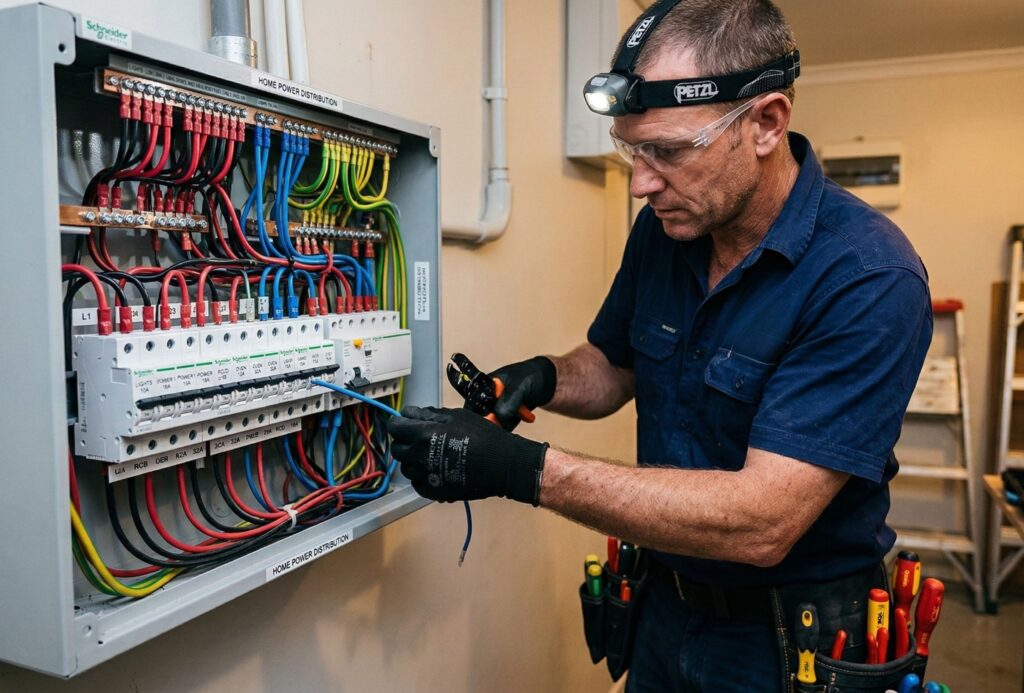
- Opening, modifying, or touching anything inside your
The “OK for DIY” List (What you can legally do):
- Change a light bulb.
- Plug in an appliance.
- Reset a circuit breaker or safety switch.
- Install or replace a battery-operated smoke alarm (not a 240V one).
- Clean your A/C filters.
That’s about it. The list is small for a reason.
The Solution: Get a Pro, Get a Certificate
When you hire a licensed, professional team like Sunshine Coast Projects & Electrical, you’re not just paying for our time. You’re paying for:
- Our Licence & Insurance: We are fully licensed and hold $20 million in public liability insurance. If anything goes wrong (which it won’t), you are protected.
- Our Expertise: Our electricians are masters of their trade. They are trained, experienced, and up-to-date with all Australian Standards.
- A Compliance Certificate: For new circuits, you get a “Certificate of Compliance.” This is your legal, iron-clad proof that the work was done safely, to standard, and by a licensed professional. It’s the document you’ll show your insurance company.
- Peace of Mind: Knowing the job is done right, the first time. Knowing your family is safe. Knowing your insurance is valid. That peace of mind is priceless.
We’re a local Sunshine Coast team. We’re your neighbours. We believe in honest, upfront pricing and giving you the straight-up advice you need to hear.
So, please, put the tools down. That “simple” job isn’t worth the risk.
for a free, fixed-price quote. We’ll get that job done safely, legally, and give you the peace of mind you deserve.
DIY Electrical FAQ (Frequently Asked Questions)
Q: Is it really illegal to do any electrical work in QLD? A: Yes. Unless you are a licensed electrician, it is illegal for you to perform any electrical work on your own home. This is governed by the Electrical Safety Act 2002 to prevent fires, electric shocks, and deaths.
Q: What electrical work can I legally do myself in Queensland? A: The list is very short. You can legally change a lightbulb, plug in an appliance, reset a safety switch or circuit breaker, and install a battery-operated (not hard-wired) smoke alarm. That’s it.
Q: Will DIY electrical work definitely void my home insurance? A: Yes. If you have a fire or other incident, your insurance company will send an investigator. If they find that illegal, non-compliant DIY electrical work was the cause, they are fully within their rights to deny your claim, leaving you with the entire cost.
Q: How much does it cost to get a power point installed legally? A: The cost for a licensed electrician to safely install a new power point on the Sunshine Coast is typically between $150 and $300, depending on the complexity (e.g., plaster vs. brick wall, distance from the switchboard). We provide for all work.
Q: What is a Certificate of Compliance (COC)? A: A COC is a legal document provided by your electrician after they perform certain types of work (like installing a new circuit). It’s their legal declaration that the work is 100% safe, tested, and complies with all Australian Standards. It’s your ultimate protection for your insurance.