Can I change a power point myself QLD? No. In Queensland, homeowners and tenants must not replace, move, install or reconnect a fixed power point, light switch or light fitting unless they hold the appropriate electrical licence. Changing a globe, plugging in an appliance or resetting a safety switch is different because those tasks do not disturb fixed wiring.
Fixed wiring is permanently connected to a property’s electrical supply. Work on it can involve live conductors, hidden cable faults, earthing and circuit protection that cannot be judged from the visible faceplate or fitting.
Sunshine Coast Projects & Electrical helps Sunshine Coast property owners arrange licensed replacements, fault checks, upgrades and urgent repairs. This practical guide explains where the legal line sits, which warning signs need fast action and what licensed electrical work involves. For broader information, read the detailed Queensland DIY electrical work guide.
Key takeaways
Fixed power points, switches and light fittings need appropriately licensed electrical work.
Switching off a breaker does not make DIY electrical work legal or safe.
Stop using fittings that spark, smell burnt, feel hot or trip safety switches.
Keep invoices, certificates and other relevant records after electrical work.
Queensland’s Electrical Safety Office and the Electrical Safety Act 2002 (Qld) set the legal framework for electrical work.
Table of Contents
- Can I change a power point, light switch or light fitting myself in Queensland?
- Why is DIY electrical work dangerous even when the breaker is off?
- What should you expect from a licensed electrician in Queensland?
- In summary
- Frequently asked questions
- 5.1 Can a handyman replace a light switch in Queensland?
- 5.2 Can I replace a ceiling light fitting myself in Queensland?
- 5.3 Can I change a light switch to a dimmer switch myself?
- 5.4 What should a tenant do if a power point is loose or sparking?
- 5.5 Do I need a safety switch when replacing a power point?
- 5.6 Can I install an outdoor power point myself in Queensland?
- 5.7 What paperwork should I receive after electrical work in Queensland?
Can I change a power point, light switch or light fitting myself in Queensland?
Changing a fixed power point, switch or light fitting in Queensland is electrical work, not ordinary household maintenance. The answer to “can I change a power point myself in QLD?” is no unless the person doing the work holds the appropriate licence and meets Queensland’s legal requirements. The Electrical Safety Act 2002 (Qld) defines electrical work broadly, including installing, altering, repairing, testing and connecting electrical equipment.
Property ownership, confidence with tools, an online tutorial or an identical replacement does not create permission to work on fixed wiring. A tenant has the same restriction as an owner-occupier.
What electrical work can homeowners and tenants do themselves?
Homeowners and tenants can carry out ordinary use tasks, provided they do not disturb fixed wiring or open fixed electrical accessories. The practical boundary is whether the task involves a permanently connected electrical installation.
| Job | Can a homeowner or tenant do it? | Practical guidance |
|---|---|---|
| Plug in or unplug an appliance | Generally allowed | Use undamaged plugs, cords and outlets only. |
| Change a user-replaceable globe or lamp | Generally allowed | Turn the fitting off and use the correct lamp type and wattage. |
| Reset a safety switch or circuit breaker once | Generally allowed | If it trips again, leave it off and arrange an electrician. |
| Clean the exterior of an accessible outlet or switch | Generally allowed | Keep liquids, sprays and metal objects away from electrical accessories. |
| Replace a fixed power point | Not allowed without the appropriate licence | This includes burnt, USB, weatherproof, single and double outlets. |
| Replace or move a fixed light switch | Not allowed without the appropriate licence | This includes dimmers, smart switches and switch upgrades. |
| Replace a fixed light fitting | Not allowed without the appropriate licence | This includes pendants, downlights and exhaust-fan light units. |
| Install or wire a ceiling fan | Not allowed without the appropriate licence | Ceiling fans connect to the fixed electrical installation. |
| Replace, rewire or repair an appliance plug or cord | Do not assume it is permitted | Check current Electrical Safety Office guidance or arrange licensed help. |
| Work inside a wall, ceiling, switchboard or junction box | Not allowed without the appropriate licence | Arrange a licensed electrical contractor. |
| Put up shelves, paint walls or replace batteries in a remote | Generally allowed | Take care around concealed cables and electrical equipment. |
A power point, light switch and fixed ceiling fitting connect to the building supply. Even work that appears small can expose conductors or affect protective devices.
Why is a like-for-like electrical replacement still licensed work?
A like-for-like replacement remains electrical work because the visible item is only one part of the installation. Searches for “can I change a power point myself QLD?” often assume a new outlet simply connects the same way as the old one. That assumption can be unsafe.
A licensed electrician must account for issues such as:
hidden cable damage
loose terminals
poor earthing
incorrect polarity
moisture entry
damaged mounting points
unsuitable circuit protection
earlier unlicensed alterations.
Changing a single outlet to a double outlet does not increase the circuit’s safe capacity. The circuit may already supply multiple appliances, and the existing wiring or protective device may need assessment.
Kitchens, laundries, bathrooms, garages, sheds, outdoor areas, pools and spas need added location checks. Older wiring may also need attention before a fitting is replaced. For a damaged outlet, an added power point or a renovation upgrade, arrange residential electrical services rather than treating the work as a cosmetic swap.
Why is DIY electrical work dangerous even when the breaker is off?
DIY electrical work remains dangerous after a breaker is switched off because isolation is not proof that every conductor is dead. The legal answer remains no, even where the switchboard label appears clear. Electrical shock, burns, arc faults and electrical fires can result from work that seems minor.
Queensland restricts electrical work because risks can sit behind the wall, ceiling, switch or outlet rather than at the visible fitting.
Why turning off the circuit breaker is not enough
Turning off a circuit breaker can be appropriate when responding to a fault, but it does not make electrical work safe for an unlicensed person. Moving a breaker to the off position does not make replacing a power point lawful.
Switchboard labels can be wrong, incomplete or affected by past renovations. More than one circuit may run through the same wall cavity, ceiling space or fitting point. Other hazards can include damaged wiring, solar systems, batteries, generators and unexpected supply paths.
Licensed electricians use controlled isolation procedures and suitable test equipment before handling conductors. A non-contact tester, plug-in tester or appliance that has stopped operating is not a substitute for professional testing. Removing an outlet cover to inspect the wiring can itself create a serious risk.
What warning signs mean you should call an electrician now?
Burning smells, heat, scorch marks, melted plastic, buzzing, crackling and sparking need prompt electrical attention. A loose outlet or repeated safety-switch trip also needs assessment.
Stop using the affected outlet, switch or fitting and keep children, pets and moisture away from the area. Other warning signs include:
tingling from an appliance or tap
a plug that falls out easily
water exposure near electrical equipment
flickering lights on one circuit
a power point that feels hot
a safety switch that will not reset.
Smoke, flames, electric shock or active sparking require 000 first where there is immediate danger. For urgent faults that are not an immediate threat to life, contact us through the contact page to request licensed help. Do not reconnect or continue using damaged electrical accessories while waiting.
What should you expect from a licensed electrician in Queensland?
A licensed electrician does more than fit a new faceplate or light. The assessment, testing and records behind the work are important parts of a safe electrical installation.
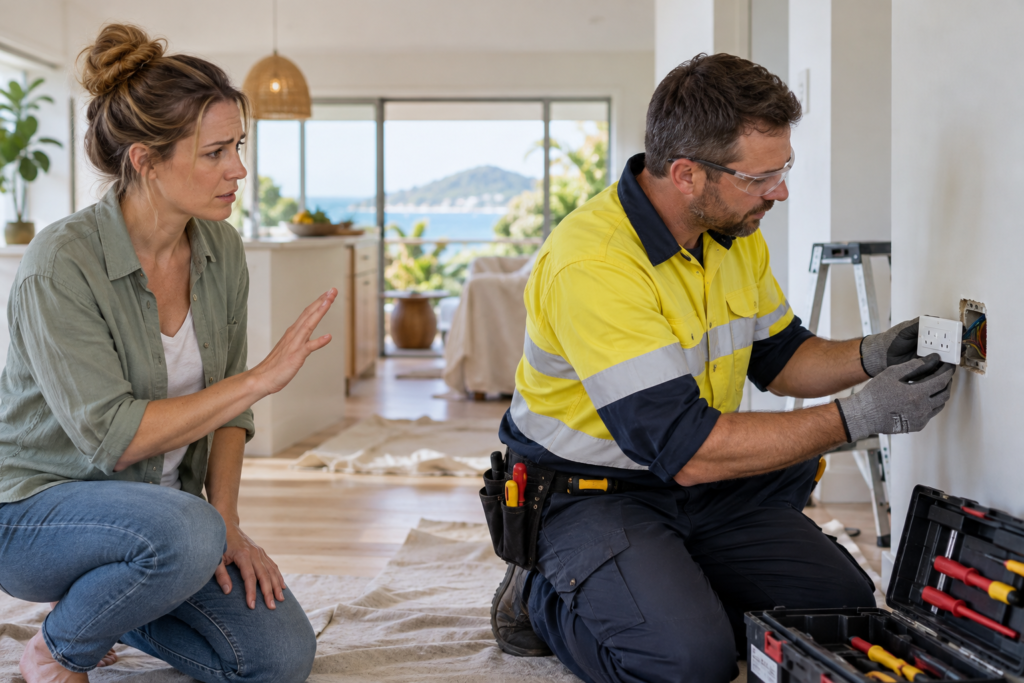
The electrician should assess the fault, isolate the circuit, inspect the wiring and mounting arrangement, complete the required work and test the installation. This can identify deeper faults before they cause another trip, shock or fire.
What does an electrician check when replacing an outlet, switch or fitting?
An electrician checks the circuit and surrounding installation before replacing an outlet, switch or fitting. That professional assessment is why a quick-looking replacement still needs appropriate licensing.
Depending on the work, checks may cover:
cable condition and terminations
earthing and polarity
insulation condition
circuit protection
mounting security
suitability of the selected item for its location
safety-switch protection where relevant.
A hot power point may point to a loose connection, water entry, damaged cable or an overloaded circuit. The visible outlet may not be the source of the problem.
Post-war brick homes, acreage properties and older Sunshine Coast homes may have ageing wiring or limited safety-switch coverage. Larger renovations may need new circuits, switchboard work or rewiring instead of another outlet on an already loaded circuit. Licensed electrical installation work is carried out under applicable legal requirements and wiring rules, including AS/NZS 3000.
How do you choose a legitimate electrical contractor?
A legitimate electrical contractor should be able to show current Queensland licence details, provide a written scope and explain the testing and records relevant to the job. Cost matters, but cash-only work without an invoice or licence details can create major problems after a fault.
Before booking, consider these checks:
Search the contractor through Queensland’s public Electrical Licence Search.
Ask for a written quote or clear scope of work.
Confirm who will perform the electrical work.
Ask what testing and documentation apply to the job.
Keep the invoice and any certificate or product paperwork supplied.
Be cautious with unusually cheap complex work, missing licence information or pressure to skip testing. Do not rely only on advertising, referrals or verbal claims.
Sunshine Coast Projects & Electrical can assist with licensed residential replacements, fault finding, upgrades and urgent electrical work across the Sunshine Coast. Ask for relevant licence details, a written quote, invoice and applicable documentation before the electrician leaves site.
In summary
Queensland homeowners and tenants should not replace fixed power points, light switches or light fittings themselves. The practical answer to “can I change a power point myself in QLD?” is that ordinary use tasks are generally allowed, while work that touches fixed wiring needs an appropriately licensed professional.
A globe replacement or a single safety-switch reset is not the same as opening an outlet or reconnecting a fitting. Stop using damaged accessories rather than attempting a quick repair. Sunshine Coast Projects & Electrical can assist homeowners, renovators, landlords and businesses with compliant replacements, fault finding, upgrades and urgent electrical assistance across the Sunshine Coast.
Even a simple power point replacement is regulated in Queensland, because it counts as electrical work that needs a Queensland electrical licence. You can confirm the rules on the Electrical Safety Office Queensland website.
Frequently asked questions
Questions about Queensland electrical work usually come back to the same rule: fixed electrical accessories need appropriately licensed work, even when a job looks quick or familiar. Keep records of completed work for property, rental, insurance and future sale purposes.
Can a handyman replace a light switch in Queensland?
No. A handyman cannot replace a fixed light switch unless they hold the appropriate electrical licence and meet the requirements that apply to the work. A switch connects to fixed wiring even where the new item looks identical.
Check licence details through Queensland’s public search rather than relying only on advertising, referrals or verbal claims.
Can I replace a ceiling light fitting myself in Queensland?
No. Replacing a fixed ceiling light fitting is electrical work and needs an appropriately licensed electrician. Changing a globe or lamp designed for user replacement is different.
Ceiling fittings can conceal damaged insulation, loose connections, poor earthing or wiring faults. A licensed electrician can inspect and test the fitting after replacement.
Can I change a light switch to a dimmer switch myself?
No. Replacing a standard switch with a dimmer involves fixed wiring and requires an appropriately licensed electrician. The electrician should also check whether the dimmer suits the lighting type, load and existing circuit.
Do not choose a dimmer only by appearance or price. Incompatible products can cause poor operation or equipment damage.
What should a tenant do if a power point is loose or sparking?
A tenant should stop using the outlet and report it promptly to the property manager or landlord. Do not remove the cover, tighten screws or attempt a replacement.
Smoke, fire, active sparking or electric shock may require 000 where immediate danger exists. Keep people away from the affected area until help arrives.
Do I need a safety switch when replacing a power point?
A safety switch, also called an RCD, reduces shock risk by disconnecting supply when it detects current leakage. It does not replace correct wiring, earthing, circuit protection or professional testing.
An electrician can check existing RCD coverage and advise on any work required. Queensland rental properties also have safety-switch duties, so landlords and tenants should seek property-specific advice.
Can I install an outdoor power point myself in Queensland?
No. An outdoor power point needs an appropriately licensed electrician because weather protection, placement and electrical protection must suit the location.
Pool, spa, garden, shed and garage areas add risks from water, dust, impact and higher-demand equipment. An indoor outlet with a cover is not automatically suitable for outdoor use.
What paperwork should I receive after electrical work in Queensland?
Licensed electrical contractors test completed work and provide relevant documentation where required. Keep certificates, invoices, warranty details and product information with property records.
These documents can help with insurance, rental management, renovations, future sales and fault investigations. Ask what records apply before the work begins.