Test and tag requirements for Queensland businesses depend on workplace risk and electrical safety law, not one blanket rule for everyone. Employers must keep plug-in electrical equipment safe under the Work Health and Safety Act 2011 (Qld) and the Electrical Safety Act 2002 (Qld).
In practice, this means plug-in tools and appliances in higher risk environments must be regularly inspected, electrically tested and tagged by a competent person in line with AS/NZS 3760, with shorter intervals on construction sites and longer cycles in clean, low risk offices. These business test and tag requirements help show that electrical risk is being managed in a structured way.
For Sunshine Coast operators, that matters because electrical incidents can lead to injury, fines and insurance issues. This guide from Sunshine Coast Electrician explains what test and tag actually involves, when it is mandatory, how often to test, who can legally perform it and how it fits into wider workplace electrical safety. You will also see practical examples so you can match the rules to your own workplace.
Key Takeaways
A few key messages help frame business test and tag requirements before looking at the detail. Keeping these in mind makes it easier to line up your current practices with Queensland expectations.
-
There Is No Single Rule For Every Business
Queensland law focuses on managing electrical risk, not ticking one universal checklist. A small Maroochydore office may justify light touch inspection, while a Nambour workshop needs frequent testing. Business test and tag requirements always link back to how and where equipment is used. -
Higher Risk Environments Need Stricter Test And Tag
Workplaces with moisture, dust, vibration or outdoor conditions must have regular inspection and testing of plug‑in equipment. That covers construction sites, workshops, commercial kitchens, cleaners and hire fleets. In these settings, tags and records are a clear expectation under Queensland test and tag compliance. -
Test And Tag Is Only One Part Of Electrical Safety
Testing and tagging sits beside safe installation, safety switches, good cord management and staff training. Relying on tags alone without fixing wiring or damaged outlets leaves gaps. A good program treats test and tag as one control inside a wider electrical safety plan. -
Records And Documentation Really Matter
If an incident happens, regulators and insurers want to see dates, results and actions taken. Without decent records, it is hard to prove that equipment was being checked properly. Sunshine Coast Electrician provides clear reports so your paperwork matches your on-site practices. -
Local, Licensed Support Makes Compliance Easier
Working with a local Sunshine Coast electrician who understands Queensland legislation removes guesswork. Sunshine Coast Electrician can combine test and tag inspections with switchboard checks, RCD testing, electrical safety inspections and preventative maintenance, so you cover multiple duties in one visit.
“Workplaces that manage electrical risks proactively are far less likely to experience serious incidents.” – WorkSafe Queensland guidance
What Are Business Test And Tag Requirements In Queensland?
Business test and tag requirements in Queensland describe how workplaces inspect, electrically test and label plug‑in equipment so it stays safe to use. Under state work health and electrical safety law, this program is a recognised way for a person conducting a business or undertaking (PCBU) to show that equipment does not present unacceptable risk.
Test and tag means checking in‑service electrical tools, appliances, extension leads and portable RCD boards that plug into sockets at a workplace. The technical benchmark is AS/NZS 3760, which sets methods, pass levels and suggested inspection intervals. According to Standards Australia, this standard allows intervals between three months and five years, depending on the environment. Sunshine Coast Electrician aligns test and tag work with AS/NZS 3760 so clients can point to a clear reference if questioned by a regulator or insurer.
Queensland law does not say that every kettle and phone charger must carry a tag at all times. Instead, test and tag is one accepted method of meeting the general duty to manage electrical risk under the Work Health and Safety Act and the Electrical Safety Act. For many businesses, following test and tag requirements across Australia is a straightforward way to show that duty has been taken seriously.
What Does Test And Tag Involve Day To Day?
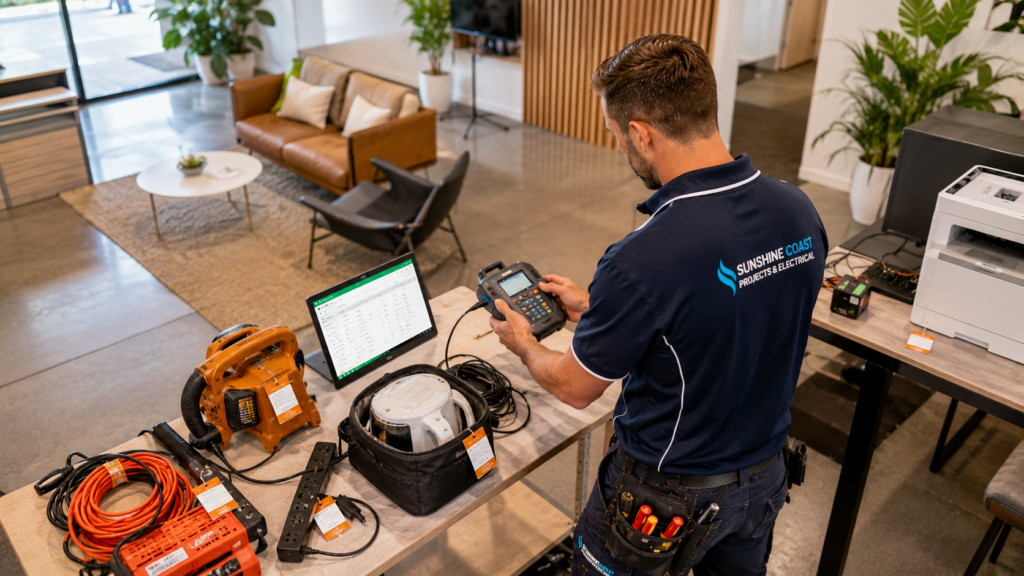
Day to day, test and tag involves a mix of visual checks, electrical tests and record keeping on the tools and appliances you already use. The goal is to pick up damage before someone receives a shock or causes a fire.
-
Visual Inspection
A competent person examines cords, plugs, sockets and housings for cuts, crushing, exposed copper, burn marks or missing covers. They also look for signs of moisture, dust build‑up or rough use. Many electrical faults show up at this stage, which is why good testers spend time looking before they plug anything into a test meter. -
Electrical Testing
The tester uses a calibrated appliance tester to check earth continuity, insulation resistance and polarity, and may run leakage tests for some items. Sensitive gear such as IT equipment is tested with suitable settings so electronics are not damaged. According to WorkSafe Queensland, using the right test equipment and settings is part of being a competent person. -
Tagging And Records
Items that pass receive a durable tag showing the tester, date and next test due date. Failed items are removed from use and marked clearly so workers do not plug them back in. Results go into a logbook or digital register so you can track electrical equipment testing in the workplace over time. Any repair work is handled separately by a licensed electrician.
Sunshine Coast Electrician carries out this process using fully licensed electricians and calibrated instruments, so testing fits neatly with other electrical safety inspections and compliance testing you may need.
Key Laws And Standards That Drive Test And Tag Requirements
The rules that drive test and tag compliance Queensland‑wide sit across several Acts, regulations and standards. At the top level, the Work Health and Safety Act 2011 places a primary duty on a PCBU to keep workers and others safe, which clearly includes electrical hazards.
The Work Health and Safety Regulation 2011 adds detail. Regulation 147 requires electrical risks to be managed through a structured risk management process. Regulation 150 then requires regular inspection and testing of certain plug‑in equipment used in higher risk operating environments such as construction and demolition work.
Alongside that sits the Electrical Safety Act 2002 and Electrical Safety Regulation 2013, which cover licensing, installations and safety switches in Queensland. AS/NZS 3760 sets in‑service inspection and testing methods, while AS/NZS 3012 sets extra requirements for construction sites. Regulators and insurers across Australia, including Safe Work Australia, treat these standards as the practical test of whether your approach to testing and tagging is reasonable.
Which Sunshine Coast Businesses Actually Need Test And Tag – And When Is It Mandatory?
Test and tag requirements become mandatory for Queensland businesses once plug‑in equipment is used in conditions that are likely to damage it. When tools or appliances are exposed to moisture, dust, vibration, heat or frequent movement, the law expects regular inspection and testing by a competent person.
In low risk offices, there is no specific regulation that forces a set interval for every appliance. However, the Work Health and Safety Act still requires electrical risk to be controlled. Many Sunshine Coast offices and retail tenancies adopt lighter test and tag programs as part of their workplace electrical safety responsibilities, often driven by landlord or insurer expectations.
Tip: If you are unsure whether your workplace is classed as higher risk, start with a simple risk assessment and ask your electrician to review it.
Comparing Low Risk And Higher Risk Workplaces
Low risk workplaces are typically clean, dry and well organised, with equipment that stays in one place most of the time. Think professional suites in Maroochydore, small real estate offices or call centres with computers, monitors and a few kitchen appliances. In these spaces, a risk‑based approach might rely on:
-
pre‑use visual checks
-
RCD protection
-
good cord management
-
less frequent formal testing.
Higher risk or hostile environments expose equipment to much harsher conditions. Construction sites, manufacturing workshops, commercial kitchens in Mooloolaba, outdoor maintenance crews and car washes all fit this group. Under Regulation 150, plug‑in electrical equipment in such areas must be inspected and tested regularly, and must not be used if overdue. Sunshine Coast Electrician often zones a single site into lower and higher risk areas so test and tag intervals match the actual conditions.
Industries And Properties On The Sunshine Coast That Typically Require Test And Tag
Electrical incidents are not rare background events. Research from Safe Work Australia found that 142 workers died from contact with electricity between 2003 and 2015, which shows why regulators pay close attention to business test and tag requirements and wider electrical maintenance.
Many Sunshine Coast industries commonly need structured test and tag programs:
-
Construction And Trades
Builders, plumbers, electricians, shopfitters and civil contractors all use portable tools and extension leads on temporary supplies. These items see constant movement, mechanical knocks and weather exposure. Sites often require current tags before letting subcontractors onto the job. -
Workshops, Manufacturing And Automotive
Joinery shops, metal fabricators, panel beaters and mechanics use grinders, welders, hoists and compressors in dusty or oily environments. Cords can be crushed, and equipment often runs for long hours. Regular electrical testing and tagging helps keep both staff and expensive plant safe. -
Hospitality, Tourism And Retail
Cafés, restaurants, clubs, hotels and shops use a mix of kitchen gear, bar equipment, fridges, sound systems and display lighting. Heat, moisture and cleaning chemicals put strain on appliances in back‑of‑house areas. Front‑of‑house gear tends to be lower risk but is still part of a thorough test and tag Sunshine Coast program. -
Schools, Childcare, Healthcare And Aged Care
These sites combine IT, AV, lab equipment, kitchen appliances and often workshop tools, used heavily by staff and students or residents. Portable medical equipment has extra standards on top of AS/NZS 3760. In such environments, electrical safety compliance for small business operators and larger organisations is closely scrutinised. -
Cleaning, Maintenance, Community Venues And Body Corporates
Cleaners move vacuums and polishers through multiple buildings, often in damp areas. Community halls, surf clubs, strata common areas and holiday complexes rely on portable gear for events, gardening and pool upkeep. Sunshine Coast Electrician frequently sets up combined programs for body corporates that cover both test and tag and broader common area electrical safety inspections.
How Often Does Test And Tag Need To Be Done In Australia?
When people ask how often test and tag needs to be done, the accurate answer is that frequency depends on risk and environment. AS/NZS 3760, along with regulator guidance, sets suggested intervals for different workplace types rather than a single annual rule.
Test and tag frequency requirements are shortest where damage is likely, such as construction and demolition sites. In cleaner, lower risk spaces like standard offices, intervals are longer and businesses may rely more on visual checks and RCD protection. A good schedule also takes into account:
-
how old equipment is
-
how often it fails
-
previous incidents or near misses
-
any conditions placed by landlords or insurers.
Test And Tag Frequency Guide By Workplace Type
The table below gives a simple guide to common intervals across Queensland. It reflects AS/NZS 3760 and WorkSafe Queensland guidance and can be adjusted up or down after a proper risk review.
| Workplace Type | Local Examples | Typical Interval | Risk Notes |
|---|---|---|---|
| Construction And Demolition | Residential builds, shop fit‑outs | About 3 months | Tools and leads face moisture, knocks and constant movement |
| Workshops And Manufacturing | Joinery, metal, automotive | Around 6 months | Dust, vibration and heavy use increase wear on cords and housings |
| Commercial Kitchens And Hospitality | Cafés, restaurants, clubs, hotels | 6 to 12 months | Heat, steam and cleaning chemicals stress appliances and plugs |
| Commercial Cleaning Equipment | Contract cleaners, body corporate cleaners | About 6 months | NT WorkSafe suggests this for hostile use across many sites |
| Equipment Hire | Tool hire, party hire | Inspect every hire, test about 3 months | Both hire firm and hirer share responsibility for safe gear |
| Higher Risk Non‑Construction | Outdoor work, wet plant rooms | Up to 12 months | Moisture, dust or corrosive substances justify shorter intervals |
| Standard Offices And Low Risk Areas | Administrative offices, dry retail | 12 to 24 months as policy | No set Queensland law, but many landlords and insurers expect testing |
Guidance from WorkSafe Queensland confirms that portable tools on construction and demolition sites should be inspected and tested at least every three months, which lines up with the first row in this guide.
How To Set The Right Test And Tag Intervals For Your Business
Setting the right intervals is about risk, not copying a neighbour’s schedule. Start by listing all plug‑in equipment and grouping items by environment, such as office, workshop, outside or kitchen. Then look at how often items are moved, how hard they are worked and whether you have had many failures or near misses.
-
Use A Risk Assessment Mindset
Think about how equipment could be damaged, and what might happen if it failed. A floor grinder used on wet concrete clearly needs closer attention than a screen in a meeting room. Use AS/NZS 3760 as your base, then adjust where your history shows more frequent problems. -
Differentiate Zones On One Site
Many Sunshine Coast businesses combine offices, workshops and outdoor areas. There is no need to set one test date for every item. Instead, give each zone a sensible interval and keep a simple register so nothing is missed. -
Align With Landlord And Insurer Expectations
Some shopping centres, body corporates and insurance policies specify minimum frequencies. Check those before locking in your own plan. Sunshine Coast Electrician regularly helps clients fit their schedule around these external requirements and carries out after‑hours testing to avoid disruption.
Who Can Do Test And Tag In Australia – And What Records Must You Keep?
Business test and tag requirements also address who is allowed to carry out testing and how you document the work. The WHS Regulation calls for a competent person to inspect and test plug‑in equipment. That does not always mean a fully licensed electrician, but it does mean proper training, experience and the right instruments.
Records, tags and reports are just as important as the tests themselves. If a regulator visits, they will ask who did the testing, when it occurred and what was found. Having a clear register and test and tag certificate‑style reports helps show that your electrical safety compliance as a small business or larger operation is part of an ongoing safety system, not a once‑off exercise.
Who Is Qualified To Perform Electrical Testing And Tagging?
Under WHS law, a competent person is someone with the knowledge and skills gained through training, qualification or experience to perform inspection and testing safely, and an Evidence-Grounded Hybrid Framework for laboratory operations audits demonstrates how defined competency standards and structured audit approaches improve the reliability of technical inspection outcomes. In the test and tag context, they must also understand AS/NZS 3760 and the local Queensland legislation that sits around it.
-
Dedicated Test And Tag Technicians
Many providers use technicians who have completed formal test and tag training and work under structured procedures. For straightforward workplaces such as offices, retail and small workshops, this can be suitable provided their equipment is calibrated and methods follow the standard. You still need licensed electricians to fix any faults they find. -
Fully Licensed Electricians
On complex sites, such as medical facilities, data centres or large industrial plants, using licensed electricians for test and tag adds another layer of assurance. They can safely disconnect gear, repair faults and pick up wider wiring issues. Sunshine Coast Electrician uses fully licensed electricians for all testing, which means issues discovered can often be repaired during the same visit. -
In‑House Staff With Proper Training
Some larger organisations train selected workers to perform testing. This can work where staff receive solid training, have access to quality instruments and keep good records. However, trying to save money by buying a cheap tester and asking untrained staff to handle test and tag can leave serious gaps and liability if something goes wrong.
Test And Tag Certificate And Record Keeping Requirements
Good documentation backs up your physical testing. At a minimum, each item should have:
-
an identifier or description
-
the location
-
date tested
-
name of the tester
-
outcome (pass/fail)
-
next test due date.
This information should be recorded somewhere safe, and guidance such as Checking the net contents of packaged goods from NIST illustrates how rigorous documentation of measurement-based inspections — including instrument calibration records and outcome registers — forms a recognised foundation for demonstrating compliance in regulated environments. The physical tag usually carries a short version of this data, while the full detail lives in a register or digital system.
Records must be kept at least until the next test or until the equipment is removed from service. Many businesses keep several years of history so they can spot patterns, such as a certain area constantly damaging leads. According to Safe Work Australia, clear records form an important part of demonstrating due diligence under occupational health and safety electrical requirements.
Sunshine Coast Electrician provides detailed electrical safety and compliance reports after each visit. These reports double as test and tag records and link each tag back to a clear result, which is handy during audits, property sales or insurance reviews.
How Test And Tag Fits Into Your Wider Workplace Electrical Safety Strategy
Business test and tag requirements only cover one piece of the electrical safety picture in Queensland workplaces. Safe installations, RCDs, switchboard condition, fault finding, staff training and clear procedures all support the same goal of keeping people safe around electricity.
A strong electrical safety approach starts with good design and installation by licensed electricians. It then continues with regular inspection and preventative maintenance, including but not limited to electrical testing and tagging. Sunshine Coast Electrician often bundles test and tag with switchboard upgrades, safety switch testing, emergency lighting checks and general maintenance, so your workplace electrical safety requirements are handled in a coordinated way.
“Testing and tagging should form part of a broader risk management strategy, not be relied upon as the only control.” – Adapted from Safe Work Australia guidance
Workplace Electrical Safety Responsibilities For Employers And Property Managers
Business owners, PCBUs and property managers on the Sunshine Coast have overlapping responsibilities when it comes to electrical safety, whether they run a café, a factory or a body corporate.
Key responsibilities include:
-
Identify And Record Electrical Equipment
Start with an inventory covering tools, appliances, extension leads, portable RCDs and any portable EV chargers used for work. Note where each item lives and what type of environment it sees. This list becomes the backbone of your electrical equipment testing program. -
Carry Out Risk Assessments And Choose Controls
Look at which items operate in wet, dusty, hot or outdoor areas and which sit in dry offices. Use that assessment to select controls such as RCDs, guarding, safe work methods and test and tag. Review the assessment when you add new equipment or change how areas are used. -
Use Competent Testers And Licensed Electricians
Make sure the people testing your gear understand AS/NZS 3760 and use calibrated instruments. When faults turn up, call on licensed electricians so repairs are done safely and to code. Sunshine Coast Electrician offers both testing and repair services, which keeps responsibility clear. -
Remove Unsafe Gear And Keep Records Current
When something fails a test or looks damaged, take it out of service straight away and mark it clearly. Update your register with the failure, the repair or disposal and any follow‑up testing. This cycle of test, fix and document is at the heart of small business electrical safety compliance.
Consequences Of Poor Test And Tag Compliance (Legal, Financial, Safety)
Ignoring test and tag obligations for employers can have serious legal and financial consequences. WHS regulators can issue improvement and prohibition notices, and they may prosecute where a serious breach occurs. For the most serious offences, the maximum fine for a body corporate under the Work Health and Safety Act 2011 is three million dollars according to WorkSafe Queensland.
Civil liability is another risk. If a worker, customer or tenant is injured because of unsafe electrical gear, a lack of inspection and testing records can make it hard to argue that reasonable steps were taken. Insurance claims after fires or shocks can also be reduced or disputed if policies required test and tag compliance that did not occur.
There is also the simple cost of disruption and lost reputation. An electrical fire in a restaurant or a serious shock in a workshop can shut down trade, damage trust and lead to lengthy investigations. Regular electrical safety inspections, clear records and prompt repairs with help from Sunshine Coast Electrician reduce these risks and show that management treats electrical safety as a priority.
Common Myths Vs Facts About Business Test And Tag Requirements
Across the Sunshine Coast, many myths about test and tag regulations Australia‑wide create confusion. Some businesses spend more than they need to by testing far more often than required, while others barely test at all and hope nothing goes wrong. Clearing up these misunderstandings helps set a balanced, risk‑based approach.
The following section picks out common myths and sets them against the actual position under Queensland law and Australian standards. This helps you check your current program, spot any gaps and decide where an adjustment might be needed.
Myth Vs Fact Comparison Table
The table below summarises frequent misunderstandings about business test and tag requirements and what they really mean on the ground for Sunshine Coast workplaces.
| Myth | Fact | What It Means For Your Business |
|---|---|---|
| There is no law that mentions test and tag, so I do not need it | WHS law requires you to manage electrical risk, and inspection and testing is a widely accepted way to show that | Even if the phrase “test and tag” is not written into every section, you still need a clear method for keeping plug‑in equipment safe |
| Everything in every workplace must be tested every year | AS/NZS 3760 allows intervals from three months in harsh conditions to much longer in low risk areas | Choose intervals that match your environment rather than copying a single annual cycle that may over‑test or under‑test items |
| Once something has a tag, it is safe until the tag date expires | A tag only shows the item was safe at the time of testing and can be damaged the next day | Staff still need to look for cuts, crushing and heat damage and report issues even when tags are in date |
| Any staff member can buy a cheap tester and handle test and tag | Only a competent person with training, procedures and calibrated instruments should test equipment | Untrained DIY testing can miss faults or damage sensitive electronics and leaves management exposed if an incident occurs |
| Office environments never need test and tag | Low risk offices may not have a fixed legal interval, but landlords, insurers and policies often expect periodic testing | Even in offices, a basic program helps control risk from heaters, power boards and extension leads under desks |
Sunshine Coast Electrician can review your current practices, check them against Queensland legislation and AS/NZS 3760 and help you correct any over‑testing or under‑testing without blowing your maintenance budget.
In Summary
Business test and tag requirements for Sunshine Coast workplaces sit inside a wider Queensland framework covering work health and electrical safety. Rather than a single rule for every site, the law expects you to look at how and where equipment is used, then apply inspection and testing at intervals that match the risk.
A sensible program has a few common parts:
-
a proper equipment inventory
-
risk‑based intervals guided by AS/NZS 3760
-
use of competent testers
-
clear records and documentation
-
prompt repair or removal of unsafe items.
It should also link neatly with other safety measures such as RCD testing, switchboard checks and routine preventative maintenance.
Sunshine Coast Electrician provides commercial electrical services, test and tag inspections, electrical safety inspections, fault finding and ongoing maintenance for businesses across the Sunshine Coast and surrounding areas.
If you manage a business, body corporate, community venue or home‑based operation on the Sunshine Coast, now is a sensible time to review your electrical testing and tagging requirements. Contact Sunshine Coast Electrician to arrange professional test and tag services and holistic electrical safety inspections, and help keep your workplace safe, reliable and compliant with Queensland law.
Frequently Asked Questions
Is test and tag legally required for every Queensland business?
Not always. Queensland businesses have a legal duty to manage electrical risks, but the need for regular test and tag depends on the type of workplace and the level of risk. Higher-risk environments typically require more frequent inspection and testing than low-risk office settings.
A risk assessment can help determine the most appropriate testing program for your workplace.
What equipment should be included in a business test and tag program?
Most portable electrical equipment that plugs into a power outlet should be considered for inspection. This may include power tools, extension leads, power boards, kitchen appliances, office equipment, cleaning equipment and portable RCDs.
The equipment selected for testing should reflect how and where it is used within the workplace.
How often should electrical equipment be tested and tagged?
Testing intervals vary according to the working environment and the level of electrical risk. Equipment used on construction sites or in harsh operating conditions generally requires more frequent testing than equipment located in clean, low-risk offices.
A competent person can recommend suitable inspection intervals based on current standards and your workplace conditions.
Can business staff carry out test and tag?
Test and tag must be carried out by a competent person with appropriate training, knowledge and suitable test equipment. In some organisations this may be an appropriately trained employee, while others engage an external provider.
Any electrical repairs identified during testing should be completed by a licensed electrician.
What happens if electrical equipment fails testing?
If an appliance or tool fails inspection or electrical testing, it should be removed from service immediately so it cannot be used accidentally. Depending on the fault, it may be repaired by a licensed electrician or replaced.
Records should also be updated to document the failed item and any corrective action taken.
Does test and tag replace electrical inspections or RCD testing?
No. Test and tag applies to portable electrical equipment, while fixed wiring, switchboards, safety switches (RCDs) and other electrical installations require separate inspection and maintenance.
A comprehensive workplace electrical safety program usually includes both portable appliance testing and inspection of the building's electrical infrastructure.
Why are accurate test and tag records important?
Maintaining accurate records helps demonstrate that electrical safety is being actively managed. Test results, inspection dates, failed items and corrective actions provide useful documentation for workplace safety systems and future maintenance.
Good record keeping can also assist during workplace audits, insurance enquiries and incident investigations.