Installing a split system air conditioner on the Sunshine Coast requires careful planning to make sure of efficient cooling and long-term reliability. Many homeowners overlook details, leading to common mistakes that can result in higher running costs, frequent breakdowns, and even safety hazards. This guide will help you understand and avoid these pitfalls, making sure your split system air conditioning Sunshine Coast installation provides comfortable, worry-free climate control.
This article outlines the most common mistakes made when installing a split system air conditioner in a Sunshine Coast home. These include incorrect unit sizing, poor placement of indoor and outdoor units, inadequate electrical systems, the risks of DIY attempts, and neglecting ongoing maintenance. By understanding these issues, you can make informed decisions to protect your investment and enjoy efficient cooling. Let’s explore how to get your installation right from the start.
Key Takeaways
-
Accurate sizing prevents inefficient operation and higher bills.
-
Strategic unit placement is important for performance and longevity.
-
Proper electrical planning avoids overloading and provides safety.
-
DIY installation is risky, illegal, and voids warranties.
-
Regular maintenance and correct usage maximise efficiency and lifespan.
Jump to section
- What Are The Most Common Mistakes When Installing Split System Air Conditioning On The Sunshine Coast?
- Is Your Split System Sized Correctly? Avoiding The Costly Error Of Wrong Capacity
- Where Should Your Split System Go? Preventing Poor Unit Placement Mistakes
- Is Your Electrical System Up To Task? Avoiding Overload And Fire Hazards
- Why You Can’t DIY: The Risks Of Unlicensed Air Conditioning Installation
- How To Maximise Your Split System’s Lifespan: Avoiding Maintenance And Efficiency Errors
- Conclusion: Invest In Smart Comfort, Avoid Costly Mistakes
- Frequently Asked Questions
What Are The Most Common Mistakes When Installing Split System Air Conditioning On The Sunshine Coast?
The most common installation mistakes for a split system air conditioning Sunshine Coast home involve five key areas: incorrect sizing, poor unit placement, electrical system overload, attempting unlicensed installation, and neglecting post-installation maintenance. These errors can dramatically reduce performance, increase running costs, and create significant safety issues, particularly in Queensland’s demanding climate. Understanding these pitfalls is the first step toward a successful installation.
Professional expertise is the best way to navigate these challenges and make sure you receive a compliant, safe, and energy-efficient system suited to local conditions. An experienced installer considers every factor, from room dimensions to the specific demands of our coastal environment. This attention to detail protects your investment and guarantees comfort when you need it most.
The Sunshine Coast Climate: Why Mistakes Cost More Here
The local climate on the Sunshine Coast makes properly installed air conditioning a necessity, not a luxury. The region’s intense summer heat and high humidity place enormous strain on any cooling system. An improperly installed unit will struggle to keep up, working harder and consuming more power just to provide minimal comfort. This also increases the likelihood of mould growth indoors if the system cannot effectively dehumidify.
Furthermore, the salt-laden coastal air is highly corrosive to outdoor mechanical equipment. A poorly placed outdoor unit, exposed to direct salt spray, will suffer from premature rust and component failure. This aggressive environment, typical for beachfront or canal-side properties, demands careful consideration. In this setting, installation mistakes are not just inconvenient; they lead to significantly higher running costs and a drastically shortened lifespan for your air conditioner.
Investing in a professional installation on the Sunshine Coast isn’t just about comfort; it’s about protecting your property and saving money in the long run against our challenging climate.
An Overview Of Key Installation Errors To Watch Out For
To make sure your new air conditioner performs flawlessly, it is important to be aware of the specific errors that can occur during installation. These mistakes can turn a valuable home improvement into a source of frustration and unexpected expense.
Here are the key installation errors we will cover in detail:
-
Incorrect Sizing: A unit that is either too large or too small for the space will never operate efficiently, leading to discomfort and high power bills.
-
Poor Placement: Positioning indoor and outdoor units in less-than-ideal locations can obstruct airflow, cause noise issues, and reduce performance. This includes considering factors like direct sunlight, salt spray, and internal furniture layouts.
-
Electrical Overload: Many homes have switchboards that cannot safely handle the power demands of a modern air conditioner, creating a serious fire risk.
-
DIY Risks: The dangers of unlicensed installation range from refrigerant leaks and system failure to voided warranties and legal penalties. Beyond legality, there are significant safety concerns for your family and property.
-
Neglecting Maintenance: Simple post-installation oversights, like not cleaning filters, can have a major impact on performance, energy efficiency, and indoor air quality.
Sunshine Coast Projects & Electrical addresses each of these potential issues through expert planning and careful service.
Is Your Split System Sized Correctly? Avoiding The Costly Error Of Wrong Capacity
Selecting the correct size, or kilowatt (kW) capacity, for your air conditioner is one of the most important decisions you will make. An incorrectly sized air conditioner is a recipe for disappointment, as it will never cool your space effectively, leading to wasted energy and a shortened operational life. A system that is not matched to the room will constantly struggle against the heat and humidity.
Professional load calculations are the only way to match a unit’s capacity to the specific requirements of your room and the challenging Sunshine Coast climate; for further technical guidance, Heat Pumps | Carrier outlines how manufacturers design residential systems around precise capacity and climate considerations. A qualified technician will assess multiple factors to determine the perfect size, providing optimal performance and efficiency. This scientific approach removes all guesswork from the process.
Why “Guessing” Your AC Size Is A Bad Idea On The Sunshine Coast
A common mistake is to either underestimate or overestimate the required capacity of a split system. Both scenarios lead to significant problems, which are amplified by Queensland’s high heat and humidity. An undersized unit will lack the power to cool your room on a hot day. It will run continuously at maximum output, driving up your energy bills and causing excessive wear on the compressor, which dramatically shortens its lifespan. Imagine a small car constantly driving uphill at full throttle – that’s your undersized AC.
Conversely, an oversized unit creates a different set of issues. It will “short-cycle,” meaning it blasts the room with cold air and shuts off before it has had a chance to properly dehumidify the space. This leaves the room feeling cold but uncomfortably damp and clammy – a common complaint in humid Sunshine Coast homes. This frequent on-off cycling also places unnecessary strain on the system’s components, uses more power than a correctly sized unit, and often leads to higher running costs despite initial perceived power. It also won’t effectively remove the moisture from the air, creating an ideal environment for mould.
How To Get The Right Size For Your Sunshine Coast Home
Determining the right size for your split system is a science, not a guess. A professional installer from Sunshine Coast Projects & Electrical will conduct a thorough assessment, considering many factors beyond simple floor area. These include:
-
Room dimensions: Length, width, and ceiling height.
-
Home insulation: Quality and type of wall and ceiling insulation.
-
Window specifics: Size, orientation (west-facing windows capture intense afternoon sun, adding significant heat load), glazing type, and shading.
-
Number of occupants: More people generate more body heat.
-
Heat sources: Appliances like TVs, computers, or kitchen equipment.
-
Roof type and colour: Dark roofs absorb more heat.
-
External shading: Awnings, trees, or neighbouring buildings.
While a detailed assessment is always best, here is a general guide for standard homes. However, factors like high ceilings, large glass areas, or poor insulation will significantly alter these estimates:
-
Small bedrooms (up to 20m²): Typically require a 2.5kW system. This is ideal for most standard bedrooms, home offices, or studies.
-
Medium-sized living areas or large master bedrooms (20-40m²): Often need a 5.0kW unit. This size works well for many open-plan kitchens/dining areas or larger bedrooms found in Sunshine Coast homes.
-
Large, open-plan living and dining spaces (40-60m²): May require a 7.0kW system or larger. For very large or high-ceiling spaces, or properties with significant sun exposure, systems up to 9.0kW or multiple units might be recommended.
By insisting on professional load calculations, Sunshine Coast Projects & Electrical makes sure your unit is perfectly sized for peak performance and energy efficiency, saving you money in the long run.
Where Should Your Split System Go? Preventing Poor Unit Placement Mistakes
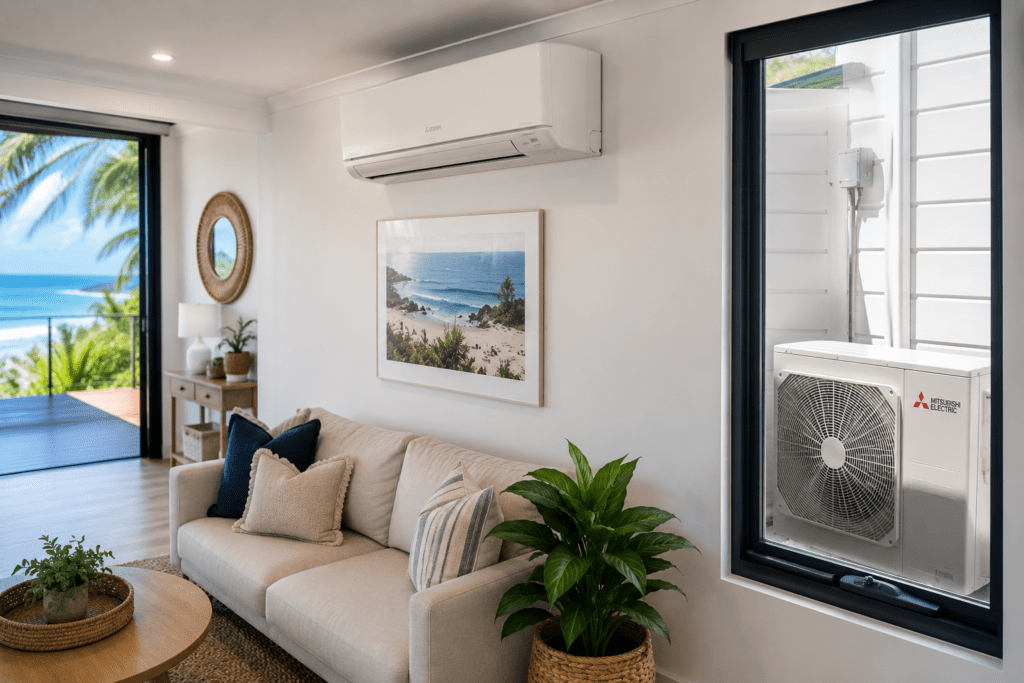
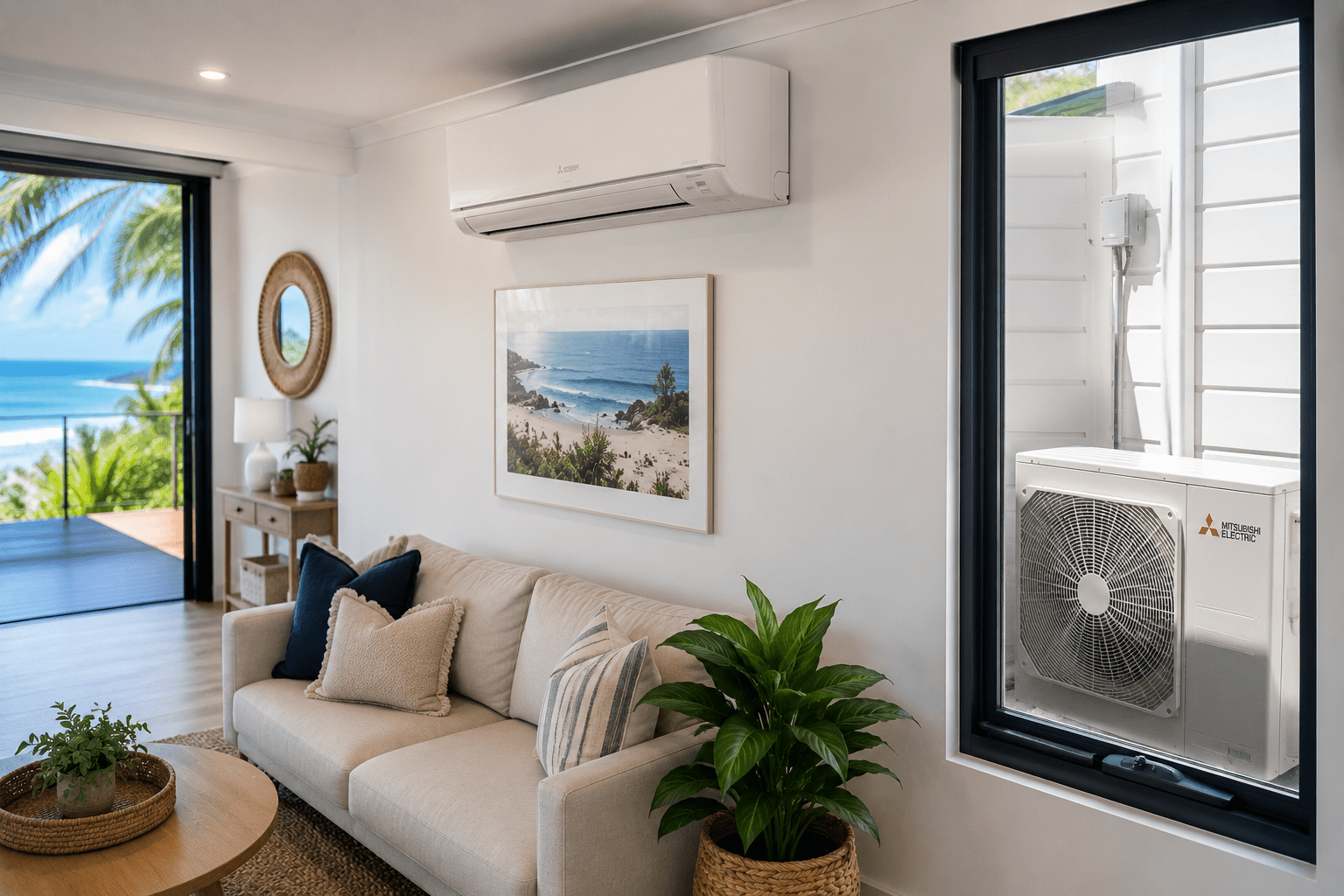
The physical location of your indoor and outdoor units has a direct impact on their performance, efficiency, and longevity. Incorrect indoor unit placement can lead to poor airflow, uncomfortable drafts, and uneven cooling, while a poorly positioned outdoor unit can severely hamper its ability to cool effectively and may lead to premature failure, especially in our coastal environment.
Strategic placement is a key part of a professional installation, and findings from Sustainable Hybrid Cooling: Integrating indirect evaporative and split air conditioning research highlight how placement and integration decisions significantly affect indoor air quality and efficiency in humid climates. A skilled technician will consider airflow dynamics inside and environmental factors outside, like sun exposure and salt air. Getting the placement right from the start makes sure your split system air conditioning Sunshine Coast system works as intended for years to come.
Common Indoor Unit Placement Errors To Avoid
Positioning the indoor unit correctly is about more than just aesthetics; it is about maximising comfort and efficiency. A common error is placing the unit where its airflow is blocked by curtains, tall furniture, or architectural features like bulkheads. This prevents conditioned air from circulating freely throughout the room, causing the unit to work harder than necessary and creating hot and cold spots. Another frequent mistake is installing the unit so it blows cold air directly onto a couch, bed, or workspace, creating uncomfortable drafts that can deter people from using the system.
Placing the unit near a heat source, such as directly above a large television, near kitchen appliances, or facing a large, unshaded window, can confuse its thermostat. This causes the unit to run longer than needed, trying to cool a perceived hotter temperature, thereby wasting energy. Finally, providing the unit is installed with a slight slope for proper condensate drainage is essential. An incorrect slope can lead to water leaks, which can damage your walls, flooring, and promote mould growth – a significant concern in our humid climate. A professional will also consider internal noise levels, positioning the unit to minimise disturbance in quiet areas like bedrooms or home offices.
Crucial Outdoor Unit Placement Mistakes In Sunshine Coast Conditions
The placement of the outdoor unit is just as important as the indoor one, especially given our local climate challenges. Placing an outdoor unit in direct, baking sunlight, particularly the intense afternoon sun common on the Sunshine Coast, forces it to work much harder to dissipate heat, with research such as Performance Evaluation of an evaporatively-cooled split system confirming how ambient heat exposure directly degrades system performance. This can reduce its efficiency by up to 10% or more, as demonstrated in An experimental study on how setpoint temperature and condenser conditions affect split-type air conditioner performance. The unit should ideally be installed in a shaded, well-ventilated area to allow it to breathe properly and operate efficiently. Confining it in a tight space, allowing it to be overgrown with foliage, or placing it too close to walls will restrict airflow and lead to overheating, increased energy consumption, and premature component wear.
For coastal properties, a major mistake is placing the unit in the direct path of salt spray from the ocean, which will cause it to rust and fail prematurely. Even a few hundred metres from the beach, salt corrosion can be an issue. Noise is another consideration; the unit’s fan can generate sound, so it should be positioned away from bedroom windows, outdoor living areas, and neighbouring properties to avoid disturbance. Proper mounting on a sturdy, level surface using anti-vibration pads is also important to minimise noise and prolong the unit’s life. At Sunshine Coast Projects & Electrical, we strategically position outdoor units to avoid these issues, providing optimal performance and a longer lifespan for your investment.
Sunshine Coast AC Installer Tip: For coastal homes, always ask your installer about units with anti-corrosion coatings and strategic placement away from direct sea breezes. It makes a big difference to longevity.
Is Your Electrical System Up To Task? Avoiding Overload And Fire Hazards
Installing a powerful modern appliance like a split system air conditioner on an outdated or inadequate electrical system is a serious risk. This oversight can lead to frequently tripped circuit breakers, damage to the air conditioner’s sensitive electronics, and even create a severe fire hazard within your home. For the safety of your family and property, this step cannot be ignored.
Before any installation, a professional electrical health check is non-negotiable. This assessment determines if your current system can handle the additional load safely. A potential switchboard upgrade might be necessary to provide the safe and reliable operation of your new air conditioner.
The Hidden Dangers Of An Overloaded Switchboard In Older Sunshine Coast Homes
Many older Sunshine Coast properties, from classic Queenslanders built in the early 20th century to 70s-80s brick homes, were built with switchboards never designed for today’s high-demand appliances. These older boards often feature outdated ceramic fuses and lack the capacity for a new, powerful split system. Adding a high-capacity air conditioner to one of these systems can easily overload the circuits, especially when other modern appliances like dishwashers, electric ovens, or charging stations are in use.
This overload can cause constant power trips, which are frustrating but also a warning sign. The greater danger is the heat generated in the wiring. Overheated wiring can melt its protective insulation, creating a serious fire hazard inside your walls. Relying on old, inadequate electrical infrastructure is a risk that simply is not worth taking with your family’s safety or your home’s integrity. Such issues are often hidden until a problem arises, making a pre-installation inspection essential.
How To Ensure Electrical Safety And Compliance For Your New AC
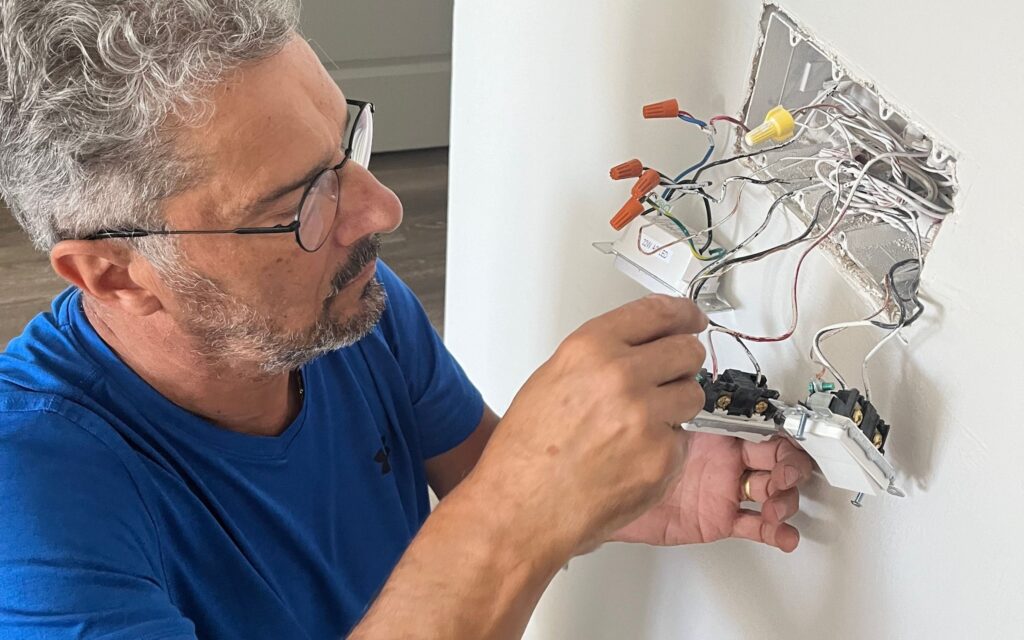
Making sure your home’s electrical system is safe for a new air conditioner involves a few key steps. The process should always begin with a vital electrical check from a licensed electrician. For most medium to large split systems, installing a dedicated circuit wired directly to the switchboard is a requirement. This prevents the air conditioner from interfering with other appliances, avoids nuisance tripping, and provides a stable power supply for your unit.
In many cases, particularly for older homes, a full switchboard upgrade is the best solution. This involves replacing old fuses with modern RCBOs (Residual Current Breaker with Overcurrent), which provide dual protection. RCBOs protect against both short circuits (preventing fires) and earth leakage (preventing electrocution). This brings your home’s electrical system up to current safety standards. Sunshine Coast Projects & Electrical, as Master Electricians, makes sure every installation strictly adheres to Australian Standards (AS/NZS 3000) and local safety regulations, providing complete peace of mind. We can assess your existing electrical system and recommend any necessary upgrades.
Why You Can’t DIY: The Risks Of Unlicensed Air Conditioning Installation
Attempting to install a split system air conditioner yourself or hiring an unlicensed person to do it is a decision fraught with risk. In Australia, this type of work is not only dangerous but also illegal. A DIY installation will instantly void your manufacturer’s warranty and may compromise your home insurance policy, leaving you exposed to significant financial liabilities.
Only licensed professionals who hold both an electrical licence and a refrigeration handling licence (ARC – Australian Refrigeration Council) are qualified to perform this work. Engaging a certified expert like those at Sunshine Coast Projects & Electrical provides a safe, compliant, and efficient installation that protects both your home and your investment.
The Legal And Warranty Pitfalls Of DIY Or Unlicensed Work
The legal and financial consequences of uncertified air conditioning work are severe. Under Australian law, handling refrigerants without an Australian Refrigeration Council (ARC) licence is illegal due to the environmental risks of ozone depletion and climate change from refrigerant leaks. Similarly, all hardwired electrical work, which is required for split systems, must be completed and certified by a licensed electrician. Failing to comply can result in heavy fines from authorities like the Electrical Safety Office and the Australian Refrigeration Council.
Furthermore, manufacturers will not honour the warranty on any unit installed by an unlicensed individual. If something goes wrong with the system, you will be responsible for the full cost of repairs or replacement, which can run into thousands of dollars. Additionally, if an uncertified installation causes a fire, water damage, or other property damage, your home insurance claim may be denied, as most policies require work to be carried out by qualified professionals. When you choose a professional company, you get the backing of a workmanship guarantee, something Sunshine Coast Projects & Electrical provides for a full 12 months.
What Can Go Wrong? Safety Risks And Performance Issues
Beyond the legal and financial issues, a poor installation can lead to a host of practical problems and safety hazards. Incorrect wiring, loose connections, or an overloaded circuit can easily spark an electrical fire, putting your family and home at extreme risk. Improperly flared refrigerant lines are a common issue in DIY jobs, leading to slow refrigerant leaks that cripple the system’s efficiency, harm the environment, and are expensive to locate and repair. Leaks also mean the system will not cool effectively and will cost more to run.
Other risks include:
-
Electrical shock: Working with high voltage without proper training is extremely dangerous.
-
Refrigerant burns: Contact with refrigerant can cause severe frostbite.
-
System damage: Incorrect vacuuming of the lines can leave moisture and non-condensable gases in the system, leading to compressor failure.
-
Poor performance: Even if the system runs, its performance will likely be suboptimal, meaning you will pay more in running costs for less effective cooling, and it will break down sooner.
With decades of expertise, the team at Sunshine Coast Projects & Electrical guarantees flawless electrical and refrigeration work, mitigating these risks entirely and providing you with a reliable, efficient cooling system.
How To Maximise Your Split System’s Lifespan: Avoiding Maintenance And Efficiency Errors
Once your split system is professionally installed, avoiding common maintenance and operational mistakes is key to its long-term health. Regular maintenance, including both simple tasks you can do yourself and an annual professional service, is essential for maintaining high air quality, optimal efficiency, and extending the unit’s lifespan.
Similarly, understanding how to operate your system smartly can drastically lower your running costs and prevent unnecessary wear and tear on its components. A little bit of knowledge about proper use goes a long way in protecting your investment and enjoying comfortable cooling without excessive bills.
Neglecting Regular Maintenance And Servicing
One of the most damaging mistakes is neglecting basic maintenance. The dust filters on the indoor unit are your first line of defence. If they become clogged with dust, pet dander, and other airborne particles, airflow is restricted, forcing the system to work harder and consume more electricity. This can also lead to poor indoor air quality, reduced cooling capacity, and mould growth – a common problem in the Sunshine Coast’s humid climate, particularly for older residents whose health is more sensitive to air quality issues, as Db511.Pdf from the CDC highlights the prevalence of health conditions exacerbated by poor indoor environments. Homeowners should clean these filters every few months, more frequently if you have pets or live in a dusty area.
Other issues like blocked condensate drains, caused by algae or debris, can lead to water leaking from the indoor unit, damaging your walls, floors, or furniture. Microscopic refrigerant leaks can gradually reduce the system’s cooling power and eventually damage the compressor beyond repair. An annual professional service by a licensed technician is vital to address these deeper issues through:
-
Chemical cleaning: Deep cleaning of coils and fans to remove stubborn mould and grime.
-
Refrigerant pressure checks: To identify and fix any leaks, and make sure correct refrigerant levels.
-
Tightening electrical connections: Preventing loose connections that can lead to faults or fire hazards.
-
Drainage line clearing: Flushing the condensate line to prevent blockages.
-
Overall system inspection: Checking for wear and tear on components, ensuring efficient operation.
Operational Mistakes That Waste Energy And Shorten Life
How you use your air conditioner has a big impact on its efficiency and lifespan. A common error is falling for the “18-degree myth”—the belief that setting the thermostat to a very low temperature will cool the room faster, a misconception addressed in practical guides like Surviving 43°C: A Quick fix guide for struggling air conditioners, which explains optimal operating strategies during extreme heat. It will not. It only forces the compressor to run continuously at maximum output, driving up your power bill significantly. An optimal setting in summer for both comfort and energy efficiency is a comfortable 23-24°C. Every degree lower can significantly increase your running costs.
Another mistake is leaving doors and windows open while the air conditioner is running. This allows the cool air to escape and hot, humid air to enter, forcing the system into a never-ending battle against the outdoor heat. This is like trying to cool your entire neighbourhood! Furthermore, blocking the indoor or outdoor vents with furniture, plants, or other objects prevents proper airflow, leading to uneven cooling, inefficient operation, and unnecessary strain on the unit. Using timer functions, sleep modes, and pairing your AC with ceiling fans can further reduce energy consumption and improve comfort. Sunshine Coast Projects & Electrical can guide you on the best practices for your specific system and lifestyle.
Conclusion: Invest In Smart Comfort, Avoid Costly Mistakes
Successful split system air conditioning Sunshine Coast ownership depends on avoiding common installation and operational mistakes. Your long-term comfort and value are secured by prioritising correct sizing, thoughtful unit placement, electrical integrity, professional installation, and ongoing maintenance. Trusting local experts like Sunshine Coast Projects & Electrical guarantees a safe, compliant, and energy-efficient cooling system perfectly matched to your home and our specific coastal climate. Don’t leave your comfort to chance; make sure it’s done right from the very beginning.
Contact us today for a fast, upfront, and obligation-free quote on your split system air conditioning needs.
Frequently Asked Questions
Question: How much does split system air conditioning installation cost on the Sunshine Coast?
The cost typically ranges from $2,000 to $5,000. This price varies based on the unit’s size and brand, as well as the complexity of the installation. Factors influencing cost include whether it’s a simple back-to-back setup, the need for switchboard upgrades, or difficult access. A professional quote will break down these costs.
Question: What size split system do I need for my living room?
This depends heavily on your room’s dimensions, ceiling height, insulation quality, and window orientation. For instance, a west-facing living room with large windows will need more cooling capacity. Large, open-plan living areas on the Sunshine Coast often require a 7.0kW to 9.0kW system. Sunshine Coast Projects & Electrical performs professional load calculations for precise sizing, which is the most accurate way to determine your needs.
Question: Can I install a split system air conditioner myself?
No, DIY installation is illegal and dangerous in Australia. It requires a licensed electrician for all wiring and an ARC-licensed technician for refrigerant handling due to environmental and safety regulations. Unlicensed work voids all manufacturer warranties, can create a serious fire hazard in your home, and may lead to significant fines and insurance issues.
Question: Are split systems good for coastal areas like the Sunshine Coast?
Yes, they are an excellent choice if the right unit is selected and installed correctly. Premium brands often offer special anti-corrosion coatings, which are highly recommended for properties near the ocean. Proper placement of the outdoor unit away from direct salt spray and sea breezes is essential for longevity and to prevent premature rust. Regular cleaning also helps.
Question: What’s the best temperature to set my air conditioner for energy efficiency?
For optimal comfort and energy efficiency in summer, setting your thermostat to 23-24 degrees Celsius is ideal. Every degree lower can significantly increase your running costs by making the compressor work harder. Modern inverter systems are most efficient when run continuously at a moderate temperature, rather than constantly turning on and off at very low settings.
Question: How often should I get my split system serviced?
You should clean the dust filters yourself every few months, or more frequently if you notice reduced airflow or have pets. An annual professional service by a licensed technician is vital to keep efficiency high, prevent major breakdowns, maintain healthy air quality (especially to prevent mould), and hold your manufacturer and installation warranties.
Question: Can Sunshine Coast Projects & Electrical help with switchboard upgrades alongside AC installation?
Absolutely. As Master Electricians, this is our specialty and a common requirement for many older Sunshine Coast homes. We conduct thorough electrical health checks and perform professional switchboard upgrades to safely support your new split system and other modern appliances, including home EV chargers. This makes sure your entire electrical system is compliant with current Australian Standards and ready for modern demands.