Are you tired of rising fuel prices dictating your weekly budget? When it comes to Petrol vs Electric Cars, more Australians are asking which option truly saves more money over time. Do you dream of a car that costs less to run and is kinder to our beautiful Sunshine Coast environment?
This shift in thinking is driving a major change in how we choose our next vehicle.
For homeowners and business operators here on the Sunshine Coast, this isn’t just a hypothetical debate; it’s a practical financial decision. The choice between petrol and electric has long-term implications for your wallet and your lifestyle. This article cuts through the noise to deliver a straightforward, honest comparison focused on real-world savings. We’ll break down everything from the initial purchase price to ongoing running costs and maintenance to help you make an informed decision.
As local experts with over 20 years of experience, we at Sunshine Coast Projects & Electrical are committed to providing transparent advice and quality electrical services. We believe in making the transition to electric vehicle ownership both accessible and affordable. Backed by our 12-month workmanship guarantee and a promise of free, upfront quotes, we’re here to help you navigate your electrical needs, whether it’s a simple repair or a full EV charger installation.
Key Takeaways
-
Electric vehicles (EVs) typically have higher upfront purchase costs, but these are offset by significantly lower running costs, especially when utilizing home charging and solar power.
-
Maintenance for EVs is generally simpler and cheaper than for petrol cars due to having far fewer moving parts in the engine and drivetrain.
-
A professional home EV charger installation is the most important step for maximizing the financial savings and convenience benefits of owning an electric car.
The Upfront Showdown: Purchase Price & Incentives
For most people, the first hurdle when considering a new vehicle is the sticker price. It’s a common understanding that electric vehicles have historically carried a higher price tag than their petrol-powered equivalents, primarily due to the cost of advanced battery technology and manufacturing. While this has been a significant barrier, the financial outlook is changing rapidly.
The price gap between petrol and electric cars is steadily narrowing. As manufacturing scales up and battery technology improves, EVs are becoming more competitive across various vehicle segments. However, the most significant factor leveling the playing field for Australian buyers is government support. To encourage the switch to cleaner transport, both federal and state governments offer a range of incentives that can dramatically reduce the effective purchase price of an EV.
Currently, for residents on the Sunshine Coast, the Queensland Government has offered programs like the Zero Emission Vehicle Rebate Scheme, which can provide thousands of dollars back on eligible new EV purchases. Furthermore, some models may qualify for stamp duty exemptions or reductions, providing another immediate saving. For businesses and employees, the federal Fringe Benefits Tax (FBT) exemption for eligible electric cars can make novated leasing an incredibly attractive and tax-effective option. It’s essential for prospective buyers to check the current QLD government offerings, as these incentives can turn a seemingly expensive EV into a financially savvy choice. This brings us to the concept of the Total Cost of Ownership (TCO), because the initial price is only one part of the financial story. A careful calculation of TCO considers not just the purchase price, but also fuel, maintenance, insurance, and resale value over the vehicle’s lifespan.
“The overall cost of owning an electric vehicle is rapidly becoming a significant factor in consumer decisions, often presenting a more economical choice over the lifespan of the car.” – Clean Energy Council Report, 2023
Fueling Your Ride: Running Costs & Maintenance Savings
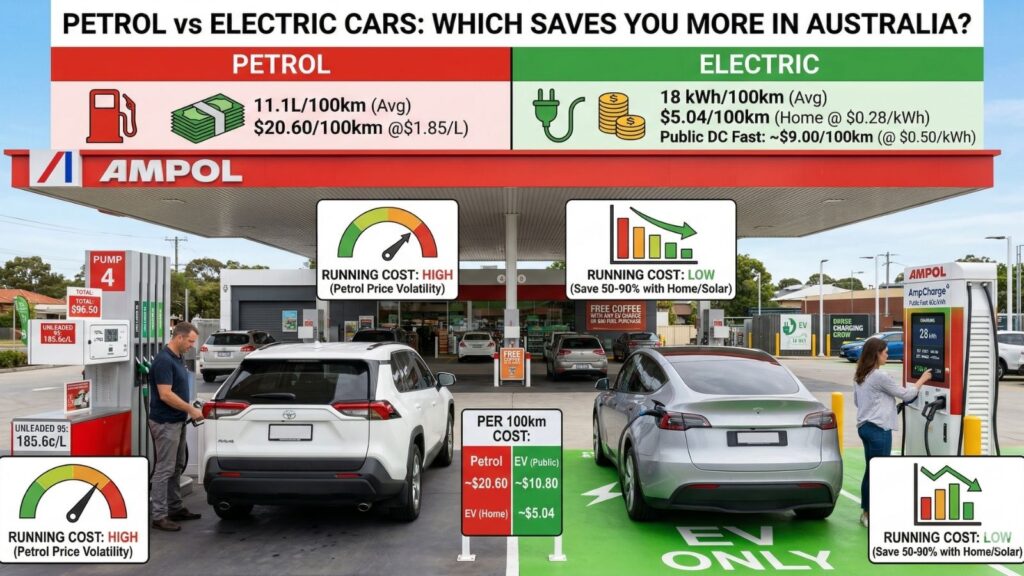
This is where electric vehicles truly begin to pull ahead in the financial race. The ongoing expenses associated with keeping a car on the road are where the most substantial long-term savings are found, and the difference between petrol and electricity is stark. For drivers on the Sunshine Coast, the constant fluctuation of petrol prices is a familiar and often frustrating part of the weekly budget. These costs are tied to volatile global markets, leaving you with little control over this major expense.
In contrast, the “fuel” for an EV—electricity—is far cheaper and more stable. The cost per kilometre for a petrol car can easily be $15-$20 per 100km, while an EV charged at home might cost as little as $3-$7 for the same distance. The savings become even more impressive when you factor in smart charging strategies. By using an off-peak electricity tariff, you can charge your car overnight for a fraction of the standard rate. For Sunshine Coast homeowners with a solar power system, the savings are immense—you can essentially power your car for free using the clean energy generated by the sun. Making use of smart charging apps and timers allows owners to further optimize when they charge, taking advantage of the cheapest available electricity.
The financial benefits continue in the service bay. An electric vehicle has drastically fewer moving parts than a petrol car. There is no engine oil to change, no spark plugs or filters to replace, no exhaust system to repair, and no complex multi-speed gearbox. This mechanical simplicity translates directly to lower maintenance costs and less frequent servicing. While a petrol car requires regular, often costly, services to maintain its engine, an EV’s maintenance schedule is typically limited to checks on:
-
Tyres: Similar to petrol cars, but wear can be reduced due to regenerative braking.
-
Brakes: Often wear slower due to regenerative braking, which converts kinetic energy back into electricity, reducing the need for friction braking.
-
Wiper fluid and cabin filters: Standard for any vehicle.
-
Software updates: Often performed remotely or during routine checks.
While insurance premiums for EVs are becoming more competitive, and registration costs vary by state, the savings on fuel and maintenance create a compelling financial advantage over the life of the vehicle.
Maximising Your Savings with Home EV Charger Installation
The absolute game-changer for EV ownership is having a dedicated charger at home. It offers the greatest convenience and the lowest possible running costs. At Sunshine Coast Projects & Electrical, we specialize in the expert installation of Level 2 wall chargers, which is the key to making your EV lifestyle seamless. We can assess your existing electrical infrastructure and integrate the charger with your solar system, allowing you to charge your vehicle directly from the sun. This professional installation makes sure you can take full advantage of cheaper off-peak electricity rates for overnight charging. More importantly, it guarantees the safety, compliance, and long-term reliability of your setup, all handled by licensed and insured electricians. With a free, transparent, fixed-price quote from us, you can eliminate the hassle of public charging stations and start every day with a full “tank.” Our team also provides guidance on choosing the right charger and understanding your electricity tariffs to further maximize your savings.
Beyond the Wallet: Driving Experience, Environment & Charging Practicalities
While the financial savings are a major drawcard, the benefits of electric vehicles extend far beyond your bank account. The driving experience itself is often a revelation for those new to EVs. Electric motors deliver instant torque, resulting in smooth, silent, and incredibly responsive acceleration. This makes navigating city traffic or merging onto the highway effortless and enjoyable. The quiet operation creates a more serene cabin environment, reducing driver fatigue on longer trips. Furthermore, the low-slung position of the battery pack gives most EVs a lower centre of gravity, leading to improved handling and stability through corners, making for a more engaging drive.
From an environmental standpoint, the advantage is clear. EVs produce zero tailpipe emissions, which contributes directly to cleaner air quality right here on the Sunshine Coast. While the overall carbon footprint depends on how the electricity is generated (the “well-to-wheel” emissions), this impact is drastically reduced when charging with renewable energy. As Australia’s energy grid progressively incorporates more clean energy sources, the environmental benefits of EVs will only grow. For homeowners with solar panels, an EV becomes an exceptionally green mode of transport, drawing energy directly from the sun. The manufacturing of batteries does have an environmental impact, but the industry is making great strides in battery recycling and ethical material sourcing to create a more sustainable lifecycle.
Concerns about “range anxiety” are also becoming a thing of the past. Most modern EVs offer a driving range of 300-600+ kilometres on a single charge, which is more than enough for daily commutes and weekend trips around the Sunshine Coast and beyond. While the public charging network of AC and DC fast chargers is expanding rapidly across Australia, the reality for most owners is that the vast majority of charging happens conveniently at home, overnight. This means waking up every morning with a full charge, much like plugging in your phone.
The Long Game: Resale Value & Future-Proofing Your Investment
When making a significant purchase like a car, it’s wise to consider its long-term resale value. Historically, there have been questions about the resale value of EVs, often linked to concerns about battery longevity. However, these worries are largely being put to rest. Modern EV batteries are engineered to last the lifetime of the vehicle and come with extensive warranties, typically for 8-10 years or 160,000 km, offering peace of mind. Battery degradation over time is proving to be minimal for most drivers.
As public confidence grows and the demand for used EVs increases, their resale values are becoming more stable and predictable. In fact, as Australia’s shift towards electrification accelerates, propelled by government policies like fuel efficiency standards, owning an EV is increasingly seen as a future-proof investment. The long-term demand for petrol vehicles may decline, potentially impacting their future resale values more significantly. Choosing an electric car today is not just about immediate savings; it’s about aligning with the future direction of transport in Australia and making a wise long-term purchase.
Ready to Start Saving on Fuel?
With the right setup, you could dramatically reduce your weekly fuel costs—or even eliminate them entirely.
👉 Get a free EV charger quote and see how easy it is to switch.
Conclusion
While the higher upfront cost of an electric car is a valid consideration, the story doesn’t end there. Once you factor in the substantial long-term savings on running costs and maintenance, the financial case for EVs becomes incredibly strong, especially for those who can charge at home. The best choice finally depends on your personal lifestyle, driving habits, and budget.
For Sunshine Coast residents ready to adopt the future of driving and realize significant savings, the path starts at home. Contact Sunshine Coast Projects & Electrical today for a free, transparent quote on an expert EV charger installation.
FAQs
Are electric cars cheaper to maintain than petrol cars in Australia?
Yes, generally. EVs have significantly fewer moving parts, which means you can say goodbye to oil changes, spark plug replacements, and complex engine servicing. Maintenance typically focuses on simpler items like brakes, tyres, and software updates, resulting in lower and less frequent service bills over the vehicle’s lifetime.
How much can I save on fuel costs by switching to an EV on the Sunshine Coast?
The savings can be substantial. Petrol costs are volatile and expensive, whereas charging an EV at home, especially with solar power or during off-peak hours, is dramatically cheaper. Many drivers find they can reduce their “fuel” bill by 70-90%, with solar owners potentially driving on sunshine for virtually no cost.
Is the initial purchase price of an electric car worth it in Australia?
While EVs often have a higher upfront cost, government incentives like Queensland’s ZEV rebate scheme and federal FBT exemptions can significantly reduce this initial outlay. When you consider the huge long-term savings on fuel and maintenance, the total cost of ownership for an EV is often lower, making the initial investment very worthwhile.