Sunshine Coast Home EV Charger Installation: What Homeowners Need to Know
Home EV charger installation on the Sunshine Coast typically involves installing a Level 2 wall charger connected to a dedicated circuit by a licensed electrician. Most homes can support EV charging, but older properties may require switchboard upgrades or electrical capacity checks to ensure safe, fast, and compliant charging for your electric vehicle.
How Sunshine Coast Homeowners Can Prepare Their Property for EV Charger Installation
With the sunny skies and beautiful roads of the Sunshine Coast becoming home to more electric vehicles every day, the conversation is shifting from “if” to “how” we power this new wave of transport. Plugging into a standard wall socket might seem like an easy fix, but it’s like trying to fill a swimming pool with a garden hose—slow, inefficient, and not designed for the job. A proper home EV charger installation is the key to revealing the full potential of your electric car.
This upgrade is about more than just convenience; it’s about making your home safer, smarter, and ready for the future. For Sunshine Coast homeowners, getting this right means making sure your electrical system can handle the load safely and that you’re charging in the most cost-effective way possible. As local electricians with over 20 years of experience serving our community, we at Sunshine Coast Projects & Electrical have seen firsthand the difference a professional installation makes.
This guide will walk you through everything you need to know in 2026. We’ll cover the benefits, explain the different types of chargers, detail the installation process, and show you how to get the most savings with solar and smart technology. Consider this your complete resource for preparing your home for the electric revolution, backed by trustworthy, local expertise.
Key Takeaways
- Dedicated home EV chargers offer unmatched convenience, far superior speed, and important electrical safety compared to using a standard power point for your vehicle.
- Understanding your home’s power supply (single-phase vs. three-phase) and choosing the right charger type, with Level 2 being the recommended residential solution, is the key first step.
- A professional electric vehicle charger installation is needed to make sure compliance with Australian safety standards and to properly address any challenges with your home’s existing electrical infrastructure.
- You can achieve maximum cost savings by integrating your charger with a home solar system and using smart charging features to take advantage of off-peak electricity rates.
Unpacking The Benefits Of A Dedicated Home EV Charger
Opting to install a dedicated EV charging station at your Sunshine Coast home provides a host of advantages that go well beyond simply plugging into a wall socket. These benefits touch on everyday ease of use, charging speed, electrical safety, and intelligent energy management, completely changing your ownership experience.
“Having a dedicated EV charger at home isn’t just about convenience; it’s about seamlessly integrating electric driving into your daily life with safety and efficiency at the forefront.” — A seasoned EV owner
Unmatched Convenience And Accessibility
Imagine arriving home, parking your car, and plugging it in within seconds. A wall-mounted, tethered charger is always ready and waiting. This simple act removes the daily chore of digging a portable charger out of the boot, untangling cables, and finding an available power point. It creates a smooth routine that makes sure you can wake up every morning to a fully charged vehicle, ready for your daily commute or weekend adventures. Sunshine Coast Projects & Electrical makes sure a tidy and practical setup that integrates perfectly into your daily life, making charging an effortless part of your day.
Superior Charging Speed And Efficiency
The most noticeable improvement from a dedicated home electric car charging point is the significant boost in charging speed. A standard household outlet delivers about 1.4-2.4kW, adding only 10-12km of range per hour. In contrast, a 7kW single-phase charger—the common choice for most homes—adds approximately 35-40km of range per hour. For properties with three-phase power, a compatible charger can deliver up to 22kW, providing a massive 50-130km of range per hour. This speed is a game-changer for drivers with longer commutes and makes it easy to schedule charging during cheaper off-peak electricity periods.
Enhanced Electrical Safety And Reliability
Safety is a non-negotiable aspect of any electrical work. An electric car charger for home is connected via its own dedicated circuit directly to your switchboard. This is an important safety feature that prevents overloading your existing household circuits, which may already be supporting other large appliances. Continuous high-power draw from a shared circuit can lead to overheating, damage to your home’s wiring, or frequent breaker trips, particularly in older properties. Sunshine Coast Projects & Electrical prioritises the safety of your home’s electrical system, making sure all components are installed to current Australian safety standards, including 40A Type A RCBOs and 10mm² cabling to prevent any hazards.
Smart Features For Optimised Charging
Modern home chargers come with smart technology that gives you powerful control over your energy use. Through Wi-Fi connectivity and mobile apps, you can monitor charging sessions, track energy consumption, and schedule charging remotely. This allows you to program your car to charge only during off-peak periods when electricity is cheapest, leading to direct savings on your power bill. Many smart chargers also integrate with home solar systems, automatically using your self-generated power to charge your car for free. These features help Sunshine Coast homeowners manage their EV charging proactively and keep their running costs to a minimum.
Understanding EV Charger Types And Your Home’s Power On The Sunshine Coast
Before you can proceed with an installation, it’s important to understand the different types of chargers available and how they relate to your home’s specific power supply. This knowledge will help you choose the right equipment and prepare for a smooth installation process with a qualified EV charging station electrician.
Level 1 Chargers: The ‘Granny Charger’ Overview
A Level 1 charger, often called a ‘granny charger’, is a portable unit that plugs into a standard 10A household power point. While it offers a basic charging method, it is by far the slowest option, delivering only 1.4-2.4kW of power. This equates to adding just 10-12km of range per hour, meaning a full charge could take over 24 hours. Due to its slow speed and the potential risk of overheating old wiring from prolonged use, it is not recommended as a primary, everyday charging method. It’s best kept in the car for emergency top-ups.
Level 2 Chargers: The Preferred Residential Solution
Level 2 chargers are the standard for residential installations. These are dedicated, wall-mounted units that an electrician hardwires directly to your switchboard. They offer significantly faster and safer charging, typically delivering 7kW on a single-phase connection or up to 22kW on three-phase power. A level 2 EV charger installation can provide a full charge in 4-12 hours, making it perfect for convenient overnight charging. The dedicated circuit makes sure it can handle the sustained power draw safely and efficiently.
Level 3 Chargers: Commercial Fast Charging (Brief Mention)
Level 3 chargers, or DC Fast Chargers, are the ultra-fast stations you see at public charging locations. They provide direct current (DC) at very high power levels (50kW to 350kW), capable of charging a vehicle to 80% in under an hour. Due to their immense power requirements and high cost, they are designed for commercial and public use and are not suitable for a residential EV charger installation.
The Important Difference: Single-Phase Vs. Three-Phase Power
Most average Australian homes on the Sunshine Coast are connected to single-phase power, which is perfectly adequate for a 7kW charger to meet daily driving needs. Some larger homes or properties with workshops may have three-phase power, which offers a higher capacity for faster charging. You can usually identify your power type by checking your switchboard; a single main switch indicates single-phase, while three main switches suggest three-phase. Sunshine Coast Projects & Electrical can easily confirm your home’s power supply during a site assessment.
Assessing Your Home’s Electrical Infrastructure
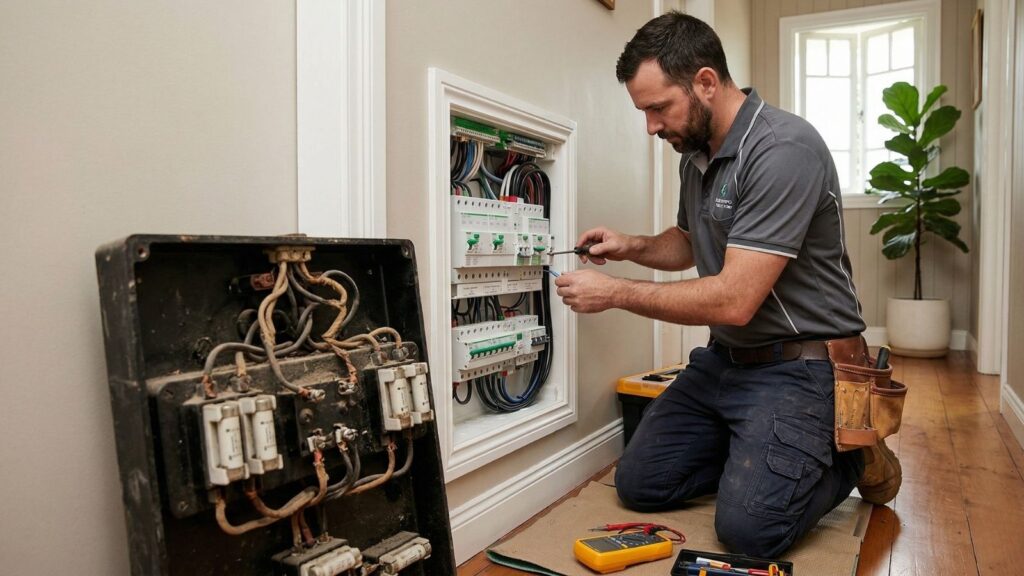
An important first step is a professional assessment of your home’s electrical system, particularly given that new research reveals stark inequities in EV charger access across different property types and neighbourhoods, making it critical to understand your home’s specific situation. A licensed electrician will inspect your switchboard to confirm it has enough capacity for the new charger. Key considerations include the condition of the board, as older homes may require an upgrade to meet current safety standards. They also check main breaker limits, which can be a factor in townhouses that share supply. Sunshine Coast Projects & Electrical provides comprehensive Home Readiness Assessments to determine if your infrastructure is safe and ready, identifying any necessary upgrades to support your new home EV charging point.
The Professional Home EV Charger Installation Process With Sunshine Coast Projects & Electrical
A safe and compliant home EV charger installation is a job for a qualified professional. At Sunshine Coast Projects & Electrical, our process is designed to make sure your new charging station is installed correctly, functions optimally, and meets all Australian safety standards.
Selecting The Optimal Location For Your Charger
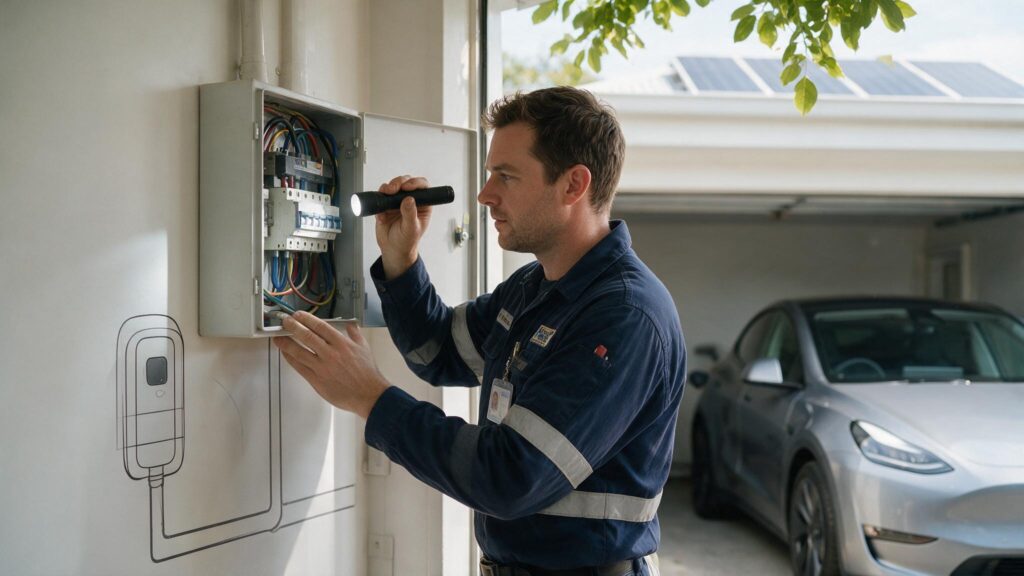
The most common location for a charger is in the garage or carport. During our consultation, we help you determine the best spot based on several factors. We consider where your vehicle’s charging port is located and how you normally park to make sure the cable can reach comfortably. The distance to your switchboard can also influence the complexity and cost of the installation. If you need an outdoor installation, we’ll make sure the charger has an appropriate weather-resistance rating, such as IP65, to withstand the elements.
The Importance Of A Professional Site Assessment
This is an important first step. A thorough site assessment by a licensed electrician is important for a safe and successful outcome. During this visit, we inspect your electrical panel to confirm it can support the new load and identify the best route for wiring. For older homes, we’ll determine if a switchboard upgrade is needed to handle the charger safely. Sunshine Coast Projects & Electrical conducts these detailed assessments to identify and solve any challenges upfront, such as old wiring or insufficient capacity, giving you complete peace of mind.
Key Electrical Components: Wiring, Conduit, And Circuit Protection
A professional electric charging station installation involves more than just mounting a box on the wall. We install a dedicated circuit from your switchboard to the charger, using 10mm² power cabling to minimise voltage drop and make sure efficient power delivery. This wiring is protected within a conduit for safety. We also install important protection devices, like a 40A Type A RCBO, to guard against overcurrents and earth leakage faults. As required by Australian standards, we install an isolator switch within one metre of the charger, allowing you to safely disconnect power for maintenance.
Post-Installation Procedures And Homeowner Guidance
Our job isn’t finished once the charger is on the wall. We conduct thorough testing to confirm everything is working correctly and complies with AS/NZS 3000:2018 Wiring Rules. After that, we take the time to walk you through how to use your new charger, interpret its status lights, and get the most out of its smart features. We’ll explain safety protocols and offer tips on cost-saving strategies like off-peak charging. As your local, trustworthy electrician for Tesla charger installation and other brands, Sunshine Coast Projects & Electrical provides a 12-month workmanship guarantee and makes sure you feel confident and educated about your new system.
Maximising Savings: Solar Integration, Smart Charging, And Costs
One of the greatest appeals of owning an EV is the potential for huge savings on running costs. For Sunshine Coast homeowners, combining a home charger with solar power and smart energy management is the key to getting the lowest possible “refuelling” expenses.
“The true economic advantage of an EV comes alive when you pair it with home solar. It’s not just driving electric; it’s driving on sunshine.” — Renewable Energy Advocate
Utilizing Solar Power And Battery Storage For EV Charging
Charging your EV directly from your rooftop solar system is the best way to save money. During the day, any excess power your panels generate can be sent straight to your car, providing you with free, clean energy for your commute. A home solar battery takes this a step further by allowing you to store that excess solar energy for use at night, so you can still charge your EV cheaply after the sun goes down. With government initiatives like the Federal Government’s Cheaper Home Batteries Program making battery storage more affordable, this integrated approach is becoming increasingly popular.
Smart Charging And Advanced Energy Management Solutions
Modern chargers come with intelligent features designed to save you money. One of the most important is Dynamic Load Management (DLM), which is important for homes with limited electrical supply. DLM monitors your home’s total energy use in real-time and adjusts the charger’s power draw to prevent tripping your main circuit breaker. Many smart chargers also support OCPP (Open Charge Point Protocol), which allows them to communicate with certain energy retailers. This enables automated charging when wholesale electricity prices are at their lowest, optimising your costs without you having to lift a finger.
Calculating And Minimising Your Home EV Charging Costs
Your exact charging cost depends on your vehicle’s battery size, how much you drive, and your electricity tariff. The cheapest way to charge is always from your own solar. The next best option is to use a smart charger to schedule charging during your provider’s off-peak hours, which are typically overnight. For example, charging a Hyundai Kona Electric on an off-peak rate of 15c/kWh could cost as little as $7 for a full 370km of range. Sunshine Coast Projects & Electrical helps homeowners slash their energy bills by designing smart electrical systems that work in harmony with their EV charging needs.
Frequently Asked Questions (FAQs)
Here are answers to some of the most common questions Sunshine Coast homeowners ask about installing an EV charger.
Question: What Is The Typical Cost To Install An EV Charger At Home On The Sunshine Coast?
The electric car charging point installation cost typically ranges from $2000 to $2500, which includes a quality charger unit and a standard installation. However, more complex jobs requiring extensive trenching or a switchboard upgrade can increase the price. Sunshine Coast Projects & Electrical always provides a free, transparent quote upfront.
Question: How Long Does It Take To Install An EV Charger?
A standard home EV charger installation can usually be completed by a qualified electrician in 4 to 8 hours. If the job is more complex and involves significant electrical upgrades or difficult wiring runs, it may take longer.
Question: Do I Need A Three-Phase Power Supply For An EV Charger?
Not usually. Most homes on the Sunshine Coast have single-phase power, which is perfectly suitable for a 7kW charger. This speed is more than enough for the daily charging needs of most EV owners. Three-phase power allows for faster charging but is not a necessity.
Conclusion
Making the move to an electric vehicle is an exciting step, and installing a dedicated home charger is a smart, safe, and efficient investment for any EV owner on the Sunshine Coast in 2026. It provides unmatched convenience, faster charging, and the potential for substantial cost savings, especially when paired with solar power and smart technology.
Remember, a professional installation is needed for the safety of your home and the optimal performance of your charger. Don’t leave it to chance.
Ready to prepare your home for the future of driving? Contact Sunshine Coast Projects & Electrical today for a free quote on your home EV charger installation. Let our 20+ years of local experience and 12-month workmanship guarantee give you the confidence you need.
Ready to Install a Home EV Charger?
⚡ Book a Home EV Charger Assessment
Our licensed electricians will inspect your switchboard and electrical capacity to confirm your Sunshine Coast home is ready for EV charging.
⚡ Request a Free EV Charger Installation Quote
Receive a clear, no-obligation quote tailored to your vehicle, home power supply, and charging requirements.
⚡ Upgrade Your Switchboard for Safe EV Charging
Older switchboards may not support Level 2 chargers. We can upgrade your electrical system to ensure safe and compliant charging.
⚡ Speak With a Sunshine Coast EV Charging Expert
Have questions about charger types, installation costs, or solar integration? Our experienced electricians are here to help.