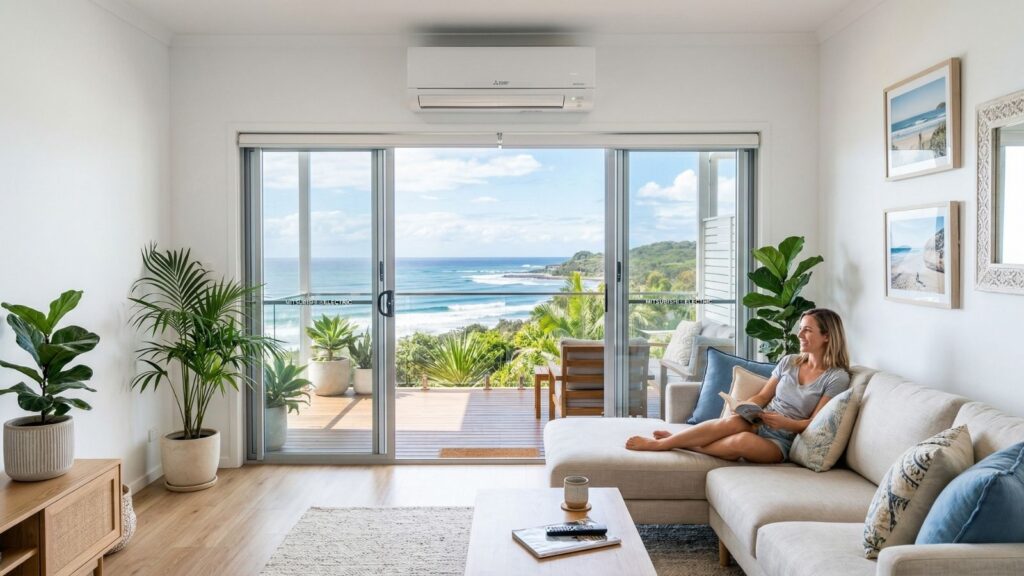
Living on the Sunshine Coast is a privilege. We get to enjoy stunning beaches, beautiful weather, and a laid-back lifestyle. But that beautiful ocean breeze that we love? It carries a secret, silent killer.
A killer that is, right now, eating away at your home’s most expensive appliances.
We’re talking about salt air corrosion.
As your local Sunshine Coast electrical and air conditioning team, we get the same sad call all the time, especially from homeowners in Marcoola, Coolum, and Mooloolaba. “My air conditioner is only three years old, and it’s dead! The repairman said it’s ‘rusted out’ and not covered by warranty. How is that possible?”
The answer is simple: salt.
That salty, humid air is the number one enemy of your air conditioner. It can reduce a top-of-the-line unit to a leaking, rusted-out piece of junk in just a few short years. But it doesn’t have to be this way.
This is our complete guide for Sunshine Coast homeowners on what salt air corrosion is, how to spot it, and the non-negotiable steps you must take to protect your investment.
What is Salt Air Corrosion?
In simple terms, corrosion is a chemical reaction where metal breaks down. When you add salt (from the ocean) and moisture (our famous QLD humidity), this process goes into hyperdrive.
The salty, humid air acts like an acid, creating an electrical reaction called galvanic corrosion that literally eats the metal components of your A/C unit for breakfast.
And here on the Sunshine Coast, we’re in the “red zone.” We don’t just have salty air; we have hot, humid, salty air. This combination is so aggressive that many experts consider coastal QLD one of the most corrosive environments in Australia.
Even if you live “inland” in suburbs like Buderim or Nambour, you are not safe. On a windy day, that salt haze can travel 10-15 kilometres from the beach, settling on your property.
How Salt Air Destroys Your Air Conditioner, Step-by-Step
The main target is your outdoor unit (the big, boxy fan). This unit’s job is to release all the heat it has pulled from inside your home. To do this, it relies on a network of delicate aluminium “fins” and copper “coils.”
Here’s the process of destruction:
- Salt Settles: Salty, moist air is sucked into the outdoor unit. The salt deposits stick to the metal coils and fins.
- Corrosion Begins: The salt and moisture start a chemical reaction, eating away at the aluminium. You’ll first see it as a white, powdery substance on the coils.
- Airflow is Blocked: As the fins corrode, they crumble. This blocks the tiny gaps that allow air to pass through.
- The “Death Spiral”:
- With airflow blocked, your A/C can’t get rid of heat.
- It has to run harder and longer to try and cool your home.
- Your power bill skyrockets.
- The compressor (the ‘heart’ of the A/C) overheats from the strain.
- Result: Catastrophic failure. The compressor dies, or the corrosion eats a tiny hole in a refrigerant line, causing it to leak.
Before you know it, you’re facing a $1,500+ repair bill or, more likely, a $3,000+ bill for a full replacement.
5 Signs Your A/C is a Victim of Salt Air Corrosion
Go outside and take a hard look at your outdoor unit. If you see any of these signs, you have a problem.
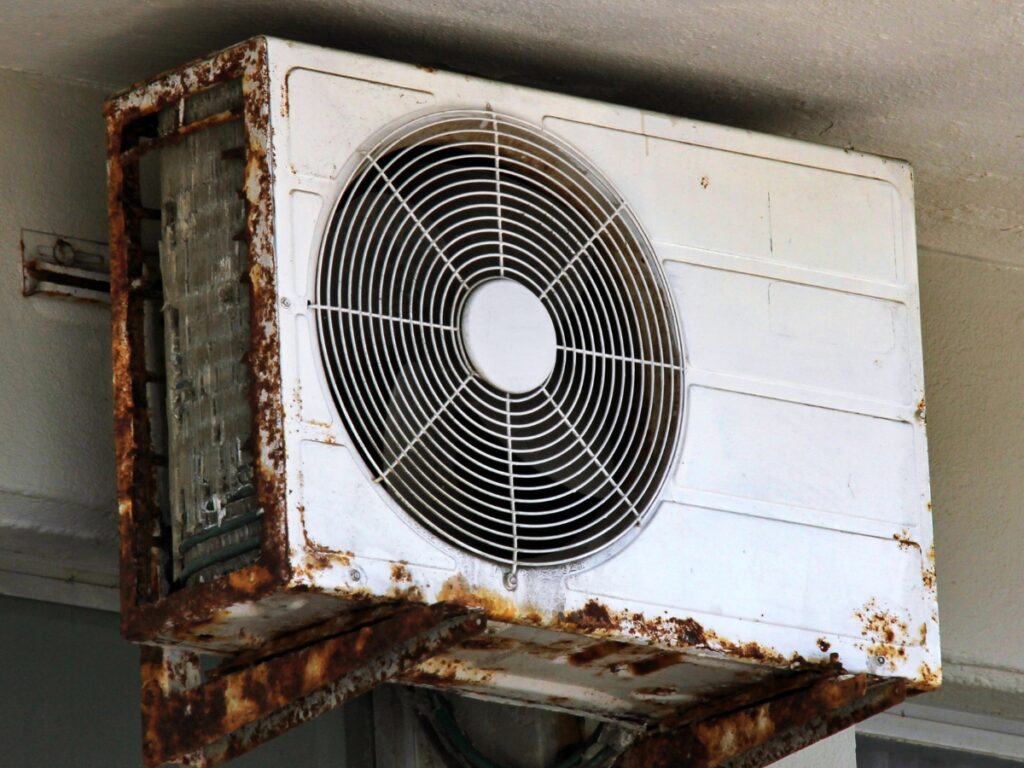
- White, Powdery Residue: This is the first sign. Look at the thin metal fins (they are usually blue, grey, or silver). If you see a white, chalky build-up, that’s the aluminium oxidising.
- Flaking or Crumbling Fins: If you (gently!) touch the fins and they flake or crumble to dust, the corrosion is in an advanced stage.
- Obvious Rust: Look at the metal base of the unit or the outer “cage.” Any visible red or brown rust is a bad sign.
- Reduced Cooling: Is the A/C always on but the house never really feels cold? It’s struggling to breathe.
- Higher Power Bills: A sudden, unexplained jump in your electricity bill is a classic symptom of an inefficient, struggling system.
How to Protect Your Air Conditioner From Salt Air Damage
The good news? You can fight back. But it requires a two-pronged attack: Smart Prevention and Relentless Maintenance.
1. Prevention: Choose the Right A/C in the First Place
This is the most important decision you’ll make. Not all air conditioners are created equal.
When you get quotes for a new air conditioning installation on the Sunshine Coast, you must ask about coastal protection.
- Look for “Blue Fin” or “Gold Fin” Coils: This is a special epoxy coating applied at the factory. It puts a barrier between the salt and the metal, dramatically slowing down corrosion.
- Ask About Build Quality: We recommend top-tier brands like Daikin and Mitsubishi Electric because they invest heavily in corrosion-resistant tech, including coated circuit boards, plastic base pans, and stainless steel components. Cheaper “no-name” brands often cut corners here, and they just don’t last.
- Strategic Placement: As your local installers, we think about where the unit goes. We try to place it out of the direct path of prevailing salty winds, ensure it has good drainage, and discuss protective (louvered) covers that shield it from the elements without restricting airflow.
Our Honest Advice: Spending a few hundred dollars extra on a unit with a factory-coated coil will save you thousands by adding 5-10 years to its lifespan.
2. Maintenance: You Have to Clean Your A/C
This is the non-negotiable part of living on the coast. You can’t just install and forget.
- Your Job (DIY): Once a month, in the cooler part of the day, turn your A/C off at the switchboard. Take your garden hose (on a gentle “shower” setting, not a high-pressure jet) and give the entire outdoor unit a thorough rinse with fresh water. This washes off the new salt deposits before they can “bake in” and start a reaction.
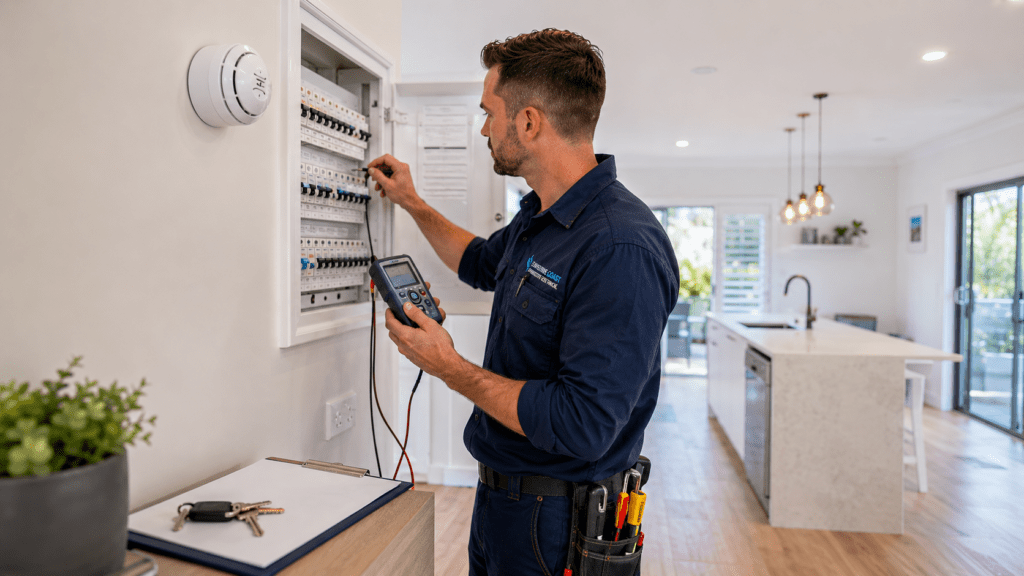
- Our Job (Professional): Once a year, you need a professional A/C service. This isn’t just a quick filter clean. Our team performs a “deep clean” specifically for coastal conditions.
- We use a pressure-safe cleaner to remove built-up salt from deep within the coils.
- We apply a special, pH-neutral cleaning solution that dissolves corrosion.
- We check refrigerant levels, electrical connections, and drainage.
- We can apply a new “sacrificial” protective coating to the coils to give them an extra layer of defence.
Is It Too Late? When to Repair vs. Replace
If your unit is already showing signs of corrosion, we’ll give you a straight-up, honest assessment.
- If it’s minor surface corrosion: A professional deep clean and service can halt the damage and add years back to your unit’s life.
- If the fins are crumbling and it’s leaking: The honest truth is that replacing it is almost always the smarter financial move. A “repair” will just be a band-aid, and the unit will fail again.
As a local Sunshine Coast team, our reputation is built on trust, not on upselling. We’ll give you the facts, a transparent quote, and our best advice, whether it’s for a service or a new, salt-proof replacement.
Don’t let the salty breeze cost you thousands. Be proactive, get your A/C serviced, and if you’re installing a new one, make sure it’s “Sunshine Coast-proof.”
Worried about your A/C? Contact Sunshine Coast Projects & Electrical today for a free installation quote or to book a professional corrosion-prevention service.
A/C Corrosion FAQ (Frequently Asked Questions)
Q: How often should I clean my A/C in a coastal home like on the Sunshine Coast? A: You should do a DIY fresh-water rinse of the outdoor unit every 1-2 months. You also need a minimum of one professional deep clean and service per year (ideally just before summer) to remove salt build-up from deep inside the coils.
Q: Will a special “coastal” air conditioner really last longer? A: Yes, absolutely. Units with features like “Blue Fin” or “Gold Fin” coils have a factory-baked-on epoxy coating. This makes it much harder for salt and moisture to attack the bare metal, often doubling or tripling the lifespan of the coils in a coastal environment.
Q: Does my A/C warranty cover salt air corrosion? A: Almost never. This is a harsh reality for many homeowners. Most manufacturer warranties have an exclusion for “environmental factors” or “corrosion,” especially if you cannot provide receipts to prove it has been professionally serviced annually. They see maintenance as your responsibility.
Q: How far inland on the Sunshine Coast is “safe” from salt air? A: There is no “safe” zone. While areas within 1km of the beach (like Marcoola or parts of Mooloolaba) are in the “severe” category, salt haze can easily travel 10-15km inland. Even if you’re in Buderim, Nambour, or Sippy Downs, your A/C is still at a higher risk than a home in Toowoomba and needs regular cleaning.